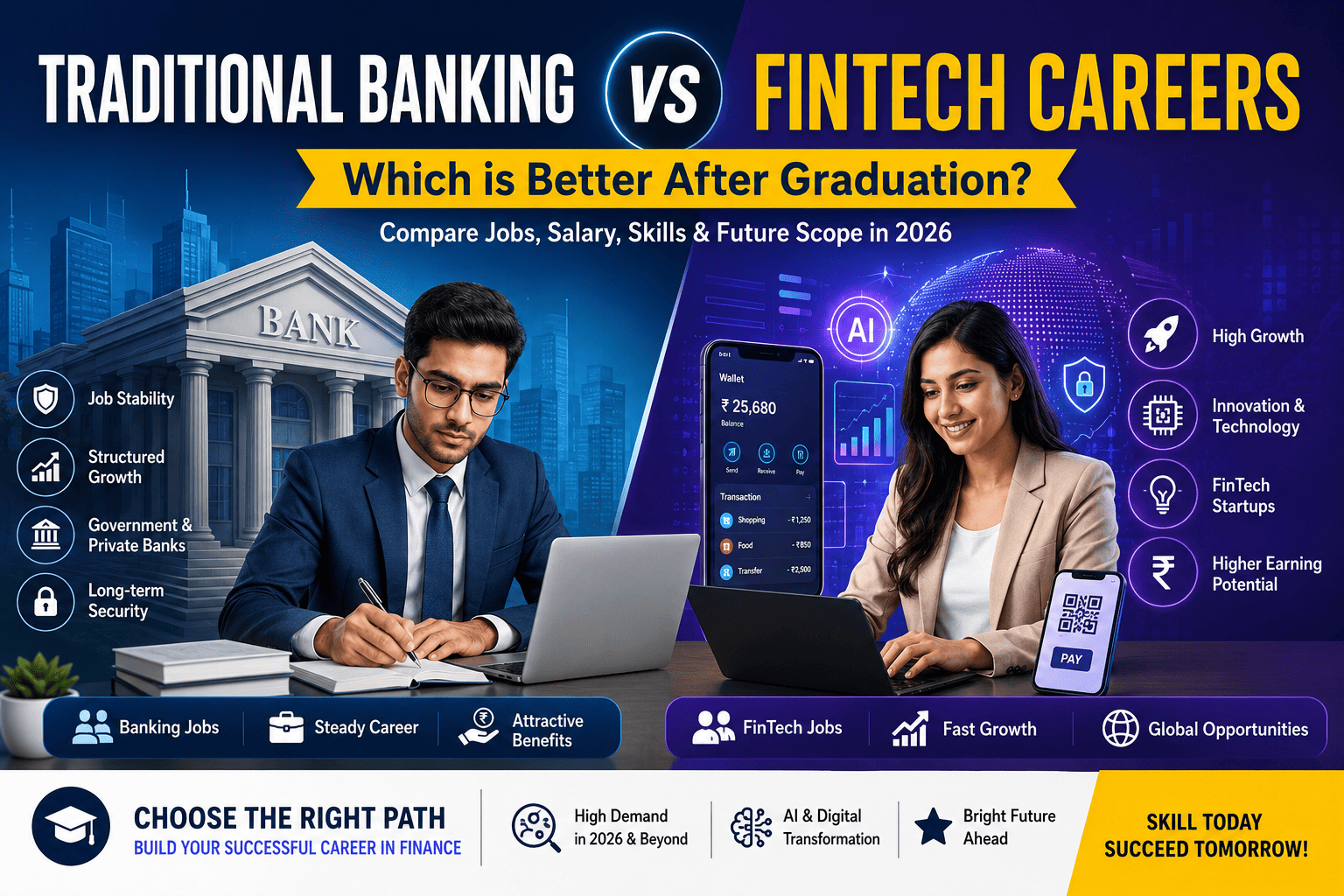
The financial industry is changing rapidly. While traditional banks remain one of the most stable career choices, the rise of Financial Technology (FinTech), Artificial Intelligence (AI), Digital Payments, Blockchain, and WealthTech has created exciting new opportunities for graduates.
Many students completing B.Com, BBA, MBA, M.Com, BA, B.Sc., or even engineering degrees often ask:
- Should I prepare for a banking career?
- Is FinTech a better career option?
- Which field offers a higher salary?
- Which career has more future growth?
- Do I need coding to work in FinTech?
The answer depends on your career goals, but one thing is certain: both industries now rely heavily on digital technology and AI. This guide compares Traditional Banking and FinTech careers based on job roles, salaries, required skills, growth prospects, and future opportunities, especially for graduates in Ahmedabad and across India.
What is Traditional Banking?
Traditional banking involves financial services offered by public sector banks, private banks, cooperative banks, regional rural banks, and financial institutions. Professionals handle customer accounts, loans, deposits, investments, compliance, and branch operations.
Common Banking Services
- Savings & Current Accounts
- Loans & Credit
- Fixed Deposits
- Insurance
- Investment Services
- Retail Banking
- Corporate Banking
- Digital Banking Support
- Customer Relationship Management
What is FinTech?
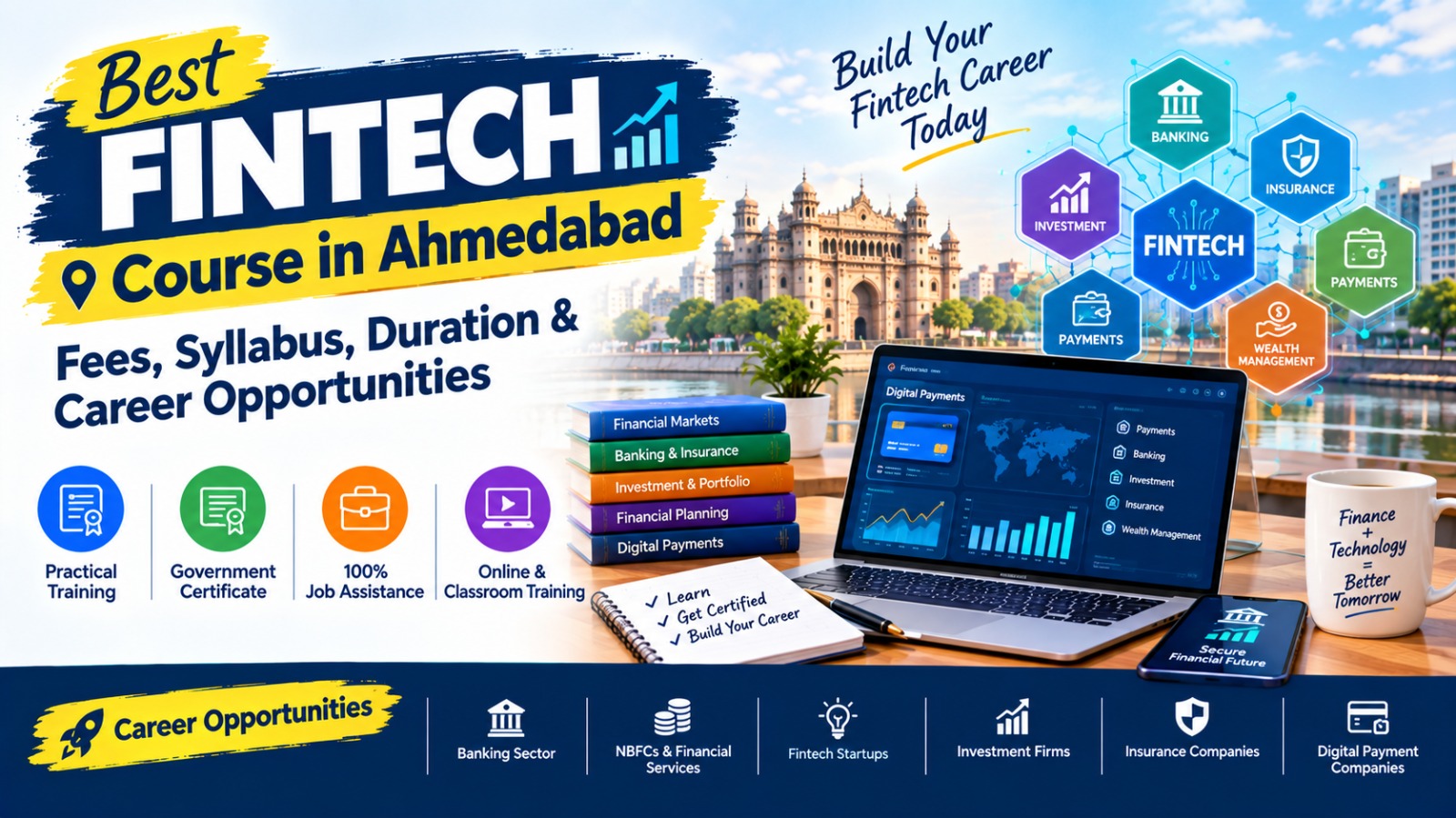
FinTech (Financial Technology) uses technology to improve financial services. It combines finance with AI, cloud computing, data analytics, mobile applications, blockchain, cybersecurity, and automation.
Examples include:
- UPI Payments
- Mobile Banking Apps
- Online Investment Platforms
- Robo-Advisory Services
- AI-Based Financial Planning
- Digital Lending
- Wealth Management Platforms
- InsurTech Solutions
- Cryptocurrency Exchanges
- Payment Gateways
FinTech professionals work on developing, managing, analyzing, and improving digital financial products and services.
Traditional Banking vs FinTech: Quick Comparison
| Feature | Traditional Banking | FinTech |
|---|---|---|
| Industry Type | Banking & Financial Institutions | Technology-Driven Financial Services |
| Innovation | Moderate | Very High |
| AI Integration | Increasing | Core Component |
| Work Environment | Structured & Process-Oriented | Agile & Fast-Paced |
| Career Growth | Stable | Rapid |
| Digital Skills Required | Basic to Intermediate | Intermediate to Advanced |
| Salary Growth | Steady | Faster with Skills |
| Startup Opportunities | Limited | High |
| Global Opportunities | Moderate | Excellent |
| Future Demand | Strong | Very High |
Eligibility
Both career paths are suitable for:
- B.Com Graduates
- BBA Students
- MBA Finance Students
- M.Com Graduates
- Commerce Students
- Economics Graduates
- Engineering Graduates
- Working Professionals
- Career Changers
Skills Required for Traditional Banking
A successful banking professional should possess:
- Financial Knowledge
- Customer Service
- Communication Skills
- Banking Regulations
- Credit Analysis
- Loan Processing
- Risk Management
- Banking Software
- Microsoft Excel
- Financial Documentation
Skills Required for FinTech Careers
Modern FinTech professionals need a combination of finance and technology skills, including:
- Digital Banking
- Financial Planning
- Data Analytics
- AI Tools for Finance
- Investment Analysis
- Financial Modelling
- Advanced Excel
- Power BI
- Payment Systems
- Cybersecurity Basics
- Blockchain Fundamentals
- Automation Tools
- Customer Experience Design
Popular Job Roles
Traditional Banking Jobs
- Probationary Officer (PO)
- Bank Clerk
- Relationship Manager
- Loan Officer
- Branch Operations Executive
- Credit Analyst
- Banking Sales Officer
- Wealth Relationship Manager
- Customer Service Executive
- Treasury Executive
FinTech Careers
- FinTech Analyst
- Financial Planner
- Investment Advisor
- Wealth Manager
- Digital Banking Specialist
- Financial Data Analyst
- Risk Analyst
- Payment Solutions Executive
- Product Analyst
- Financial Consultant
- AI Finance Executive
- Business Analyst
- Financial Technology Consultant
- Compliance Analyst
- Digital Payments Specialist
Salary Comparison in India (2026)
| Experience | Traditional Banking | FinTech |
|---|---|---|
| Fresher | ₹2.5 – ₹5 LPA | ₹3 – ₹6 LPA |
| 2–5 Years | ₹5 – ₹9 LPA | ₹6 – ₹12 LPA |
| 5–10 Years | ₹8 – ₹15 LPA | ₹10 – ₹20+ LPA |
| Senior Roles | ₹15 – ₹25+ LPA | ₹20 – ₹40+ LPA |
Note: Salaries vary based on employer, city, certifications, and experience. FinTech roles often include performance incentives and faster salary progression for professionals with AI, analytics, and digital finance expertise.
Which Industry is Growing Faster?
Traditional banking continues to expand with digital transformation, while FinTech is experiencing accelerated growth due to:
- AI Adoption
- Digital Payments
- Online Banking
- WealthTech
- InsurTech
- RegTech
- Embedded Finance
- Open Banking
- Financial Automation
- Digital Lending
Graduates with technology-enabled finance skills are increasingly sought after across both sectors.
Career Opportunities in Ahmedabad
Ahmedabad is emerging as a major hub for finance, banking, startups, and technology-driven businesses.
Graduates can explore opportunities in:
- Public Sector Banks
- Private Banks
- NBFCs
- FinTech Startups
- Investment Firms
- Stock Broking Companies
- Mutual Fund Companies
- Insurance Organizations
- Wealth Management Firms
- Corporate Finance Departments
- Financial Consultancy Firms
- Digital Payment Companies
Why Learn FinTech Along with Financial Planning?
Learning FinTech alongside Financial Planning provides a competitive advantage because employers increasingly seek professionals who understand both finance and modern technology.
Benefits include:
- Better Career Opportunities
- Higher Salary Potential
- AI-Ready Skills
- Digital Banking Knowledge
- Investment Planning Expertise
- Wealth Management Skills
- Industry-Relevant Practical Training
- Faster Career Growth
What Makes a Good FinTech Course?
A quality FinTech training program should include:
- Practical Learning
- Live Projects
- AI-Powered Finance Tools
- Financial Planning
- Digital Banking
- Mutual Funds & Investments
- Stock Market Basics
- Advanced Excel
- Power BI Fundamentals
- Resume Building
- Mock Interviews
- Internship Support
- Placement Assistance
Why Choose DMG IT Engineering & Multimedia Institute in Ahmedabad?
Students looking for industry-focused FinTech education can consider DMG IT Engineering & Multimedia Institute, Ahmedabad, which offers practical training aligned with current industry requirements.
Course Highlights
- Government Certified Professional Diploma
- MIT Approved Certification
- ISO 9001:2015 Certified Institute
- MSME Registered Institute
- AI-Integrated Learning
- Live Practical Projects
- Experienced Faculty
- Industry-Oriented Curriculum
- Financial Planning & Investment Training
- Small Batches
- Personal Mentorship
- Internship Opportunities
- Resume Preparation
- Interview Training
- Placement Assistance
- Weekday & Weekend Batches
- Easy EMI Options
- Free Demo Classes
Who Should Choose Traditional Banking?
Traditional Banking is ideal for those who prefer:
- Stable Employment
- Structured Career Growth
- Government Banking Opportunities
- Customer-Facing Roles
- Long-Term Career Security
- Regulatory & Compliance Work
Who Should Choose FinTech?
FinTech is a strong choice for graduates who enjoy:
- Technology & Innovation
- AI and Digital Finance
- Data-Driven Decision Making
- Fast Career Growth
- Startup Ecosystems
- Financial Product Development
- Investment & Wealth Management
- Digital Payments & Automation
Frequently Asked Questions (FAQs)
1. Which career is better after graduation: Banking or FinTech?
Both are excellent options. Traditional banking offers stability, while FinTech provides faster growth, exposure to emerging technologies, and potentially higher earning opportunities.
2. Is FinTech a good career in 2026?
Yes. With increasing adoption of AI, digital payments, online banking, and financial automation, FinTech is among the fastest-growing career sectors in India.
3. Can B.Com students pursue a FinTech career?
Absolutely. B.Com graduates can build careers in digital banking, financial planning, investment advisory, wealth management, and financial analytics by acquiring relevant FinTech skills.
4. Do I need coding for FinTech?
Not necessarily. Many FinTech roles focus on finance, analytics, digital banking, customer experience, and financial planning rather than software development.
5. Which field offers a higher salary?
FinTech generally offers faster salary growth, especially for professionals skilled in AI, analytics, and digital financial technologies. However, senior banking roles can also be highly rewarding.
6. Which is more secure: Banking or FinTech?
Traditional banking is known for long-term stability, while FinTech offers dynamic growth and expanding opportunities. Professionals who combine financial expertise with digital skills are well-positioned in both sectors.
7. Can working professionals switch to FinTech?
Yes. Professionals from banking, accounting, finance, insurance, or related fields can transition into FinTech by learning digital finance, AI tools, analytics, and modern financial technologies.
8. Why should I learn Financial Planning with FinTech?
Combining Financial Planning with FinTech equips you to provide comprehensive financial solutions, leverage digital tools, and meet the evolving needs of individuals and businesses.
Conclusion
Choosing between Traditional Banking and FinTech depends on your career aspirations, preferred work environment, and willingness to embrace new technologies. Banking remains an excellent option for those seeking stability, structured progression, and regulatory-focused roles. FinTech, on the other hand, offers faster innovation, broader career opportunities, and strong demand for professionals with expertise in digital finance, AI, and analytics.
For graduates in Ahmedabad and across India, developing skills in Financial Planning, Digital Banking, AI-powered Finance, Investment Analysis, and Financial Technology can significantly enhance employability and future earning potential. By selecting a practical, industry-oriented training program that combines finance with technology, you can build a successful career in the rapidly evolving financial services landscape.