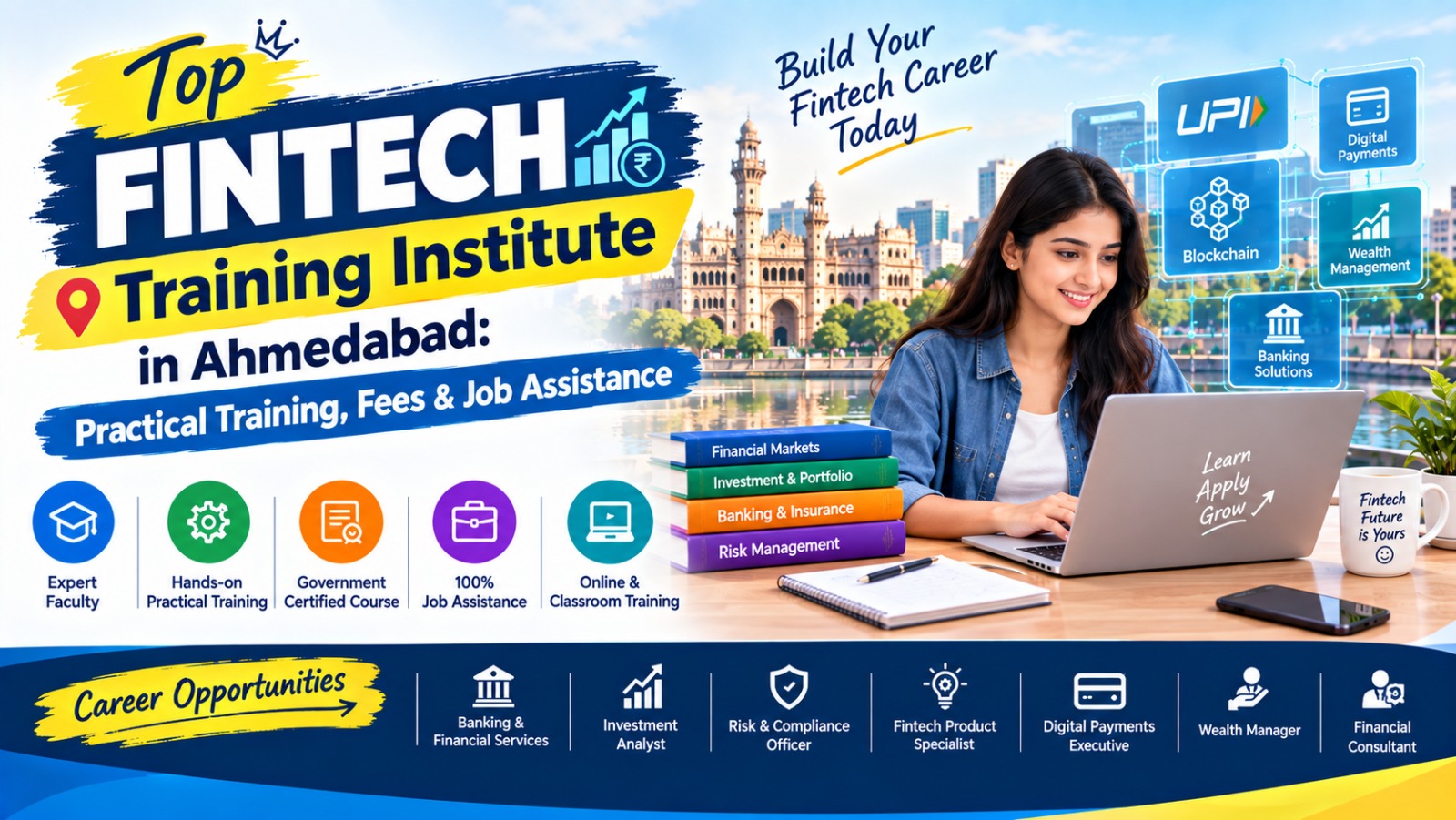
The finance industry is changing rapidly as accounting, data analytics and financial technology become increasingly connected. For students and professionals in Ahmedabad, choosing the right training program can make a significant difference in developing practical, career-oriented skills.
A FinTech course introduces technology-driven financial services such as digital banking, digital payments, financial analytics and emerging financial technologies. An Accounting course focuses on financial records, bookkeeping, taxation and business transactions. Advanced Excel training develops skills in data analysis, reporting, formulas, dashboards and financial calculations.
Instead of looking at these courses as completely separate options, learners can understand how they complement each other. This guide compares FINTECH, Accounting and Advanced Excel courses in Ahmedabad based on syllabus, duration, fees, practical learning and potential career applications.
What Is FinTech Training?
Financial Technology, or FinTech, refers to the use of technology to deliver, manage and improve financial services.
FinTech applications can be found in:
- Digital banking
- Online payments
- Mobile banking
- Financial analytics
- Digital lending
- Investment platforms
- Insurance technology
- Risk management
- Financial automation
A FinTech training program introduces learners to the connection between finance, technology and data.
Depending on the course level, students may study financial technology fundamentals, digital payments, financial data, blockchain, cybersecurity, artificial intelligence and other emerging areas.
What Is Accounting Training?
Accounting training focuses on understanding and managing financial transactions and records.
A practical accounting course may cover:
- Basic accounting principles
- Journal entries
- Ledgers
- Trial balance
- Profit and loss accounts
- Balance sheets
- GST concepts
- Invoicing
- Payroll basics
- Financial reporting
- Accounting software
Accounting knowledge is particularly useful for students and professionals interested in finance, accounts, taxation and business operations.
What Is Advanced Excel Training?
Advanced Excel is widely used for financial analysis, reporting, business operations and data management.
A comprehensive Advanced Excel course may include:
- Advanced formulas
- Functions
- Lookup functions
- Conditional formatting
- Data validation
- Pivot Tables
- Charts
- Data cleaning
- Financial calculations
- Dashboards
- Data analysis
- Reporting
Excel can complement both accounting and FinTech knowledge because financial professionals frequently work with structured data and reports.
FINTECH vs Accounting vs Advanced Excel
The three areas have different learning objectives.
| Course | Main Focus | Suitable For |
|---|---|---|
| FinTech | Finance + Technology | Learners interested in digital finance and financial technology |
| Accounting | Financial records and transactions | Commerce students, accountants and finance professionals |
| Advanced Excel | Data analysis and reporting | Students, analysts and working professionals |
| FinTech + Accounting + Excel | Integrated finance and digital skills | Learners seeking a broader finance skill set |
The best option depends on the learner’s existing education and career direction.
FINTECH Course Syllabus
A FinTech program can include several areas of modern financial services.
Core Modules
- Introduction to FinTech
- Evolution of financial technology
- Digital banking
- Digital payments
- Payment gateways
- Financial markets
- Financial data analytics
- Risk management
- Blockchain fundamentals
- AI applications in finance
- Cybersecurity awareness
- Financial technology case studies
Advanced programs may introduce additional topics such as automation, financial modelling, APIs and machine learning applications.
Accounting Course Syllabus
A practical accounting course may cover:
Accounting Fundamentals
- Accounting concepts
- Debit and credit
- Journal entries
- Ledger management
- Trial balance
Financial Statements
- Profit and loss account
- Balance sheet
- Cash flow basics
- Financial reporting
Business Accounting
- Purchase and sales entries
- Invoicing
- Receivables
- Payables
- Inventory
Taxation and Software
Depending on the program, learners may also study:
- GST fundamentals
- Tally Prime
- Payroll
- Tax-related accounting procedures
Advanced Excel Course Syllabus
Advanced Excel training can cover:
Excel Functions
- IF
- SUMIF and SUMIFS
- COUNTIF and COUNTIFS
- XLOOKUP
- INDEX and MATCH
- Logical functions
- Text functions
- Date and time functions
Data Analysis
- Sorting and filtering
- Data cleaning
- Pivot Tables
- Pivot Charts
- Conditional formatting
- Data validation
Reporting
- Interactive dashboards
- Charts
- Financial reports
- Management reports
- Business analysis
Which Course Should You Choose?
Your choice can depend on your career objective.
Choose FinTech If You Want To:
- Learn about digital financial services
- Understand digital banking
- Explore financial technology
- Learn financial data concepts
- Understand emerging technologies in finance
Choose Accounting If You Want To:
- Work in accounting
- Learn bookkeeping
- Understand GST-related accounting
- Work with business transactions
- Build accounting software skills
Choose Advanced Excel If You Want To:
- Improve data analysis skills
- Create reports and dashboards
- Work with financial data
- Automate repetitive spreadsheet tasks
- Develop business reporting skills
Consider All Three If:
You want to develop a broader combination of finance, accounting, data and technology skills.
FINTECH + Accounting + Advanced Excel: Why Combine Them?
These three skills can complement each other.
Consider a finance professional working with a company’s financial information.
Accounting helps the professional understand the transactions.
Excel helps analyse and present the data.
FinTech helps understand how technology is changing financial services and processes.
This creates a broader learning pathway:
Accounting → Data Analysis → Financial Technology
For commerce students and finance professionals, this combination can provide exposure to multiple aspects of modern financial work.
Course Fees in Ahmedabad
Fees vary depending on the institute, curriculum, course duration, certification and practical components.
Indicative ranges may look like this:
| Course | Approximate Fee Range |
|---|---|
| Basic Accounting | ₹5,000–₹20,000 |
| Advanced Excel | ₹5,000–₹20,000 |
| Foundation FinTech | ₹10,000–₹25,000 |
| Certificate FinTech | ₹20,000–₹50,000 |
| Advanced FinTech | ₹40,000–₹1,00,000+ |
| Combined Finance Skill Program | ₹20,000–₹60,000+ |
Note: These are indicative ranges for general guidance, not fixed market prices. Actual fees can differ between training providers.
Before admission, confirm:
- Total course fee
- Certification charges
- Study material
- Practical project charges
- Examination fees
- Instalment options
- Online versus classroom pricing
Course Duration
The duration depends on the depth of training.
| Course | Typical Duration |
|---|---|
| Basic Accounting | 1–3 months |
| Advanced Excel | 1–3 months |
| Foundation FinTech | 1–3 months |
| Certificate FinTech | 3–6 months |
| Advanced FinTech | 6–12 months |
| Combined Program | 3–6+ months |
Short-term programs are suitable for skill upgrades, while longer programs can provide broader practical exposure.
Practical Training: What Should You Look For?
A career-focused training program should ideally include practical exercises rather than only theoretical lessons.
For FinTech
- Digital payment case studies
- Financial data exercises
- Banking technology scenarios
- FinTech projects
For Accounting
- Accounting entries
- GST-related transactions
- Invoicing
- Ledger and financial statements
- Accounting software practice
For Advanced Excel
- Financial datasets
- Pivot Tables
- Dashboard creation
- Data cleaning
- Business reporting
Practical learning helps students understand how concepts are applied in real business situations.
Eligibility for FinTech, Accounting & Excel Courses
Eligibility varies according to the course level.
Students
These courses can be considered by:
- 12th Commerce students
- B.Com students
- BBA students
- MBA students
- Finance students
- Economics students
- IT students
Working Professionals
Training can also be relevant for:
- Account executives
- Finance professionals
- Banking employees
- Business executives
- Administrative professionals
- Entrepreneurs
For introductory FinTech programs, advanced programming knowledge is not necessarily required. However, technical requirements can vary for advanced courses.
Career Opportunities
Each course can support different career paths.
After Accounting Training
Potential roles include:
- Accounts Executive
- Junior Accountant
- Accounts Assistant
- Billing Executive
- Finance Assistant
- Taxation Assistant
After Advanced Excel Training
Potential roles include:
- MIS Executive
- Reporting Executive
- Data Support Executive
- Business Operations Executive
- Junior Data Analyst
- Finance Reporting Executive
After FinTech Training
Potential roles may include:
- FinTech Analyst
- Financial Data Analyst
- Digital Banking Executive
- Payments Executive
- Business Analyst
- Risk Analyst
- FinTech Operations Executive
- Financial Services Executive
Actual job opportunities depend on qualifications, experience, practical skills and employer requirements.
FinTech Course for B.Com Students in Ahmedabad
B.Com students already study areas such as accounting, finance, economics and business.
Adding FinTech training can introduce technology-oriented topics such as:
- Digital payments
- Digital banking
- Financial analytics
- Blockchain
- AI in finance
- Financial data management
- Risk technology
Adding Advanced Excel can further strengthen their ability to analyse and present financial information.
A possible learning pathway is:
B.Com → Accounting Skills → Advanced Excel → FinTech
This can help students build a broader understanding of traditional and technology-driven finance.
FinTech and Excel for Working Professionals
Working professionals may prefer skill combinations that can be applied to their current responsibilities.
For example:
Accounting Professional + Advanced Excel
Can support financial reporting, data analysis and management reporting.
Finance Professional + FinTech
Can provide exposure to digital financial services and technology-driven finance.
Accounting + Excel + FinTech
Can create a broader skill profile combining financial knowledge, data handling and financial technology concepts.
Depending on the training institute, learners may find weekday, evening, weekend, online or hybrid batches.
Online vs Classroom Training
Both learning formats can be useful.
| Factor | Online | Classroom |
|---|---|---|
| Flexibility | High | Moderate |
| Travel | Not required | Required |
| Trainer interaction | Virtual | Face-to-face |
| Peer interaction | Online | Direct |
| Schedule | Often flexible | Fixed batches |
| Practical support | Online | In-person |
| Suitable for | Working learners | Structured learners |
When selecting an institute in Ahmedabad, consider your schedule, preferred learning style and the level of trainer interaction you need.
How to Choose a FINTECH Training Institute in Ahmedabad
Before enrolling, compare these important factors:
1. Course Syllabus
Check whether the syllabus matches your career objective.
2. Practical Projects
Ask whether the course includes assignments, projects and real-world case studies.
3. Trainer Experience
Review the trainer’s educational and professional background.
4. Course Duration
Choose a duration that gives enough time for both concepts and practice.
5. Fees
Compare total fees rather than looking only at the advertised starting price.
6. Certification
Check what certificate is provided and whether assessment is required.
7. Learning Mode
Choose online, classroom or hybrid learning according to your requirements.
8. Career Support
Check whether the institute offers resume guidance, interview preparation or job assistance.
9. Student Reviews
Look for genuine feedback about teaching quality, practical training and learning experience.
10. Location
For classroom learning, accessibility from areas such as Navrangpura, CG Road, Satellite, Vastrapur, Thaltej, Bopal and Prahlad Nagar can be considered.
What Makes a Good Finance Training Program?
A strong program should not focus only on completing the syllabus.
Look for a learning experience that combines:
Concepts + Practice + Projects + Data Skills + Financial Knowledge + Technology
For example, a learner could study an accounting transaction, enter or organise the information, analyse it in Excel and then understand how technology can improve the broader financial process.
This integrated approach can make learning more connected to modern business environments.
Certification and Job Assistance
Many professional training programs offer certificates after successful course completion.
Before enrolling, ask about:
- Certification requirements
- Assessment method
- Course completion criteria
- Practical project requirements
- Certificate issuer
Some institutes also provide career support such as:
- Resume preparation
- Interview preparation
- Mock interviews
- Job updates
- Career counselling
Job assistance should not be treated as a guarantee of employment. Hiring depends on the candidate’s qualifications, skills, interview performance and employer requirements.
Future Scope of FinTech, Accounting & Excel Skills
Finance professionals are increasingly expected to work with both financial information and digital tools.
Future-oriented skill areas include:
- Digital banking
- Digital payments
- Financial analytics
- Automated reporting
- AI applications in finance
- Financial data management
- Risk technology
- Business intelligence
- Digital accounting
- Advanced spreadsheet analysis
While tools and technologies continue to evolve, fundamental financial knowledge, analytical thinking and practical problem-solving remain valuable skills.
Frequently Asked Questions
1. Which is better, FinTech or Accounting?
They serve different purposes. Accounting focuses on financial records and transactions, while FinTech focuses on the use of technology in financial services. Your choice should depend on your career objective.
2. Is Advanced Excel useful for FinTech students?
Yes. Excel can help with financial analysis, data organisation, reporting and dashboard creation, making it a useful complementary skill.
3. Can I learn FinTech, Accounting and Excel together?
Yes. A combined program or sequential courses can help learners develop financial, accounting, data and technology skills.
4. How much does a FinTech course cost in Ahmedabad?
Indicative fees can range from around ₹10,000 for foundation-level training to ₹1,00,000 or more for advanced programs. Fees vary according to the institute and curriculum.
5. How long does FinTech training take?
Depending on the program, it can take approximately 1–12 months. Short foundation programs are generally faster than advanced courses.
6. Can B.Com students join a FinTech course?
Yes. B.Com students can combine their existing accounting and finance knowledge with FinTech, Excel and data skills.
7. Is Advanced Excel useful for accounting jobs?
Yes. Excel is commonly used for financial calculations, data analysis, reports, reconciliations and management information.
8. Can working professionals join FinTech training?
Yes. Depending on the institute, working professionals may find online, evening, weekend or hybrid learning options.
9. Does FinTech require programming?
Not necessarily for beginner-level courses. Introductory FinTech programs can focus on financial technology concepts, digital banking, payments and analytics. Advanced technical programs may have additional programming requirements.
10. What jobs can I pursue after learning Accounting and Excel?
Potential roles include Accounts Executive, Junior Accountant, MIS Executive, Reporting Executive, Finance Assistant and other finance or operations-related positions.
11. What jobs can I pursue after FinTech training?
Potential roles include FinTech Analyst, Financial Data Analyst, Digital Banking Executive, Payments Executive, Business Analyst and FinTech Operations Executive.
12. How do I choose a FinTech institute in Ahmedabad?
Compare syllabus, practical training, trainers, fees, duration, certification, projects, learning mode, student feedback and career support before enrolling.
Conclusion
Choosing between FINTECH, Accounting and Advanced Excel courses depends on the skills you want to develop and the type of career you are targeting.
Accounting provides a foundation in financial transactions and reporting. Advanced Excel strengthens data analysis and reporting capabilities. FinTech introduces learners to technology-driven financial services such as digital banking, payments, analytics and emerging financial technologies.
For students and professionals who want a broader skill set, combining Accounting + Advanced Excel + FinTech can provide exposure to finance, data and technology from different perspectives.
When comparing a FINTECH training institute in Ahmedabad, look beyond course names and advertisements. Evaluate the syllabus, practical projects, trainers, fees, duration, certification, learning mode and career support to find a program that matches your learning requirements.