Accounting has evolved dramatically over the last decade. Businesses that once relied on handwritten ledgers and paper-based bookkeeping now use advanced accounting software, cloud platforms, Artificial Intelligence (AI), and automation to manage financial operations.
While understanding Manual Accounting remains essential for building strong accounting fundamentals, today’s employers expect professionals to work efficiently with Computerized Accounting Software such as Tally Prime, ERP systems, Advanced Excel, GST tools, and cloud-based accounting solutions.
If you’re a student, commerce graduate, accountant, entrepreneur, or job seeker wondering which accounting skills are most valuable in 2026, this guide explains the differences, career opportunities, salary potential, and why mastering computerized accounting is essential for long-term success.
What is Manual Accounting?
Manual Accounting is the traditional method of maintaining financial records using physical books, registers, and handwritten documents.
Accountants manually record:
- Journal Entries
- Ledger Accounts
- Cash Book
- Purchase Register
- Sales Register
- Trial Balance
- Profit & Loss Account
- Balance Sheet
Manual accounting develops a strong understanding of accounting principles and financial transactions.
What is Computerized Accounting?
Computerized Accounting uses accounting software and digital tools to record, process, analyze, and report financial information accurately and efficiently.
Popular computerized accounting software includes:
- Tally Prime
- ERP Accounting Software
- Cloud Accounting Platforms
- GST Utility Software
- Payroll Software
- Advanced Excel
- Financial Reporting Tools
Modern businesses depend on computerized accounting because it improves speed, accuracy, compliance, and reporting.
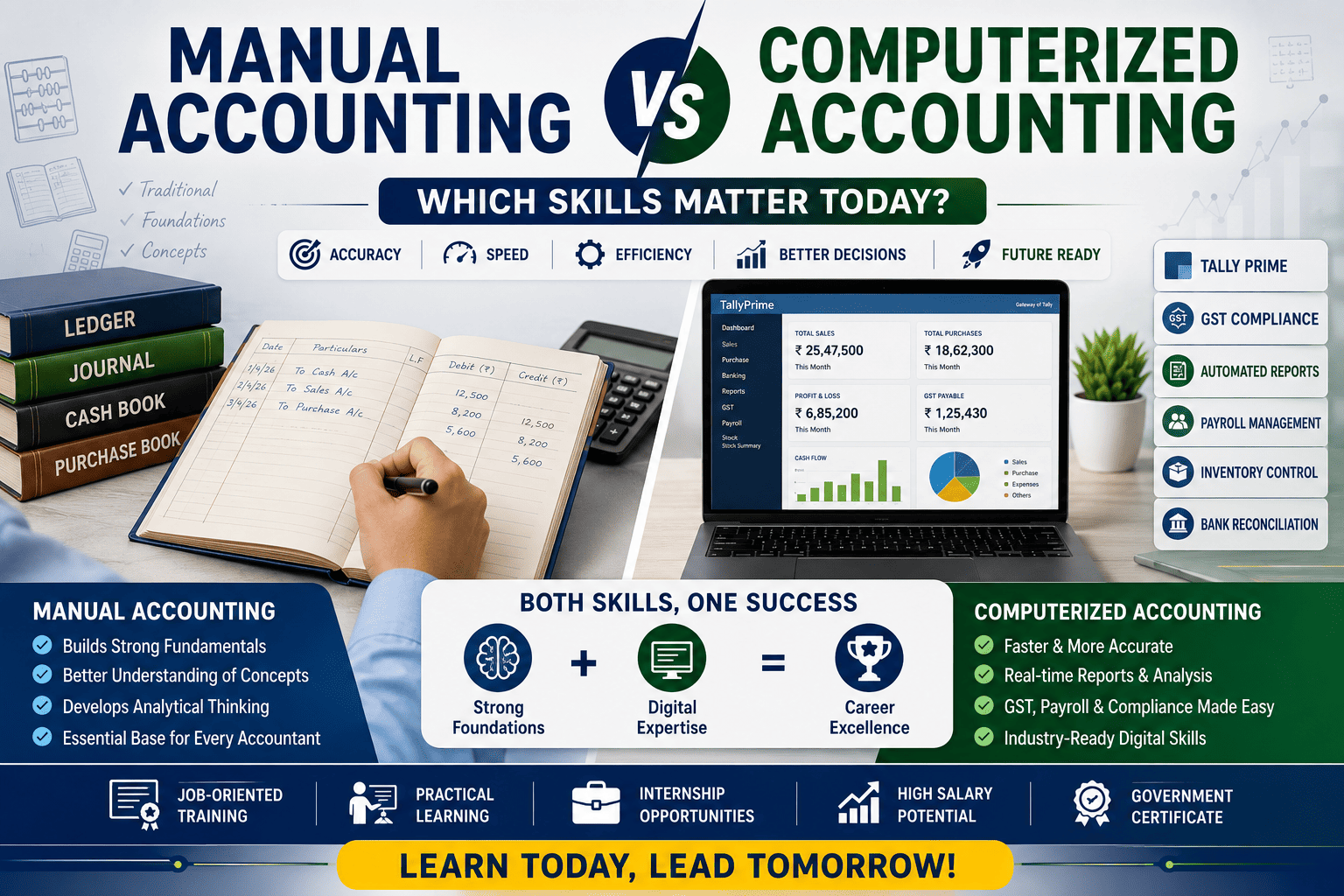
Manual Accounting vs Computerized Accounting: Quick Comparison
| Feature | Manual Accounting | Computerized Accounting |
|---|---|---|
| Recording Method | Paper-Based | Software-Based |
| Speed | Slow | Fast |
| Accuracy | Depends on Manual Calculations | High Accuracy with Automation |
| Error Detection | Time-Consuming | Automatic Validation |
| Report Generation | Manual | Instant Reports |
| GST Compliance | Difficult | Easy & Automated |
| Data Security | Limited | Better Backup & Security |
| Scalability | Limited | Suitable for Businesses of All Sizes |
| AI Integration | Not Available | Increasingly Common |
| Industry Demand | Basic Knowledge Required | Highly Preferred |
Why Manual Accounting Still Matters
Although businesses use software, manual accounting remains important because it helps students understand the fundamentals of accounting.
Benefits include:
- Strong Accounting Concepts
- Understanding Financial Transactions
- Journal & Ledger Preparation
- Financial Statement Preparation
- Better Problem Solving
- Easier Learning of Accounting Software
Manual accounting forms the foundation for every successful accountant.
Why Computerized Accounting is Essential in 2026
Organizations today require professionals who can work with digital accounting systems efficiently.
Advantages include:
- Faster Bookkeeping
- Automated GST Calculations
- Payroll Processing
- Inventory Management
- Financial Reporting
- Data Analysis
- Cloud Accessibility
- AI-Assisted Automation
- Better Productivity
- Reduced Human Errors
Computerized accounting has become the industry standard across sectors.
Skills Required for Modern Accountants
To remain competitive in today’s job market, accountants should combine traditional knowledge with digital expertise.
Accounting Fundamentals
- Journal Entries
- Ledger Posting
- Trial Balance
- Final Accounts
- Cost Accounting
- Financial Statements
Computerized Accounting Skills
- Tally Prime
- GST Accounting
- Payroll Management
- Inventory Management
- Banking Reconciliation
- ERP Software
- Microsoft Excel
- Financial Reporting
AI & Digital Skills
Modern accounting professionals should also understand:
- AI-Assisted Accounting
- AI Report Generation
- Automated Documentation
- Digital Bookkeeping
- Financial Dashboards
- Cloud Accounting Concepts
- AI Productivity Tools
Software Every Accountant Should Learn
Employers increasingly expect practical knowledge of:
- Tally Prime
- Advanced Microsoft Excel
- Microsoft Word
- Microsoft PowerPoint
- GST Utility Tools
- ERP Accounting Software
- Power BI Basics
- AI Productivity Tools
Who Should Learn Computerized Accounting?
This course is suitable for:
- 12th Commerce Students
- B.Com Students
- BBA Students
- M.Com Students
- MBA Finance Students
- Working Professionals
- Accountants
- Business Owners
- Entrepreneurs
- GST Practitioners
- Office Executives
- Freelancers
- Career Switchers
Career Opportunities
Professionals with computerized accounting skills can work as:
- Accountant
- Accounts Executive
- Senior Accountant
- GST Executive
- Payroll Executive
- Accounts Assistant
- Finance Executive
- Audit Assistant
- MIS Executive
- Tax Assistant
- Billing Executive
- ERP Executive
- Back Office Executive
- Financial Reporting Executive
Salary Comparison
| Experience | Manual Accounting Skills | Computerized Accounting Skills |
|---|---|---|
| Fresher | ₹2 LPA – ₹3 LPA | ₹2.8 LPA – ₹5 LPA |
| 2–5 Years | ₹3.5 LPA – ₹5 LPA | ₹5 LPA – ₹8 LPA |
| 5–10 Years | ₹5 LPA – ₹8 LPA | ₹8 LPA – ₹15 LPA |
| Senior Professionals | ₹8 LPA – ₹12 LPA | ₹15 LPA – ₹25+ LPA |
Professionals with expertise in Tally Prime, GST, ERP systems, Advanced Excel, AI tools, and financial analysis generally enjoy stronger career growth and higher salaries.
Industries Hiring Computerized Accountants
Qualified professionals are hired by:
- Corporate Companies
- Chartered Accountant Firms
- Manufacturing Industries
- Banks
- NBFCs
- Retail Businesses
- Export Companies
- Healthcare Organizations
- Educational Institutions
- IT Companies
- Financial Consultancy Firms
- Startups
- Government Contractors
Future Scope of Computerized Accounting
The accounting profession is becoming increasingly technology-driven.
Emerging opportunities include:
- AI-Powered Accounting
- Cloud Accounting
- Financial Analytics
- ERP Consulting
- Digital Auditing
- GST Automation
- Business Intelligence
- Financial Planning
- FinTech Operations
- Compliance Management
Professionals who continuously upgrade their digital skills will remain highly employable.
Why Practical Training Matters
Employers prefer candidates who can perform real accounting tasks rather than only understand theory.
Look for a training institute that provides:
- Live Business Projects
- GST Practical Filing
- Tally Prime Practice
- Advanced Excel Training
- ERP Exposure
- AI Accounting Tools
- Resume Building
- Mock Interviews
- Internship Opportunities
- Placement Assistance
Why Choose DMG IT Engineering & Multimedia Institute in Ahmedabad?
Students seeking career-focused accounting education can consider DMG IT Engineering & Multimedia Institute, Ahmedabad, which offers practical training in manual and computerized accounting aligned with industry needs.
Course Highlights
- Government Certified Professional Diploma
- MIT Approved Certification
- ISO 9001:2015 Certified Institute
- MSME Registered Institute
- Practical Tally Prime Training
- GST Practical Sessions
- Advanced Excel Training
- AI-Integrated Accounting Modules
- Live Accounting Projects
- Experienced Faculty
- Small Batch Size
- Personal Mentorship
- Resume Building
- Interview Preparation
- Internship Opportunities
- Placement Assistance
- Weekday & Weekend Batches
- Easy EMI Options
- Two Days Free Demo Classes
Why Ahmedabad is the Right Place to Learn Accounting
Ahmedabad is one of Gujarat’s major business and industrial centers, creating strong demand for skilled accounting professionals.
Career opportunities are available in:
- CA Firms
- Manufacturing Companies
- Corporate Offices
- Banks
- Financial Consultancy Firms
- Export Businesses
- Retail Companies
- Startups
- MSMEs
- Educational Institutions
Students benefit from practical exposure, internships, and placement opportunities across multiple industries.
Frequently Asked Questions (FAQs)
1. Which is better: Manual Accounting or Computerized Accounting?
Both are important. Manual accounting builds strong accounting fundamentals, while computerized accounting provides the practical software skills required by today’s employers. Learning both offers the best career advantage.
2. Is Manual Accounting still relevant in 2026?
Yes. Manual accounting remains valuable for understanding accounting concepts, financial transactions, and problem-solving. However, businesses primarily use computerized accounting systems for daily operations.
3. Which accounting software should I learn?
The most commonly used tools include Tally Prime, Advanced Excel, ERP software, GST utility tools, Power BI basics, and AI productivity tools.
4. Can I get a job by learning Tally Prime?
Yes. Practical knowledge of Tally Prime, GST, and computerized accounting significantly improves your chances of securing entry-level accounting and finance roles.
5. Does computerized accounting require coding?
No. Most accounting software is designed for finance professionals and does not require programming knowledge.
6. What salary can computerized accountants expect?
Freshers generally earn ₹2.8 lakh to ₹5 lakh per year, with salary growth depending on experience, software expertise, and industry.
7. Is AI replacing accountants?
No. AI is automating repetitive tasks such as data entry and report generation. Accountants who understand AI, compliance, financial analysis, and business advisory services will continue to be in high demand.
8. Who should enroll in a computerized accounting course?
Students after 12th, B.Com graduates, BBA students, MBA finance professionals, accountants, entrepreneurs, and anyone looking to build a career in accounting or finance can benefit from such a course.
Conclusion
The debate between Manual Accounting and Computerized Accounting is not about choosing one over the other—it is about combining the strengths of both. Manual accounting provides the essential foundation for understanding financial principles, while computerized accounting equips professionals with the practical skills needed to work efficiently in today’s digital business environment.
As organizations increasingly adopt AI-powered accounting, GST automation, ERP systems, cloud accounting, and financial analytics, professionals who possess both conceptual knowledge and hands-on software expertise will have the greatest career advantage. Whether you are a student, commerce graduate, working professional, or entrepreneur, investing in a practical Computerized Accounting Course in Ahmedabad can prepare you for rewarding opportunities in accounting, finance, taxation, auditing, and the rapidly evolving world of digital finance.