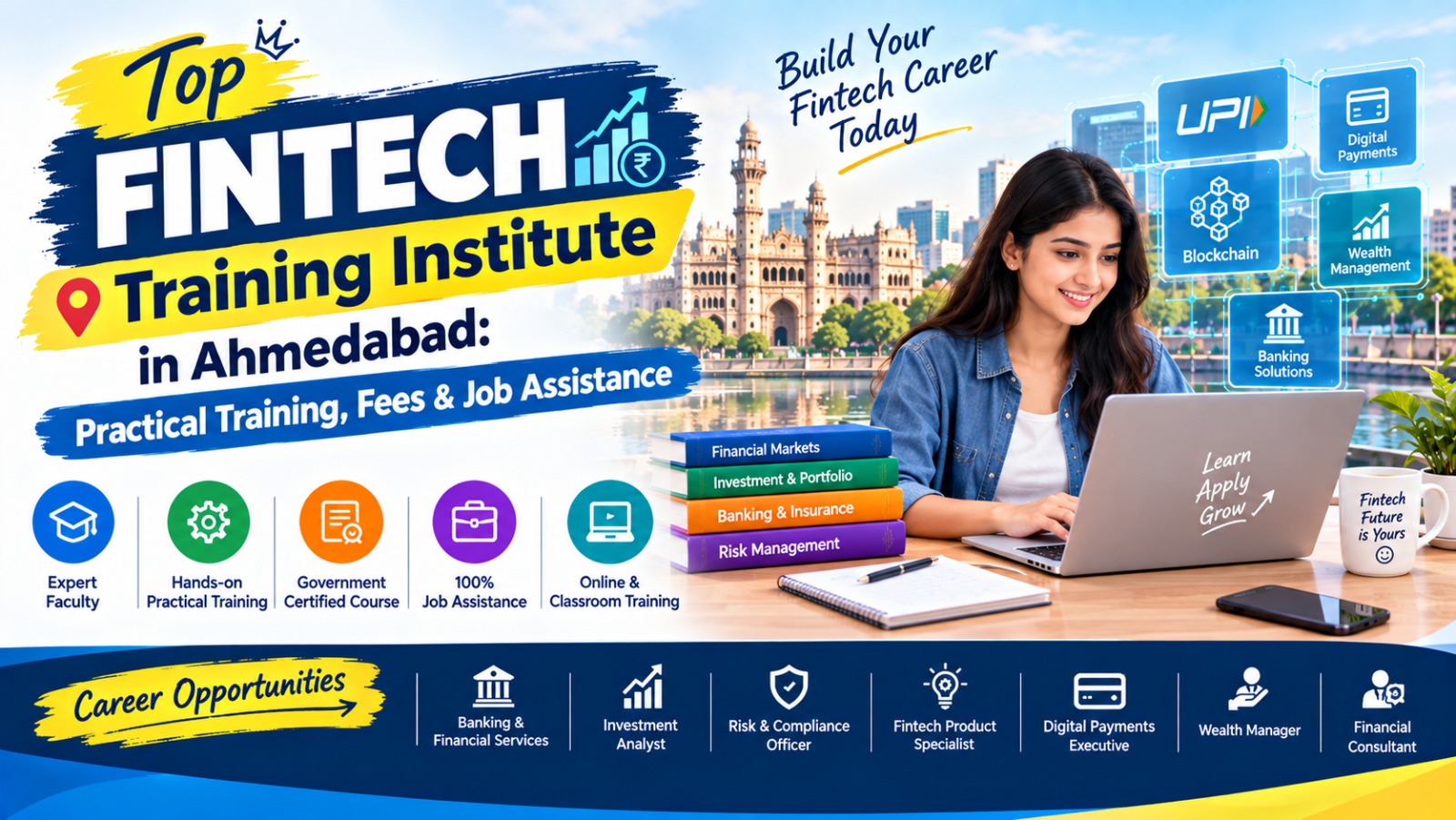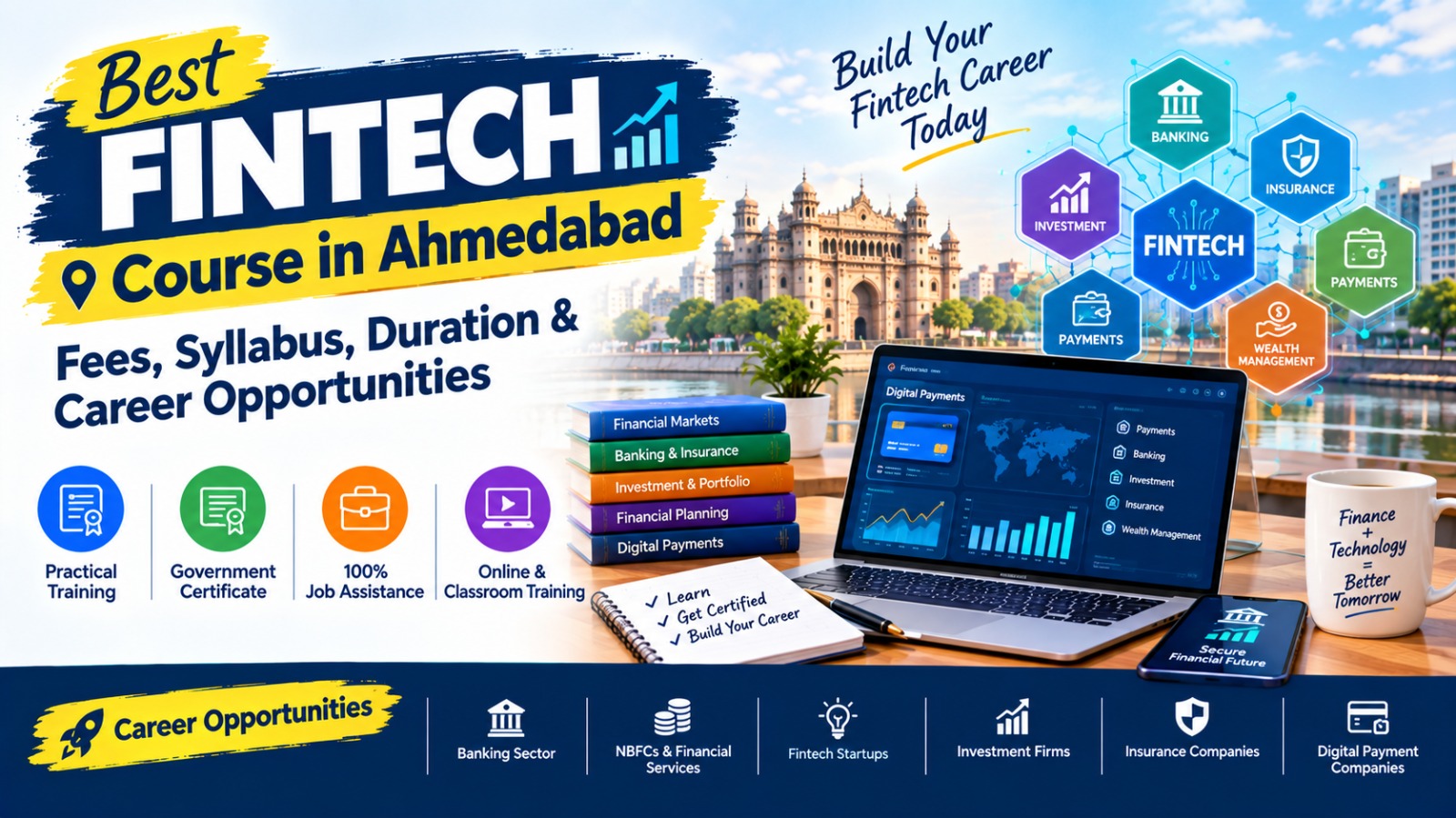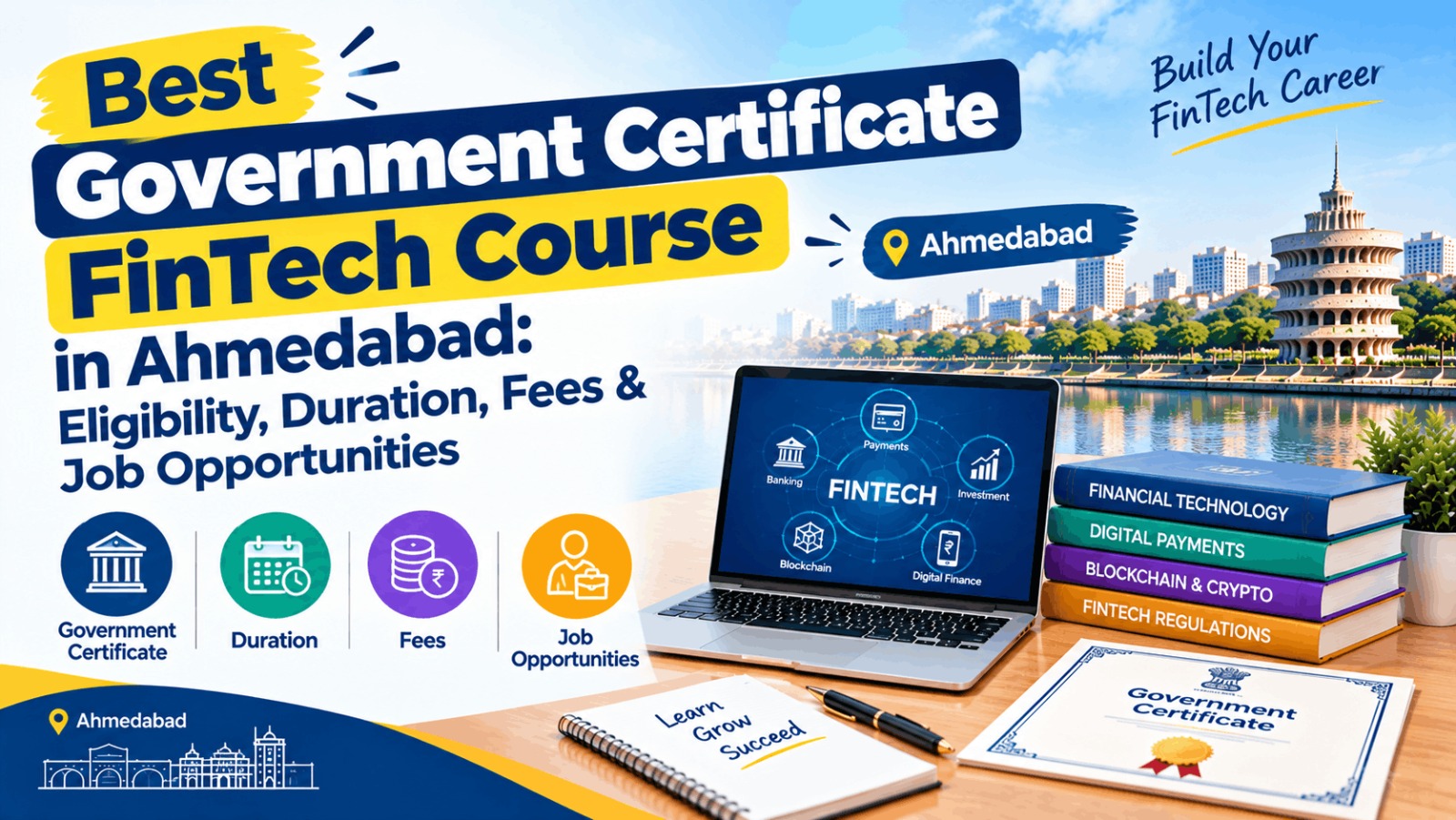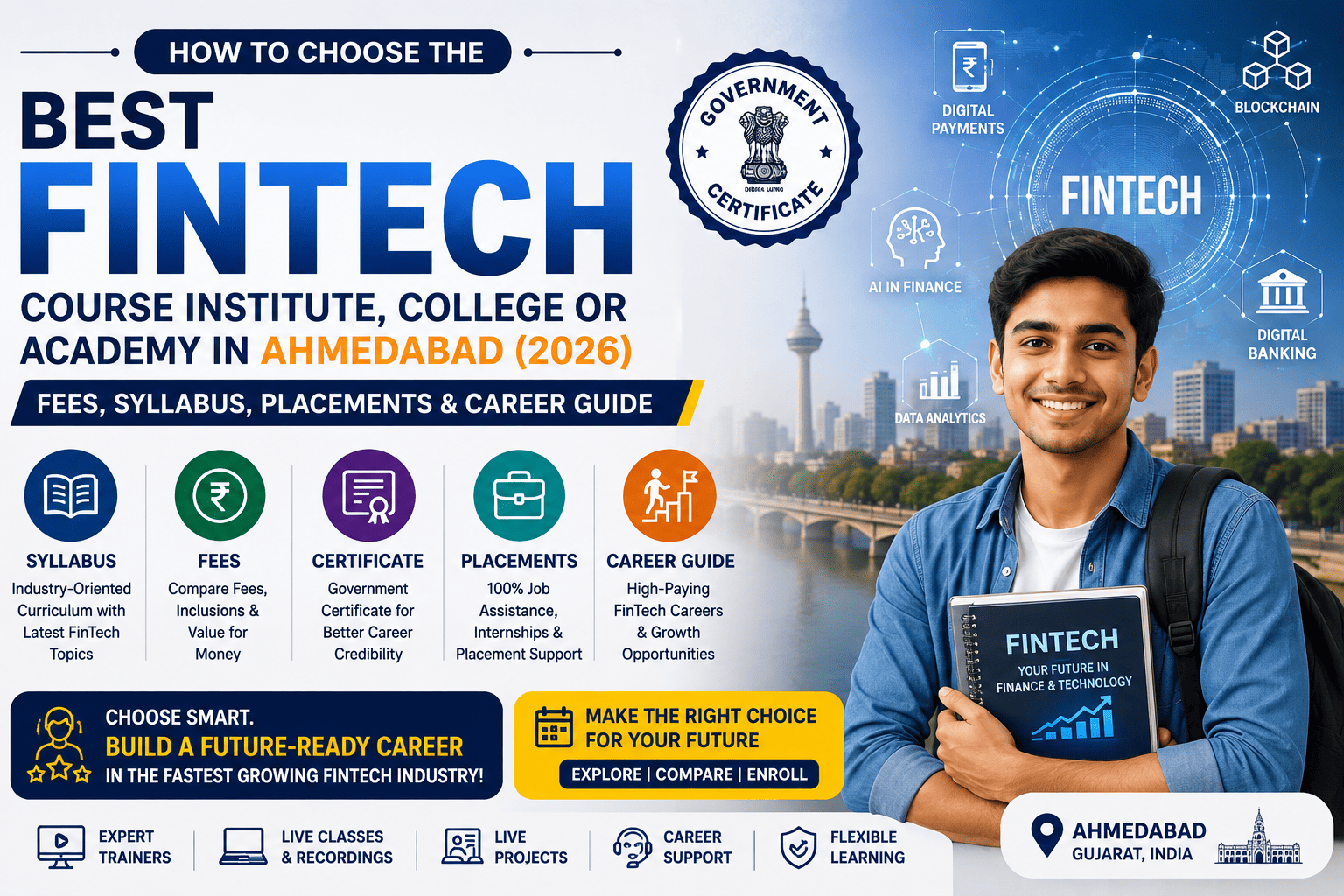
FinTech is transforming the financial services industry through digital payments, online banking, artificial intelligence, blockchain, data analytics, automation and digital investment platforms.
As financial institutions increasingly adopt technology, professionals who understand both finance and technology can access a wider range of career opportunities.
If you are searching for the best FinTech course institute, college or academy in Ahmedabad, choosing the right training provider is an important decision.
The institute you select should offer more than a certificate. A career-focused FinTech program should ideally provide an updated syllabus, practical training, projects, experienced trainers, recognised certification and structured placement or career assistance.
This guide explains how to compare FinTech institutes in Ahmedabad in 2026, including course fees, syllabus, eligibility, projects, certification, placement support and career opportunities.
What Is a FinTech Course?
A FinTech course teaches students how technology is used to create and improve financial products and services.
Depending on the institute, a comprehensive program may cover:
- Financial Technology Fundamentals
- Digital Banking
- Digital Payments
- UPI and Payment Systems
- Blockchain
- Artificial Intelligence in Finance
- Financial Data Analytics
- Power BI
- Advanced Excel
- Python for Data Analysis
- Investment Technology
- Risk Management
- KYC and AML
- Regulatory Technology
- Cybersecurity Awareness
In simple terms:
FinTech = Finance + Technology + Data + Digital Innovation
Why Choose a FinTech Course in Ahmedabad?
Ahmedabad has a strong ecosystem across education, finance, banking, technology, startups and business services.
The development of GIFT City in Gujarat has also increased the region’s importance as a financial-services and international-finance hub.
This creates an attractive environment for students interested in careers combining:
Finance + Technology + Data Analytics + Digital Business
A FinTech course in Ahmedabad can therefore be relevant for students who want to enter banking, financial services, FinTech startups, investment operations, digital payments, data analytics or financial technology roles.
Who Should Join a FinTech Course?
FinTech is not limited to computer science students.
The following learners can consider FinTech training:
1. Commerce Students
B.Com and commerce students can combine their finance knowledge with technology and analytics.
2. Finance Professionals
Accountants and finance executives can learn digital financial technologies and data tools.
3. Banking Professionals
Banking employees can develop knowledge of digital banking, payments and financial automation.
4. IT Professionals
Technology professionals can develop financial-domain knowledge.
5. Management Students
BBA and MBA students can understand FinTech business models, digital finance and financial products.
6. Working Professionals
Online and weekend courses can help professionals upgrade their skills without leaving their current employment.
7. Entrepreneurs
Business owners can learn about digital payments, financial technology, analytics and financial automation.
What Should a Good FinTech Course Syllabus Include?
One of the first things to check when comparing institutes is the syllabus.
Avoid selecting a course based only on its title. Download or request the complete curriculum before enrolling.
Core FinTech Modules
A comprehensive syllabus may include:
Module 1: FinTech Fundamentals
- What is FinTech?
- Evolution of FinTech
- FinTech ecosystem
- Traditional finance vs FinTech
- FinTech business models
Module 2: Digital Banking
- Internet Banking
- Mobile Banking
- Digital Banking
- Neo Banking
- Core Banking Technology
Module 3: Digital Payments
- UPI
- NEFT
- RTGS
- IMPS
- Payment Gateways
- QR Payments
- Digital Wallets
Module 4: Blockchain
- Blockchain fundamentals
- Distributed Ledger Technology
- Smart Contracts
- Cryptocurrency concepts
- Blockchain use cases in finance
Module 5: Artificial Intelligence in Finance
- AI fundamentals
- Fraud detection
- Credit scoring
- Financial forecasting
- Customer service automation
- AI-assisted financial analysis
Module 6: Financial Data Analytics
- Advanced Excel
- Financial modelling basics
- Data cleaning
- Data analysis
- Power BI
- Data visualization
- Financial dashboards
- Python fundamentals
Module 7: Investment Technology
- Digital investment platforms
- WealthTech
- Robo-advisory
- Portfolio technology
- Investment analytics
Module 8: Risk & Compliance
- KYC
- AML
- Financial risk
- Fraud prevention
- Regulatory compliance
- Data privacy
Practical Training: One of the Most Important Factors
A FinTech course should not be entirely theoretical.
Before joining an institute, ask:
“How many practical projects are included in the course?”
Look for training that includes:
- Live projects
- Industry case studies
- Financial datasets
- Practical assignments
- Financial dashboards
- Payment-system case studies
- Investment analysis
- Risk-analysis exercises
Examples of FinTech Projects
Financial Dashboard Project
Students can create a Power BI or Excel dashboard showing:
- Revenue
- Expenses
- Profit
- Transactions
- Customer metrics
- Financial KPIs
Digital Payment Analysis
Students can analyse payment data and identify:
- Transaction trends
- Customer behaviour
- Payment preferences
- Growth patterns
Loan Risk Analysis
A sample dataset can be used to understand:
- Credit profiles
- Loan applications
- Risk factors
- Approval patterns
FinTech Business Case Study
Students can analyse a FinTech company by studying:
- Business model
- Target customers
- Technology
- Revenue model
- Competition
- Risks
- Growth strategy
FinTech Course Fees in Ahmedabad
FinTech course fees vary considerably between institutes.
The total fee can depend on:
- Course duration
- Number of modules
- Certification
- Faculty expertise
- Live classes
- Practical projects
- Internship
- Learning materials
- Placement support
Instead of choosing the cheapest course, compare the value included in the total fee.
Before paying, ask whether the fee includes:
- Training
- Certification
- Projects
- Assessments
- Internship
- Career counselling
- Resume preparation
- Interview preparation
- Placement assistance
A course with a slightly higher fee may provide significantly more practical and career-oriented training.
How Long Does a FinTech Course Take?
FinTech programs can have different durations.
Common formats include:
- 3-month certificate courses
- 6-month professional courses
- Weekend programs
- Fast-track programs
- Online programs
- Hybrid programs
The ideal duration depends on your career goal and previous knowledge.
A beginner should generally prefer a program that provides enough time for fundamentals + practical learning + projects + career preparation.
How to Compare FinTech Institutes in Ahmedabad
Use the following checklist before choosing an institute.
| Factor | What to Check |
|---|---|
| Syllabus | Is it updated for current FinTech trends? |
| Trainers | Do trainers have relevant practical experience? |
| Projects | Are real-world projects included? |
| Certification | Who issues the certificate? |
| Learning Mode | Online, classroom or hybrid? |
| Duration | Is there enough time for practical learning? |
| Placement | What type of career assistance is offered? |
| Internship | Is internship or industry exposure available? |
| Reviews | Are student reviews genuine and recent? |
| Fees | What is included in the total fee? |
Government Certificate: What Should You Verify?
Many students search for a government-certified FinTech course in Ahmedabad.
Certification can add credibility, but you should verify the exact details before admission.
Check:
- Name of issuing authority
- Government department or authorised organisation
- Accreditation details
- Recognition status
- Certificate verification method
- Course approval details
- Whether the certificate is government-issued, government-recognised or institute-issued
Do not rely only on promotional wording such as “Government Certificate.”
Always ask the institute to provide documentary details about the certification.
Placement Assistance: What Should You Expect?
Placement support can be an important factor when choosing a FinTech institute.
Good career-support programs may include:
Resume Building
Creating a professional resume highlighting your FinTech skills and projects.
Interview Preparation
Training for:
- HR interviews
- Technical interviews
- Finance interviews
- Case-study discussions
Mock Interviews
Practice interviews can help students improve confidence and communication.
Job Referrals
Institutes may share relevant vacancies and connect eligible candidates with employers.
Placement Drives
Some institutes conduct recruitment drives with participating companies.
Career Counselling
Career guidance can help students identify suitable roles based on their education and skills.
100% Job Assistance vs 100% Job Guarantee
Students should understand the difference.
100% Job Assistance generally refers to support such as:
- Job referrals
- Interview opportunities
- Resume support
- Mock interviews
- Placement drives
- Career counselling
It does not automatically mean that every student is guaranteed a job.
Before enrolling, ask the institute for its written placement policy and understand exactly what “100% job assistance” includes.
Career Opportunities After FinTech Training
After completing a career-focused FinTech course, learners can explore roles such as:
- FinTech Executive
- Digital Banking Executive
- Financial Data Analyst
- Business Analyst
- Risk Analyst
- KYC Analyst
- AML Analyst
- Payment Operations Executive
- Financial Operations Executive
- Investment Operations Executive
- Compliance Executive
- Digital Finance Executive
- FinTech Support Executive
The exact role depends on education, experience, technical skills and employer requirements.
FinTech + Data Analytics: A Powerful Combination
One of the strongest skill combinations for finance professionals is:
FinTech + Data Analytics
Students can learn:
- Advanced Excel
- Power BI
- Python
- Data Cleaning
- Data Visualization
- Financial Dashboards
- Business Intelligence
For example, an accountant who understands Tally and Excel can expand their career profile by learning Power BI, Python and FinTech applications.
This can open opportunities in financial analytics, business analysis, reporting and digital finance.
FinTech + Accounting: Why Tally Professionals Should Consider FinTech
Traditional accounting is becoming increasingly digital.
Accountants already familiar with tools such as Tally Prime can expand their skills by learning:
Tally → Advanced Excel → Power BI → Python → FinTech
This progression can help finance professionals move from routine accounting activities toward:
- Financial Analysis
- MIS Reporting
- Business Intelligence
- Data Analysis
- Digital Finance
- FinTech Operations
FinTech + Digital Marketing
FinTech companies also need marketing professionals.
Digital marketing can help financial businesses with:
- Customer acquisition
- SEO
- Content marketing
- Social media
- Paid advertising
- Lead generation
- Email marketing
- Brand awareness
Therefore, a combination of:
FinTech + Digital Marketing
can be valuable for professionals interested in FinTech startups, financial products and digital customer acquisition.
FinTech Career Roadmap 2026
A beginner can follow this career roadmap:
Step 1: Learn basic accounting and finance
↓
Step 2: Understand FinTech fundamentals
↓
Step 3: Learn digital banking and digital payments
↓
Step 4: Develop Advanced Excel skills
↓
Step 5: Learn Power BI and financial visualization
↓
Step 6: Learn Python and data analytics basics
↓
Step 7: Understand AI and blockchain applications
↓
Step 8: Complete practical FinTech projects
↓
Step 9: Build a professional resume and portfolio
↓
Step 10: Apply for FinTech and finance-related roles
Questions to Ask Before Joining a FinTech Institute
Before making your final decision, ask the institute:
- What is the complete FinTech syllabus?
- Who are the trainers?
- How much practical training is included?
- Are live projects included?
- Who issues the certificate?
- Is the certificate government-recognised?
- What is the total course fee?
- Are there additional certification charges?
- Is internship support available?
- What exactly does job assistance include?
- Are placement statistics available?
- Can I speak with previous students?
- Are online classes live or recorded?
- Are weekend batches available?
- Is career counselling included?
These questions can help you compare institutes based on actual value rather than marketing claims.
Best FinTech Course Institute in Ahmedabad: Final Selection Checklist
Before enrolling, give preference to an institute that offers:
✅ Updated FinTech curriculum
✅ Practical training
✅ Experienced trainers
✅ Live projects
✅ Industry case studies
✅ Financial data analytics
✅ Excel and Power BI
✅ AI and blockchain fundamentals
✅ Recognised certification
✅ Internship or industry exposure
✅ Resume building
✅ Mock interviews
✅ Job assistance
✅ Flexible learning options
✅ Transparent fee structure
Frequently Asked Questions (FAQs)
1. Which is the best FinTech course institute in Ahmedabad?
The best institute depends on your career goal, budget and learning requirements. Look for an institute offering an updated syllabus, practical projects, experienced trainers, credible certification and structured career support.
2. What is the average FinTech course fee in Ahmedabad?
Fees vary according to course duration, curriculum, certification, practical training and placement support. Students should compare the complete package rather than choosing an institute only by price.
3. What is included in a FinTech course syllabus?
A comprehensive syllabus can include FinTech fundamentals, digital banking, digital payments, blockchain, AI in finance, data analytics, Power BI, investment technology, risk management, KYC and AML.
4. Who can join a FinTech course?
Commerce students, B.Com graduates, BBA and MBA students, accountants, banking professionals, IT professionals, working professionals and entrepreneurs can learn FinTech.
5. Is FinTech suitable for B.Com students?
Yes. B.Com students can combine accounting and finance knowledge with FinTech, Excel, Power BI, Python and data analytics skills.
6. Is coding necessary to learn FinTech?
Not necessarily. Many FinTech roles focus on finance, operations, analytics, compliance and business. However, learning basic Python and data analytics can be beneficial for advanced roles.
7. Are FinTech courses available online in Ahmedabad?
Yes. Many training providers offer online, classroom and hybrid learning formats. Students should check whether online classes are live, recorded or a combination of both.
8. Is a government certificate important for a FinTech course?
A credible government-recognised certification can strengthen a learner’s profile, but students should verify the issuing authority and recognition before enrolling.
9. What jobs can I get after a FinTech course?
Potential roles include FinTech Executive, Digital Banking Executive, Financial Data Analyst, Payment Operations Executive, Risk Analyst, KYC Analyst, AML Analyst, Business Analyst and Financial Operations Executive.
10. Does FinTech training provide placement assistance?
Many career-focused institutes provide resume preparation, interview training, job referrals and placement drives. Students should verify the exact placement services offered.
11. Is 100% job assistance a job guarantee?
No. Job assistance generally means career and placement support. It should not automatically be interpreted as a guaranteed job.
12. What skills should I learn along with FinTech?
Useful complementary skills include Advanced Excel, Power BI, Python, data analytics, financial modelling, AI tools, communication and digital marketing.
Conclusion
Choosing the best FinTech course institute, college or academy in Ahmedabad in 2026 requires more than comparing advertisements and course fees.
Students should evaluate the syllabus, trainers, practical training, live projects, certification, internship opportunities, learning format, career support and placement process before making a decision.
A future-ready FinTech program should combine finance with technology, data and digital innovation. Skills such as digital payments, AI, blockchain, Advanced Excel, Power BI and Python can make the learning experience more practical and career-oriented.
For students, graduates and working professionals in Ahmedabad, FinTech can be a valuable skill area for building careers across banking, digital payments, financial analytics, investment services, FinTech startups and digital finance.
The right institute is not necessarily the one with the lowest fee or the biggest advertisement. It is the one that provides transparent information, practical learning, credible certification, industry-relevant skills and genuine career support.
Choose the institute based on learning outcomes—not just promises—and build your FinTech career with skills that remain relevant in the evolving financial industry.