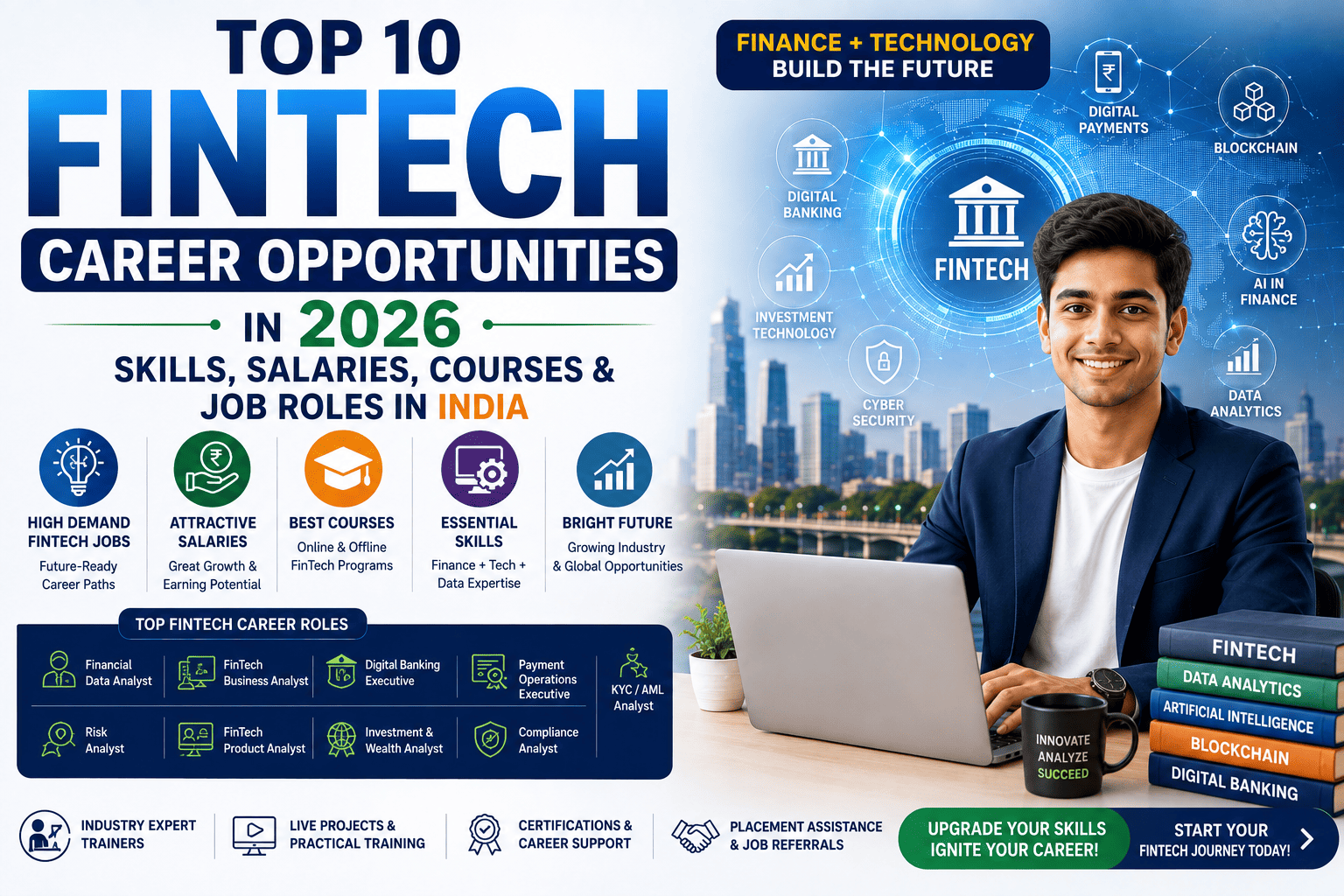
The financial industry is undergoing a major digital transformation. Digital payments, artificial intelligence, data analytics, online banking, blockchain, digital lending, cybersecurity and financial automation are changing the way financial services operate.
This transformation is creating new career opportunities for people who understand both finance and technology.
For students, graduates and working professionals in India, FinTech can offer career paths across banking, payments, analytics, investment technology, risk management, compliance and financial technology.
If you are searching for the best FinTech career opportunities in 2026, this guide explains the top 10 FinTech job roles, required skills, salary factors, courses, eligibility and career paths in India.
What Is FinTech?
FinTech, or Financial Technology, refers to the use of technology to develop, improve and automate financial products and services.
Examples of FinTech include:
- UPI and digital payments
- Mobile banking
- Digital lending
- Online investments
- Payment gateways
- Digital insurance
- Financial data analytics
- Artificial intelligence in finance
- Blockchain applications
- Automated financial services
In simple terms:
Finance + Technology + Data + Digital Innovation = FinTech
Why Are FinTech Careers Growing in 2026?
Financial organisations are increasingly adopting technology to improve:
- Customer experience
- Digital payments
- Financial reporting
- Risk management
- Fraud detection
- Customer verification
- Investment analysis
- Business intelligence
- Process automation
This means the demand for professionals who can understand finance, technology and data is expanding across different types of organisations.
FinTech careers are not limited to software developers. Commerce graduates, accountants, data analysts, banking professionals, business analysts and management graduates can also build FinTech-related careers.
Top 10 FinTech Career Opportunities in 2026
1. Financial Data Analyst
What Does a Financial Data Analyst Do?
A Financial Data Analyst works with financial and business data to identify trends, generate reports and support decision-making.
Typical responsibilities can include:
- Analysing financial datasets
- Preparing reports
- Creating dashboards
- Identifying trends
- Monitoring KPIs
- Supporting business decisions
- Presenting analytical insights
Skills Required
Important skills include:
- Advanced Excel
- Power BI
- Data visualization
- SQL basics
- Financial analysis
- Statistics fundamentals
- Python basics
- Communication
Salary in India
Entry-level salaries can vary significantly depending on company, location, qualifications and technical skills. A fresher may start around ₹3–6 LPA, while professionals with experience and advanced analytics skills can potentially earn considerably more.
Best Courses
A useful learning combination is:
Finance + Advanced Excel + Power BI + Python + FinTech
2. FinTech Business Analyst
A FinTech Business Analyst connects business requirements with technology solutions.
They may work on financial applications, payment platforms, banking systems or digital financial products.
Responsibilities
- Understanding business requirements
- Analysing processes
- Preparing documentation
- Working with technology teams
- Identifying process improvements
- Testing digital solutions
- Analysing business performance
Skills Required
- Business analysis
- Finance fundamentals
- FinTech knowledge
- Excel
- Power BI
- SQL basics
- Documentation
- Communication
- Problem-solving
Salary Range
Depending on experience and employer, entry-level business analyst roles can start around ₹4–7 LPA, with experienced professionals potentially earning significantly higher salaries.
3. Digital Banking Executive
Digital banking has transformed traditional banking services.
A Digital Banking Executive may work with digital banking operations, customer services, digital products or banking technology.
Job Responsibilities
- Supporting digital banking operations
- Handling digital customer processes
- Understanding online banking services
- Monitoring transactions
- Supporting digital products
- Coordinating with banking teams
Skills Required
- Banking fundamentals
- FinTech knowledge
- Digital payment systems
- Customer service
- Excel
- Communication
- Basic data analysis
Career Scope
This role can be suitable for graduates interested in combining banking + technology.
4. Payment Operations Executive
Digital payments have become an important part of modern financial services.
Payment Operations professionals help monitor and manage transaction-related processes.
Responsibilities
- Transaction monitoring
- Payment processing support
- Reconciliation
- Payment issue resolution
- Reporting
- Operational coordination
- Fraud-related escalation
Skills Required
- Finance fundamentals
- Digital payment knowledge
- Excel
- Reconciliation
- Data analysis
- Communication
- Problem-solving
Suitable Courses
A combination of:
Accounting + Tally Prime + Advanced Excel + FinTech + Digital Payments
can be useful for students interested in finance operations.
5. KYC & AML Analyst
KYC means Know Your Customer, while AML means Anti-Money Laundering.
KYC and AML professionals help financial organisations follow customer verification and compliance processes.
Responsibilities
- Customer verification
- Document review
- Transaction monitoring
- Risk identification
- Compliance checks
- Customer due diligence
- Escalating suspicious activities
Skills Required
- Banking knowledge
- KYC fundamentals
- AML concepts
- Risk awareness
- Analytical thinking
- Documentation
- Attention to detail
- Communication
Career Scope
KYC and AML roles are available across:
- Banks
- NBFCs
- FinTech companies
- Payment organisations
- Financial service providers
6. Risk Analyst
Financial organisations need professionals who can identify and evaluate financial risks.
A Risk Analyst may work with:
- Credit risk
- Operational risk
- Market risk
- Fraud risk
- Financial risk
Responsibilities
- Analysing financial information
- Identifying risk factors
- Preparing reports
- Monitoring risk indicators
- Supporting risk-management teams
- Analysing customer or transaction data
Skills Required
- Finance
- Statistics
- Excel
- Power BI
- Data analytics
- Risk management
- Problem-solving
Career Growth
Professionals can progress from entry-level analyst roles into specialised risk-management positions with experience and additional qualifications.
7. FinTech Product Analyst
A Product Analyst helps financial technology companies understand how customers use their digital products.
For example, a product analyst may analyse a:
- Payment application
- Digital banking platform
- Investment application
- Lending platform
- Financial dashboard
Responsibilities
- Analysing customer behaviour
- Tracking product KPIs
- Identifying user trends
- Preparing product reports
- Supporting product teams
- Analysing feature performance
Skills Required
- Data analytics
- Excel
- Power BI
- SQL
- Product understanding
- Customer behaviour analysis
- Communication
Career Potential
This can be an attractive career direction for professionals interested in FinTech + Data + Product Management.
8. Investment & WealthTech Analyst
WealthTech combines wealth management and technology.
Professionals in this area can work with digital investment platforms, portfolio analytics and technology-enabled wealth-management services.
Responsibilities
- Investment data analysis
- Portfolio reporting
- Market research
- Customer analytics
- Investment operations
- Performance reporting
Skills Required
- Investment fundamentals
- Financial markets
- Excel
- Power BI
- Data analytics
- Financial modelling
- Research skills
Career Path
A learner can progress from investment operations or analytical roles toward specialised positions in wealth management, investment technology and financial analysis.
9. FinTech Compliance Analyst
As financial technology grows, compliance becomes increasingly important.
A Compliance Analyst helps organisations understand and follow applicable rules, policies and internal controls.
Responsibilities
- Compliance monitoring
- Documentation
- Risk assessment
- Policy review
- Regulatory reporting support
- KYC/AML coordination
Skills Required
- Finance
- Banking
- Compliance fundamentals
- KYC
- AML
- Risk management
- Analytical skills
- Documentation
Career Scope
Compliance professionals can work in:
- Banks
- FinTech companies
- NBFCs
- Investment firms
- Payment companies
- Financial service organisations
10. AI & Financial Technology Analyst
Artificial intelligence is becoming increasingly relevant to financial services.
AI can support:
- Fraud detection
- Financial forecasting
- Customer support
- Credit assessment
- Data analysis
- Document processing
- Automation
An AI-focused FinTech professional may work with business and technology teams to identify how AI can improve financial processes.
Skills Required
- Finance fundamentals
- FinTech
- Data analytics
- Python
- AI fundamentals
- Machine learning concepts
- Generative AI
- Problem-solving
Career Potential
This is one of the more technology-focused FinTech career paths and can be suitable for learners interested in:
Finance + Data + AI + Technology
Top 10 FinTech Jobs at a Glance
| FinTech Job Role | Key Skills | Suitable Background |
|---|---|---|
| Financial Data Analyst | Excel, Power BI, Python | Commerce, Finance, Data |
| FinTech Business Analyst | Business Analysis, Finance, Data | BBA, MBA, B.Com, IT |
| Digital Banking Executive | Banking, FinTech, Communication | Commerce, Banking |
| Payment Operations Executive | Payments, Excel, Reconciliation | Commerce, Finance |
| KYC & AML Analyst | KYC, AML, Risk | Finance, Banking |
| Risk Analyst | Finance, Excel, Analytics | Commerce, Finance |
| FinTech Product Analyst | Data, Product Analytics | Finance, IT, Management |
| WealthTech Analyst | Investments, Analytics | Finance, Commerce |
| Compliance Analyst | Compliance, KYC, AML | Finance, Banking |
| AI & FinTech Analyst | Python, AI, Data | IT, Finance, Analytics |
FinTech Salary in India in 2026
FinTech salaries vary based on several factors.
These include:
- Educational qualification
- Experience
- Job role
- Technical skills
- Company
- Location
- Industry
- Certifications
- Specialisation
Indicative Entry-Level Salary Ranges
| Role | Approx. Entry-Level Range |
| Financial Data Analyst | ₹3–6 LPA |
| FinTech Business Analyst | ₹4–7 LPA |
| Digital Banking Executive | ₹3–5.5 LPA |
| Payment Operations Executive | ₹2.5–5 LPA |
| KYC/AML Analyst | ₹3–6 LPA |
| Risk Analyst | ₹3.5–7 LPA |
| Product Analyst | ₹4–8 LPA |
| WealthTech Analyst | ₹3.5–7 LPA |
| Compliance Analyst | ₹3–6 LPA |
| AI/FinTech Analyst | ₹4–8 LPA |
Important: These are indicative career-planning ranges, not guaranteed salaries. Actual compensation can differ substantially between employers, cities, experience levels and skill sets.
What Skills Should You Learn for a FinTech Career?
A successful FinTech professional typically needs a combination of domain knowledge and technical skills.
Finance Skills
Learn:
- Accounting fundamentals
- Banking
- Financial markets
- Investment basics
- Financial products
- Risk management
Technology Skills
Learn:
- FinTech fundamentals
- Digital payments
- Digital banking
- Blockchain basics
- AI fundamentals
- Automation
Data Skills
Learn:
- Advanced Excel
- Power BI
- Data visualization
- SQL
- Python
- Statistics
Professional Skills
Develop:
- Communication
- Analytical thinking
- Problem-solving
- Business understanding
- Presentation skills
- Teamwork
Best Skill Combination for a FinTech Career
Instead of learning only one technology, students can develop a skill stack.
For Commerce Students
Tally Prime + Advanced Excel + Power BI + FinTech
For Data-Oriented Careers
Finance + Excel + Power BI + Python + FinTech
For AI-Oriented Careers
Finance + Python + Data Analytics + AI + FinTech
For Banking Careers
Banking + Digital Payments + FinTech + KYC/AML
For Business Careers
Finance + FinTech + Data Analytics + Business Analysis
Best FinTech Courses for Career Growth
When choosing a FinTech course, look for a curriculum covering both finance and technology.
A strong course can include:
FinTech Fundamentals
- Financial Technology
- FinTech ecosystem
- Traditional finance vs FinTech
Digital Finance
- Digital banking
- Digital payments
- UPI
- Payment gateways
- Digital wallets
Data Analytics
- Advanced Excel
- Power BI
- Financial dashboards
- Python
- Data visualization
Emerging Technology
- AI in finance
- Blockchain
- Automation
- Cybersecurity awareness
Financial Operations
- KYC
- AML
- Risk management
- Compliance
Practical Learning
- Live projects
- Case studies
- Financial datasets
- Portfolio development
Who Can Start a FinTech Career?
FinTech is not limited to computer science graduates.
The following learners can explore FinTech:
1. B.Com Students
Commerce students already have a foundation in accounting and finance.
2. BBA & MBA Students
Management students can combine business knowledge with FinTech and analytics.
3. Accountants
Accountants can transition toward digital finance and analytics.
4. Banking Professionals
Banking employees can upgrade their digital finance skills.
5. IT Professionals
IT professionals can add financial-domain knowledge.
6. Data Analysts
Data professionals can specialise in financial datasets and FinTech products.
7. Working Professionals
Professionals can use online or weekend courses to upskill.
FinTech Career Roadmap for 2026
If you are starting from the beginning, follow this roadmap:
Step 1: Learn Finance Fundamentals
↓
Step 2: Understand FinTech & Digital Finance
↓
Step 3: Learn Advanced Excel
↓
Step 4: Learn Power BI & Data Visualization
↓
Step 5: Learn Python Basics
↓
Step 6: Explore AI, Blockchain & Automation
↓
Step 7: Learn KYC, AML & Risk Fundamentals
↓
Step 8: Complete Practical FinTech Projects
↓
Step 9: Build Your Resume & Portfolio
↓
Step 10: Apply for FinTech, Banking & Finance Jobs
FinTech Career Opportunities for B.Com Students
B.Com students can benefit significantly from combining traditional finance education with digital skills.
A practical learning path can be:
B.Com → Tally Prime → Advanced Excel → Power BI → FinTech → Python
This can prepare students for potential roles such as:
- Financial Data Analyst
- MIS Executive
- FinTech Executive
- Banking Operations Executive
- Payment Operations Executive
- KYC Analyst
- Business Analyst
The exact role depends on additional skills, experience and employer requirements.
FinTech Career Opportunities in Ahmedabad
Ahmedabad is a major business and educational centre with opportunities across finance, accounting, banking, IT and business services.
Students can explore FinTech-related opportunities in:
- Banks
- NBFCs
- FinTech startups
- Financial service companies
- Payment companies
- Investment organisations
- Business analytics firms
- Technology companies
The wider Gujarat financial ecosystem, including GIFT City, also makes financial technology and financial-services skills increasingly relevant to the region.
For Ahmedabad learners, a useful combination can be:
Finance + FinTech + Data Analytics + Digital Skills
Is FinTech a Good Career in 2026?
Yes, FinTech can be a promising career field in 2026, especially for people who enjoy combining finance, technology and data.
However, completing a FinTech certificate alone does not guarantee employment.
Employers may also look for:
- Practical skills
- Projects
- Relevant education
- Communication
- Analytical ability
- Technical knowledge
- Industry awareness
- Experience
The best approach is therefore to build a complete career profile rather than focusing only on certification
Future Scope of FinTech Careers
Several areas are expected to remain important in the evolving FinTech industry.
Artificial Intelligence
AI can support fraud detection, customer service, forecasting and automation.
Digital Payments
Digital payment technology continues to influence consumer and business transactions.
Financial Data Analytics
Data-driven decision-making is increasingly important across financial organisations.
Embedded Finance
Financial services can increasingly be integrated into non-financial digital platforms.
Blockchain
Blockchain can support selected financial and transaction-related applications.
RegTech
Technology can help financial institutions manage compliance and regulatory processes.
Cybersecurity
Protecting financial information and digital transactions remains critical.
How to Choose the Best FinTech Course in India
Before enrolling, compare:
Syllabus
Is the curriculum current and practical?
Projects
Does the course include real-world projects and case studies?
Trainers
Do instructors have relevant finance and technology knowledge?
Certification
Who issues the certificate?
Tools
Does the course teach practical tools such as Excel, Power BI and Python?
Career Support
Does the institute provide:
- Resume building
- Mock interviews
- Career counselling
- Job referrals
- Placement assistance
Course Fees
Compare the total fee and check what is included.
Learning Mode
Choose between:
- Classroom
- Online
- Hybrid
- Weekend
based on your schedule and learning requirements.
What Does 100% Job Assistance Mean?
Some institutes advertise “100% job assistance.”
Students should understand that job assistance and job guarantee are not necessarily the same thing.
Job assistance may include:
- Job referrals
- Placement drives
- Resume preparation
- Interview training
- Mock interviews
- Career counselling
Before joining a course, ask the institute for clear details about its placement process and terms.
Frequently Asked Questions (FAQs)
1. What are the top FinTech career opportunities in 2026?
Top opportunities include Financial Data Analyst, FinTech Business Analyst, Digital Banking Executive, Payment Operations Executive, KYC/AML Analyst, Risk Analyst, Product Analyst, WealthTech Analyst, Compliance Analyst and AI/FinTech Analyst.
2. Is FinTech a good career in India?
Yes. FinTech can be a promising career field for professionals interested in finance, technology, data and digital business. Career growth depends on skills, experience and qualifications.
3. What is the salary of a FinTech professional in India?
Salary varies according to role, experience, location, company and skills. Entry-level FinTech-related roles may commonly fall within approximately ₹3–8 LPA, while experienced professionals can earn significantly more.
4. Which FinTech job is best for freshers?
Financial Data Analyst, Payment Operations Executive, KYC/AML Analyst, Digital Banking Executive and FinTech Operations roles can be suitable entry points depending on the candidate’s education and skills.
5. Can B.Com students get FinTech jobs?
Yes. B.Com students can develop FinTech careers by adding skills such as Advanced Excel, Power BI, Python, data analytics and digital finance.
6. Which skills are required for FinTech jobs?
Useful skills include finance, accounting, Advanced Excel, Power BI, Python, data analytics, digital payments, AI fundamentals, blockchain awareness, risk management and communication.
7. Is coding required for FinTech?
Coding is not required for every FinTech role. Finance, operations, compliance and KYC roles may require little coding, while data, AI and technology-oriented roles can require Python, SQL or other programming skills.
8. Which course is best for a FinTech career?
A career-oriented FinTech course should cover financial technology, digital banking, digital payments, data analytics, AI, blockchain, risk, compliance and practical projects.
9. Can accountants move into FinTech?
Yes. Accountants can expand their careers by learning Tally Prime, Advanced Excel, Power BI, Python and FinTech concepts.
10. What is the future scope of FinTech?
Future opportunities are expected across AI, digital payments, financial analytics, embedded finance, cybersecurity, blockchain, RegTech, digital banking and automated financial services.
11. Are FinTech jobs available in Ahmedabad?
Yes. Ahmedabad has opportunities across banking, financial services, accounting, analytics, technology and FinTech-related operations. The broader Gujarat financial ecosystem also provides additional opportunities.
12. Does a FinTech course guarantee a job?
No. A certificate does not automatically guarantee employment. Practical skills, projects, qualifications, communication and interview performance also influence hiring.
Conclusion
FinTech is creating a new generation of careers at the intersection of finance, technology, data and digital business.
The top FinTech career opportunities in 2026 range from Financial Data Analyst and Business Analyst to Digital Banking Executive, KYC/AML Analyst, Risk Analyst, Product Analyst and AI-focused financial technology roles.
For students and professionals, the strongest strategy is to build a practical combination of skills rather than relying on a single certificate.
A powerful career skill stack can be:
Finance + FinTech + Advanced Excel + Power BI + Python + Data Analytics
Depending on your career goal, you can add AI, blockchain, cybersecurity, investment technology or digital marketing.
Whether you are a B.Com student, accountant, banking professional, IT graduate, data analyst or working professional, FinTech can provide multiple pathways for career development.
The future of financial services is increasingly digital, data-driven and technology-enabled. Start by choosing one career direction, develop the required skills, build practical projects and continuously upgrade your knowledge.
Learn the technology. Understand the finance. Build practical skills. Create your FinTech career.