The financial-services industry is changing rapidly. Customers can now make payments, open accounts, apply for financial products, invest money and manage finances through smartphones and digital platforms.
At the same time, traditional banks continue to play a major role in lending, deposits, payments, wealth management and other financial services.
This has created an important question for students, graduates and professionals:
What is the difference between FinTech and traditional banking, and which career path is better in 2026?
The answer depends on your interests, education and career goals.
FinTech focuses heavily on technology-driven financial services, while traditional banking operates through established banking institutions and financial infrastructure. However, the two sectors are increasingly connected because traditional banks themselves use FinTech technologies to improve their services.
This guide explains the key differences between FinTech and traditional banking, their benefits, career opportunities, required skills, courses and future scope in India in 2026.
What Is FinTech?
FinTech, short for Financial Technology, refers to the use of technology to create, improve, automate or deliver financial products and services.
Common FinTech applications include:
- Digital payments
- UPI
- Mobile banking
- Payment gateways
- Digital lending
- Online investments
- WealthTech
- InsurTech
- Financial data analytics
- Artificial intelligence in finance
- Blockchain applications
- Automated financial services
Simple Definition
FinTech is the combination of finance and technology to make financial services more digital, efficient, accessible and data-driven.
What Is Traditional Banking?
Traditional banking refers to established banking institutions that provide financial services such as:
- Savings accounts
- Current accounts
- Loans
- Deposits
- Credit facilities
- Money transfers
- Investment services
- Wealth management
- Business banking
Traditional banking has historically relied heavily on branches, physical documentation and established banking processes.
However, modern banks are increasingly digital.
Many traditional banks now provide:
- Mobile banking
- Internet banking
- Digital payments
- Online account services
- Digital loan applications
- AI-powered customer support
- Data analytics
- Automated processes
Therefore, the difference between FinTech and banking is becoming less clear as banks adopt more technology.
FinTech vs Traditional Banking: Key Difference
The simplest way to understand the difference is:
Traditional Banking = Established financial institutions + conventional and digital banking infrastructure
FinTech = Technology-driven financial products, platforms and services
FinTech companies may build specialised digital solutions, while banks provide a broader range of regulated financial services.
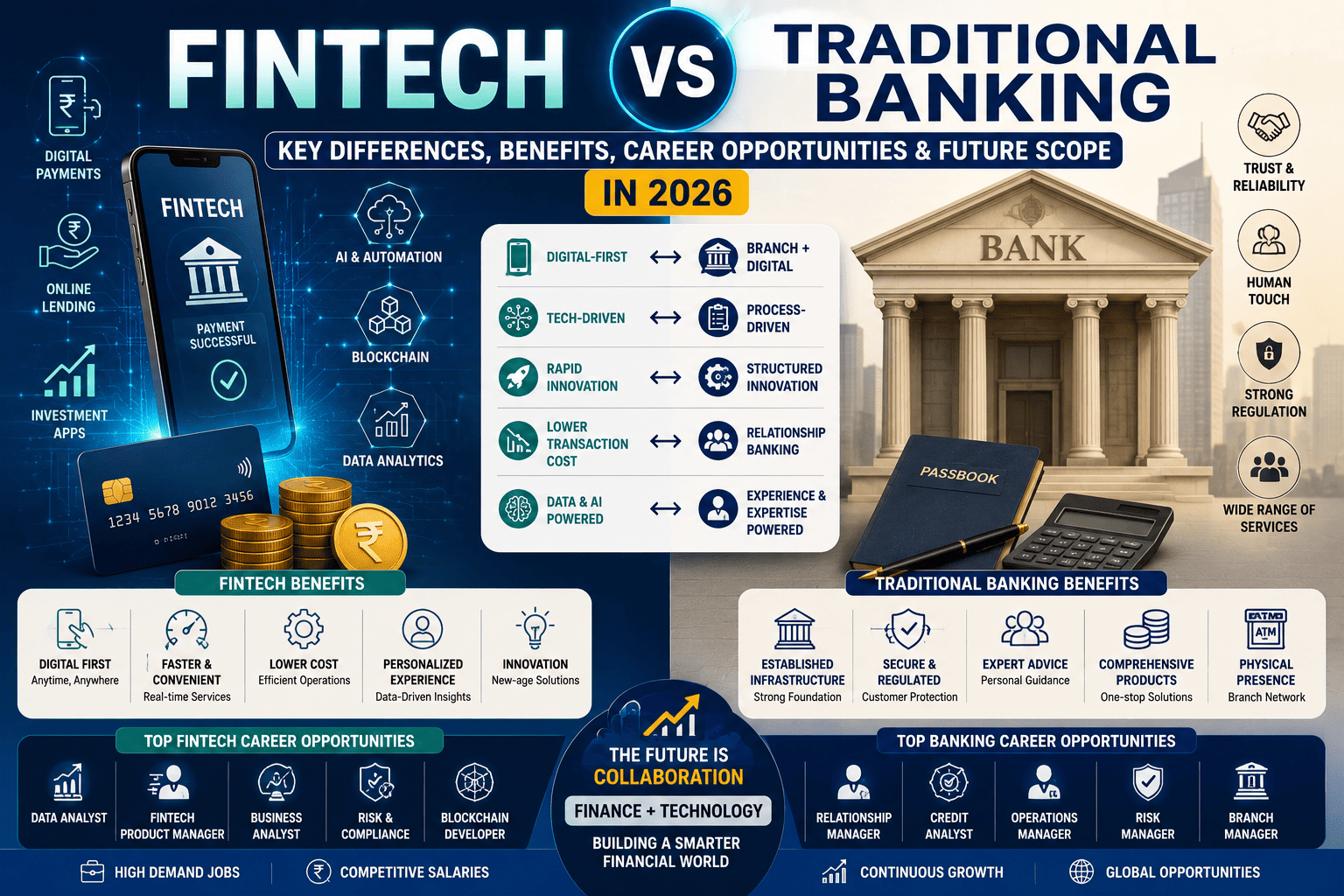
FinTech vs Traditional Banking Comparison
| Factor | FinTech | Traditional Banking |
|---|---|---|
| Primary Focus | Technology-driven financial services | Comprehensive banking services |
| Customer Access | Often digital-first | Branch + digital channels |
| Technology | Central to the business model | Increasingly technology-driven |
| Innovation | Often rapid and specialised | Structured and regulated |
| Customer Experience | Mobile and digital focused | Branch, web and mobile |
| Automation | High in many processes | Increasingly automated |
| Data Analytics | Core component | Increasingly important |
| Digital Payments | Major focus | Major banking service |
| Lending | Digital lending platforms | Bank-based lending |
| Career Areas | Technology + Finance + Data | Banking + Finance + Operations + Technology |
FinTech vs Traditional Banking: 10 Major Differences
1. Business Model
Traditional banks generally provide a broad range of financial services through established banking infrastructure.
FinTech companies often focus on solving specific financial problems using technology.
For example:
- Payments
- Lending
- Investments
- Insurance
- Financial analytics
- Digital financial management
2. Customer Experience
Traditional banking has historically included branch-based interactions.
FinTech companies often design their services around:
- Mobile applications
- Websites
- Digital onboarding
- Automated support
- Real-time notifications
- Digital transactions
The result is often a more digital-first customer journey.
3. Technology Adoption
Technology is central to FinTech businesses.
Traditional banks also use advanced technology, but their technology environments can include large legacy systems and established infrastructure.
Modern banks are increasingly investing in:
- Cloud technology
- AI
- Data analytics
- APIs
- Automation
- Cybersecurity
- Digital banking
4. Innovation
FinTech companies often specialise in specific areas and can experiment with new digital products.
Traditional financial institutions generally operate within larger systems and regulatory frameworks.
However, banks and FinTech companies increasingly collaborate through:
- Partnerships
- APIs
- Banking-as-a-Service models
- Technology providers
- Digital platforms
5. Digital Payments
FinTech has played an important role in expanding digital payment experiences.
Examples include:
- UPI
- QR payments
- Payment gateways
- Digital wallets
- Online merchant payments
Banks also provide and support many digital payment services.
Therefore, payments are an area where FinTech and traditional banking overlap significantly.
6. Lending
Traditional banks have long provided loans based on established underwriting and credit processes.
FinTech companies can use technology and data to streamline:
- Loan applications
- Customer verification
- Credit assessment
- Documentation
- Loan processing
Digital lending does not eliminate traditional banking; instead, technology can make lending processes more efficient.
7. Data Analytics
FinTech companies typically depend heavily on data.
They may analyse:
- Customer behaviour
- Transactions
- Payment patterns
- Risk indicators
- Product usage
- Financial performance
Traditional banks also use large amounts of data for:
- Risk management
- Credit decisions
- Fraud detection
- Customer analytics
- Reporting
This makes data analytics a valuable skill in both sectors.
8. Regulation and Compliance
Financial services operate within regulatory frameworks.
Both banks and FinTech companies may need processes related to:
- KYC
- AML
- Data protection
- Risk management
- Fraud prevention
- Compliance
The exact regulatory requirements depend on the business model, services offered and applicable regulations.
9. Accessibility
FinTech platforms can make certain financial services accessible through smartphones and digital channels.
Traditional banks also increasingly provide digital services, reducing the need for customers to visit branches for routine transactions.
10. Career Skills
Traditional banking careers often emphasise:
- Banking knowledge
- Finance
- Accounting
- Customer service
- Operations
- Compliance
FinTech careers can additionally require:
- Data analytics
- Python
- Power BI
- Advanced Excel
- AI
- Blockchain
- Product analytics
- Technology awareness
The overlap between the two sectors is growing.
Benefits of FinTech
FinTech offers several advantages for consumers and businesses.
Faster Digital Services
Technology can automate processes and reduce manual work.
Convenient Access
Customers can access many financial services through smartphones and websites.
Data-Driven Decisions
Analytics can help organisations understand customers, transactions and risks.
Financial Innovation
FinTech encourages new products and business models.
Automation
Repeated financial processes can be automated.
Personalisation
Data and technology can support more personalised financial experiences.
Benefits of Traditional Banking
Traditional banking also has major advantages.
Established Infrastructure
Banks have long-standing financial infrastructure and operational systems.
Wide Range of Services
Customers can access multiple financial products from one institution.
Physical Branches
Branches can remain useful for complex services and customers who prefer in-person assistance.
Financial Expertise
Banks have established teams for lending, investments, risk, compliance and financial services.
Trust and Familiarity
Established banking institutions often have strong customer relationships and long operating histories.
Is FinTech Better Than Traditional Banking?
There is no universal answer.
The better option depends on the customer’s or professional’s requirements.
FinTech may be preferable when users want:
- Digital-first services
- Fast online processes
- Mobile access
- Specialised financial products
- Technology-enabled experiences
Traditional banking may be preferable when users want:
- A broad range of banking services
- Established banking infrastructure
- Branch access
- Relationship-based services
- Traditional financial products
In reality, the future is unlikely to be simply FinTech vs banking.
It is increasingly becoming:
FinTech + Banking
FinTech and Traditional Banking Are Converging
One of the most important trends in 2026 is the increasing convergence between banking and FinTech.
Traditional banks are adopting:
- Artificial intelligence
- Cloud technology
- Mobile applications
- Data analytics
- Digital payments
- Automation
- APIs
- Digital onboarding
FinTech companies may also work with banks and other financial institutions to deliver specialised technology solutions.
This creates a broader financial ecosystem where:
Banks + FinTech Companies + Technology Providers + Data = Digital Financial Services
FinTech Career Opportunities in 2026
FinTech offers career opportunities across technology, finance, analytics and operations.
Potential roles include:
- Financial Data Analyst
- FinTech Business Analyst
- Digital Banking Executive
- Payment Operations Executive
- KYC Analyst
- AML Analyst
- Risk Analyst
- FinTech Product Analyst
- Compliance Analyst
- WealthTech Analyst
- Financial Operations Executive
- AI & FinTech Analyst
- Data Analyst
- FinTech Product Manager
- Digital Finance Executive
Traditional Banking Career Opportunities in 2026
Traditional banking offers career paths such as:
- Banking Operations Executive
- Relationship Manager
- Credit Analyst
- Loan Officer
- Financial Analyst
- Risk Analyst
- Compliance Officer
- KYC/AML Executive
- Branch Operations Executive
- Investment Operations Executive
- Treasury-related roles
- Customer Service Executive
Technology skills are becoming increasingly useful even in traditional banking roles.
FinTech vs Banking: Which Has Better Career Scope?
Both can offer strong career opportunities.
Choose FinTech if you enjoy:
- Technology
- Data
- Digital products
- AI
- Analytics
- Innovation
- Automation
Choose Traditional Banking if you enjoy:
- Banking operations
- Customer relationships
- Finance
- Lending
- Investments
- Compliance
- Financial products
Best of Both Worlds
For many students, the strongest strategy is to understand banking fundamentals + FinTech + data analytics.
This creates a flexible profile that can adapt to both traditional financial institutions and technology-driven financial businesses.
Skills Required for FinTech Careers
A FinTech professional can develop skills in four major areas.
Finance Skills
- Accounting
- Banking
- Financial markets
- Investment basics
- Risk management
- Financial products
Data Skills
- Advanced Excel
- Power BI
- Data visualization
- SQL
- Python
- Statistics
Technology Skills
- FinTech fundamentals
- Digital payments
- AI
- Blockchain
- Automation
- Cybersecurity awareness
Professional Skills
- Communication
- Analytical thinking
- Problem-solving
- Presentation
- Business understanding
Skills Required for Traditional Banking Careers
Important banking skills include:
- Banking fundamentals
- Accounting
- Finance
- Customer service
- Credit analysis
- Risk management
- KYC
- AML
- Excel
- Communication
- Financial product knowledge
Adding technology skills can make a traditional banking professional more adaptable.
Best Course for a FinTech Career
Students interested in FinTech should look for a career-oriented program covering both finance and technology.
A comprehensive syllabus can include:
FinTech Fundamentals
- Financial Technology
- FinTech ecosystem
- Digital finance
- Financial innovation
Digital Banking
- Mobile banking
- Internet banking
- Digital onboarding
- Digital customer experience
Digital Payments
- UPI
- Payment gateways
- QR payments
- Digital wallets
Data Analytics
- Advanced Excel
- Power BI
- Data visualization
- Python
- Financial dashboards
Emerging Technology
- AI in finance
- Blockchain
- Automation
- Cybersecurity
Financial Risk & Compliance
- KYC
- AML
- Risk management
- Compliance
Practical Projects
- Financial dashboards
- Payment analysis
- Loan-risk analysis
- FinTech case studies
Best Course for a Banking Career
Students interested in traditional banking can consider programs covering:
- Banking fundamentals
- Accounting
- Financial markets
- Loans and credit
- Risk management
- KYC and AML
- Customer service
- Banking operations
- Digital banking
- Advanced Excel
- Financial analysis
Adding FinTech knowledge can further improve the relevance of a banking skill set.
FinTech + Banking + Data Analytics: A Powerful Combination
One of the strongest career combinations for commerce and finance students is:
Accounting + Finance + FinTech + Data Analytics
For example:
Tally Prime → Advanced Excel → Power BI → Python → FinTech → Banking
This pathway can help students build skills for:
- Accounting
- MIS
- Financial analytics
- Banking operations
- FinTech
- Business analysis
- Digital finance
FinTech vs Banking Salary in India
Salary depends on:
- Role
- Experience
- Qualification
- Technical skills
- Location
- Company
- Industry
- Specialisation
Entry-level professionals in both sectors can start in operations, customer support, KYC, analytics, finance or banking roles.
As professionals gain experience, they can move into specialised areas such as:
- Data analytics
- Risk management
- Product management
- Investment technology
- AI
- Compliance
- Financial technology
- Business analysis
Rather than choosing a career only because of an advertised salary, students should focus on developing skills that match actual job requirements.
Future Scope of FinTech in 2026 and Beyond
FinTech is expected to remain an important part of financial-sector innovation.
Key areas include:
1. Artificial Intelligence
AI can support:
- Fraud detection
- Financial forecasting
- Customer service
- Risk assessment
- Automation
- Personalisation
2. Digital Payments
Digital payments continue to influence how individuals and businesses transact.
3. Financial Data Analytics
Data analytics can help financial institutions improve decision-making and understand customer behaviour.
4. Embedded Finance
Financial services can increasingly become integrated into non-financial digital products and platforms.
5. Blockchain
Blockchain can have applications in selected areas of financial infrastructure and digital assets.
6. RegTech
Regulatory technology can help financial organisations manage compliance-related processes.
7. Cybersecurity
As financial services become increasingly digital, protecting customer and transaction data remains essential.
Future Scope of Traditional Banking
Traditional banking is also changing rather than disappearing.
Banks are increasingly adopting:
- Digital banking
- Mobile applications
- AI
- Automation
- Cloud technology
- Data analytics
- Digital payments
- Digital lending
- Advanced cybersecurity
This means future banking professionals may need both financial knowledge and digital skills.
FinTech vs Traditional Banking: Which Career Is Better After B.Com?
For B.Com graduates, both paths can be useful.
Traditional Banking Path
B.Com → Banking Course → Banking Operations → Credit/Risk/Compliance → Management
FinTech Path
B.Com → FinTech Course → Excel → Power BI → Python → FinTech/Analytics Role
Hybrid Path
B.Com → Accounting + Finance → FinTech → Data Analytics → Banking/FinTech Career
The hybrid path can provide flexibility because it combines financial-domain knowledge with technology skills.
FinTech Career Opportunities in Ahmedabad
Ahmedabad is an important business, education and financial-services centre in Gujarat.
Students can explore opportunities in:
- Banking
- Financial services
- Accounting
- FinTech
- Business analytics
- Digital payments
- Investment services
- Financial operations
- Technology companies
The wider Gujarat financial ecosystem, including GIFT City, also contributes to the region’s financial-services and technology landscape.
For students in Ahmedabad, a practical skill combination can be:
Finance + FinTech + Data Analytics + Digital Skills
How to Choose a FinTech Course in Ahmedabad
If you are searching for a FinTech course in Ahmedabad, compare institutes on:
1. Course Syllabus
Check whether the syllabus includes current FinTech concepts.
2. Practical Projects
Look for case studies, financial datasets and real-world projects.
3. Tools
Check whether you will learn:
- Advanced Excel
- Power BI
- Python
- Data visualization
4. Certification
Verify the certificate issuer and its recognition.
5. Trainers
Check the trainers’ relevant finance and technology experience.
6. Placement Assistance
Ask whether the institute provides:
- Resume support
- Interview preparation
- Mock interviews
- Job referrals
- Placement drives
7. Course Fees
Compare the complete fee and what is included.
8. Learning Format
Consider:
- Classroom
- Online
- Hybrid
- Weekend
What Is the Future: FinTech or Traditional Banking?
The future is likely to include both.
Traditional banks have established financial infrastructure, customer relationships and broad financial services.
FinTech companies bring:
- Innovation
- Digital experiences
- Specialised technology
- Data-driven products
- Automation
The financial industry can benefit when these capabilities work together.
Therefore, the most realistic future is:
Traditional Banking + FinTech + AI + Data Analytics + Digital Infrastructure
Frequently Asked Questions (FAQs)
1. What is the difference between FinTech and traditional banking?
FinTech focuses on technology-driven financial products and services, while traditional banking is based on established banking institutions and their financial infrastructure. Modern banks also use many FinTech technologies.
2. Is FinTech better than traditional banking?
Neither is universally better. FinTech may suit people who prefer digital and technology-driven services, while traditional banking can provide broader established financial services. The two sectors increasingly overlap.
3. Which has better career opportunities: FinTech or banking?
Both have career opportunities. FinTech can offer roles in data, technology, digital payments and product analytics, while banking offers roles in operations, credit, risk, compliance, customer relationships and financial services.
4. Can B.Com students work in FinTech?
Yes. B.Com graduates can develop FinTech careers by adding skills such as Advanced Excel, Power BI, Python, data analytics and digital finance.
5. What skills are required for FinTech jobs?
Useful skills include finance, accounting, Advanced Excel, Power BI, Python, data analytics, digital payments, AI fundamentals, blockchain awareness and communication.
6. What skills are required for banking jobs?
Banking professionals benefit from knowledge of finance, accounting, banking operations, credit, risk, KYC, AML, customer service and financial products. Digital skills are increasingly valuable.
7. Is coding required for FinTech?
Coding is not necessary for every FinTech role. Operations, compliance and KYC positions may require limited technical skills, while data, AI and technology-focused roles may require Python, SQL or other programming skills.
8. Can a banker move into FinTech?
Yes. Banking professionals can transition into FinTech by learning digital payments, data analytics, product management, AI, automation or other relevant technology skills.
9. Is FinTech a good career in 2026?
FinTech can be a promising career field for people interested in finance, technology, data and digital business. Career growth depends on education, practical skills, experience and specialisation.
10. Will FinTech replace traditional banks?
It is unlikely that the entire traditional banking system will simply disappear. Instead, banks are adopting FinTech technologies, while FinTech companies and banks increasingly collaborate.
11. Which course is best for a FinTech career?
A strong FinTech course should combine finance fundamentals with digital banking, digital payments, data analytics, AI, blockchain, risk, compliance and practical projects.
12. What is the future scope of banking in 2026?
Banking continues to evolve through digital banking, AI, automation, data analytics, cybersecurity, digital payments and technology-enabled financial services.
Conclusion
The debate between FinTech vs traditional banking is not simply about choosing one and rejecting the other.
Traditional banks continue to provide essential financial services and have established infrastructure, while FinTech brings technology, innovation, automation and digital-first experiences.
In 2026, the strongest career opportunities may increasingly exist at the intersection of the two.
For students and professionals, a valuable skill combination is:
Finance + Banking + FinTech + Data Analytics + Digital Technology
Skills such as Tally Prime, Advanced Excel, Power BI, Python, financial analysis, digital payments, AI and FinTech can help build a broader career profile.
Whether you want to become a banking professional, financial analyst, FinTech executive, business analyst, risk analyst, KYC/AML professional or data analyst, understanding both traditional banking and FinTech can give you a better view of the modern financial-services industry.
The future of finance is not necessarily FinTech versus banking—it is increasingly FinTech and banking working together.