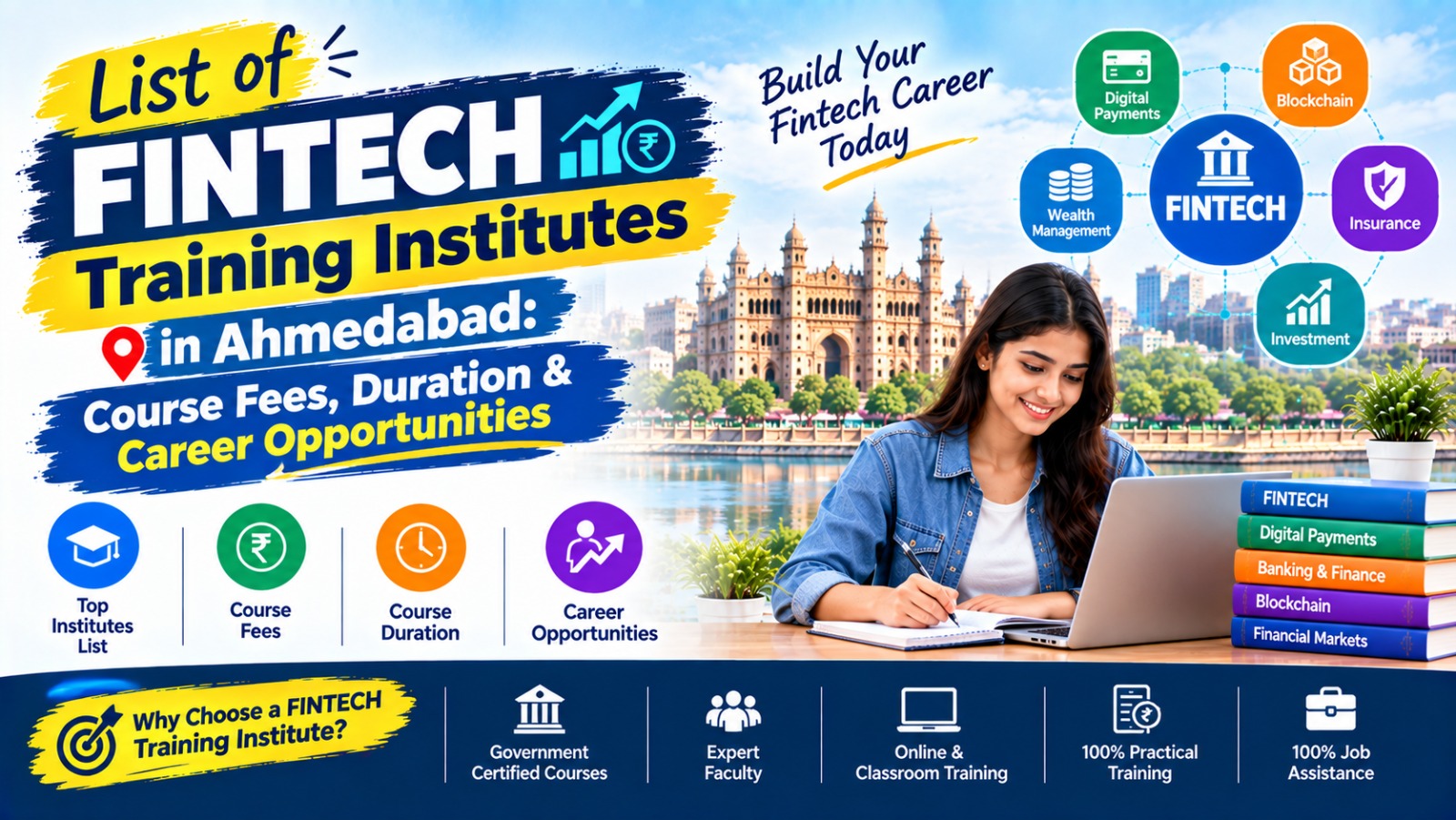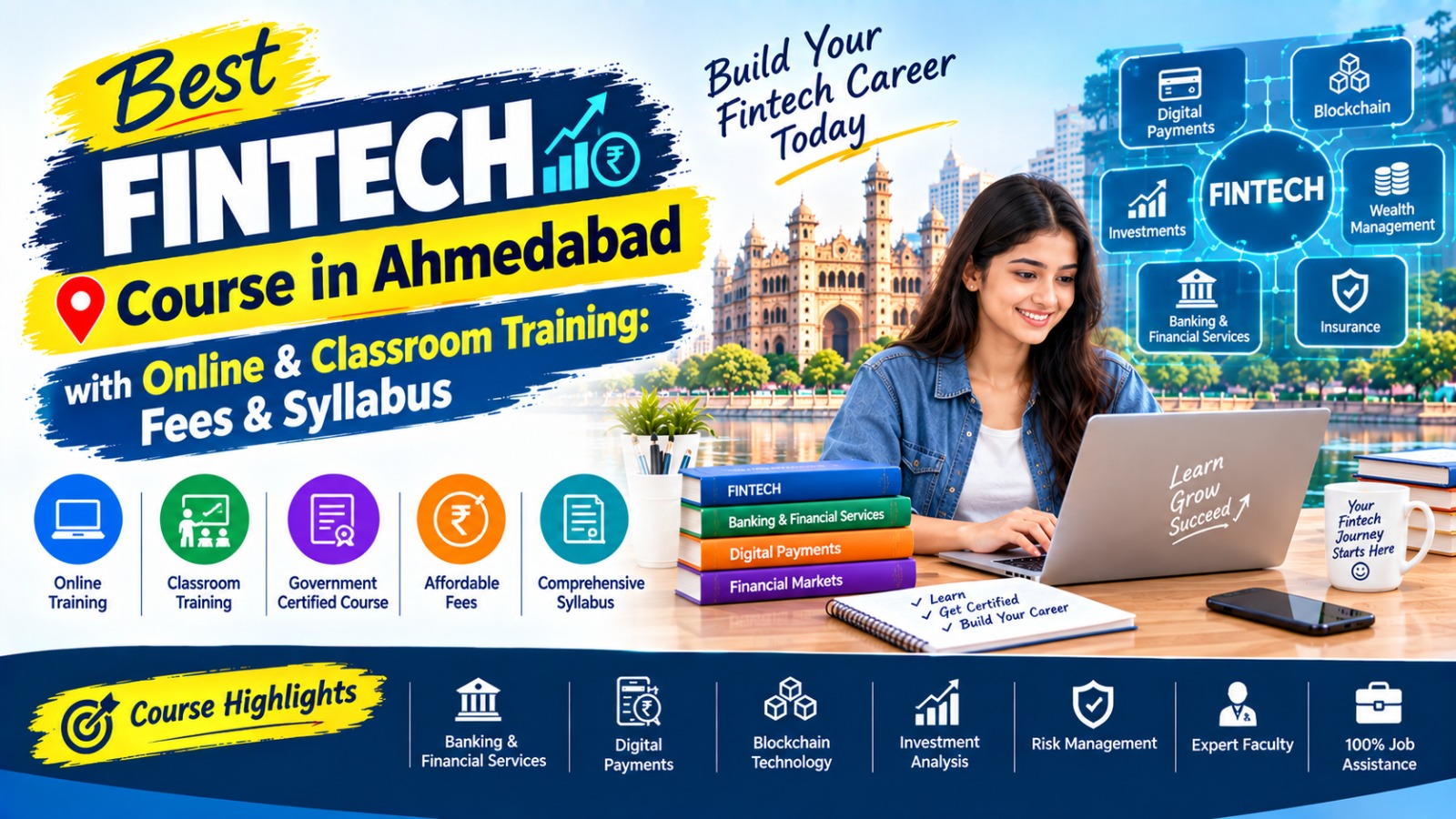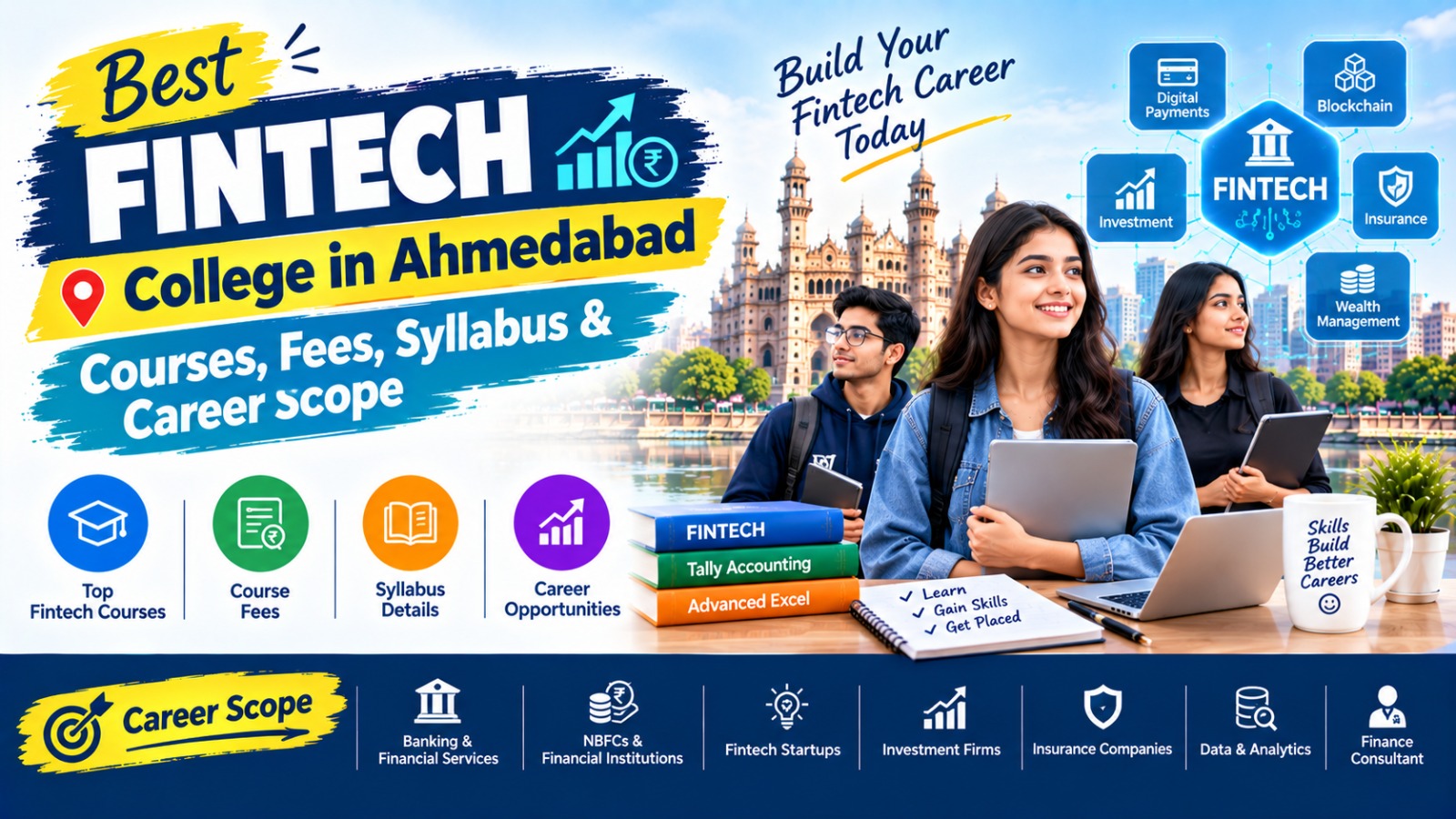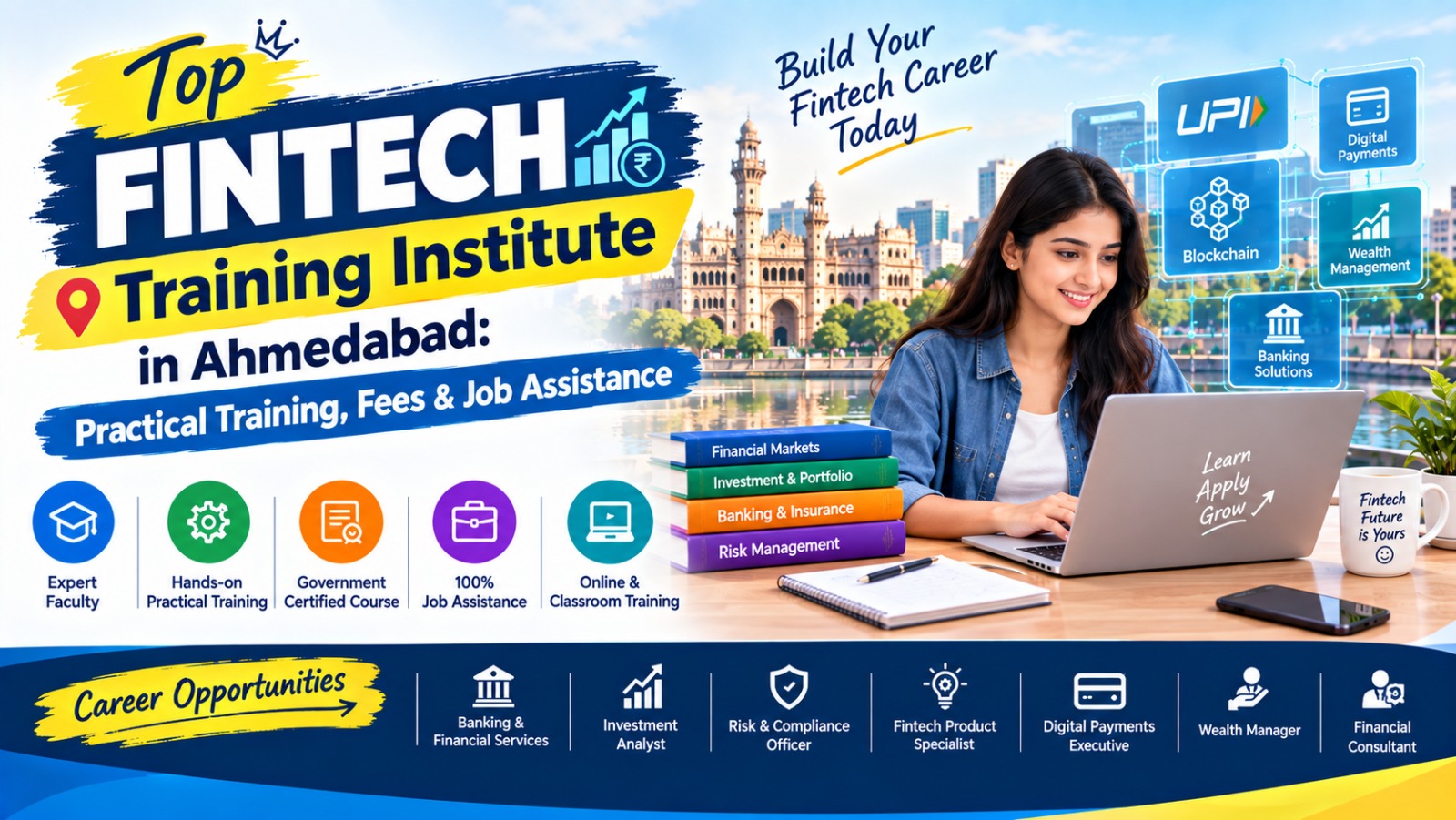
FinTech, or Financial Technology, is transforming the way people and businesses manage money, make payments, access financial services, analyze data, and interact with banks and digital financial platforms. As digital finance continues to expand, learning FinTech can open career opportunities across banking, financial services, digital payments, fintech startups, insurance, investment services, and technology-driven businesses.
For students, graduates, working professionals, entrepreneurs, and individuals looking to build a career in modern finance, enrolling in a professional FinTech course in Ahmedabad can be a practical way to develop industry-relevant knowledge and skills.
A well-structured FinTech program can cover important areas such as digital payments, financial technology, banking technology, blockchain fundamentals, cybersecurity awareness, financial data, digital lending, financial regulations, and emerging technologies.
If you are searching for the best FinTech course in Ahmedabad, this guide explains the course fees, duration, syllabus, eligibility, certification, career opportunities, and important factors to consider before selecting a training institute.
FinTech Course in Ahmedabad – Quick Overview
| Course Feature | Details |
|---|---|
| Course Name | FinTech Course |
| Location | Ahmedabad, Gujarat |
| Suitable For | Students, graduates, working professionals, entrepreneurs & career changers |
| Learning Modes | Classroom and/or Online |
| Typical Duration | Depends on the institute and course level |
| Major Topics | Digital Payments, Banking Technology, Blockchain, Digital Finance, FinTech Applications & more |
| Eligibility | Varies by institute; beginners may also be eligible |
| Certification | Institute or government-recognized certification depending on the program |
| Career Areas | FinTech, Banking, Digital Payments, Financial Services, Data & Technology |
| Learning Objective | Build practical knowledge of technology-driven financial services |
Important: Course duration, fees, certification authority, curriculum, and eligibility can vary between institutes. Students should verify the latest details directly with the training provider before admission.
What Is a FinTech Course?
A FinTech course introduces learners to the technologies and business concepts that are changing traditional financial services.
FinTech combines finance, technology, data, digital platforms, automation, security, and innovation to create faster and more accessible financial products and services.
Examples of FinTech applications include:
- Online and mobile banking
- Digital payments
- Payment gateways
- Digital wallets
- UPI-based transactions
- Online lending
- InsurTech
- WealthTech
- Investment platforms
- Blockchain-based applications
- Financial data analytics
- Fraud detection
- Digital identity and verification
- Automated financial services
A professional course helps learners understand how these systems work and how technology is being applied within modern financial businesses.
Why Choose a FinTech Course in Ahmedabad?
Ahmedabad is one of Gujarat’s major education, business, finance, and entrepreneurship hubs. The city’s growing technology ecosystem has created increasing interest in digital finance and technology-oriented career skills.
A FinTech course in Ahmedabad can be particularly useful for learners who want to combine their interest in finance and technology.
Key benefits include:
1. Learn Modern Financial Technology
Traditional finance is increasingly supported by digital platforms. FinTech education helps learners understand the technology behind modern financial services.
2. Develop Industry-Relevant Skills
A structured curriculum can provide knowledge of digital payments, financial platforms, blockchain, cybersecurity, financial data, and other important FinTech concepts.
3. Suitable for Multiple Backgrounds
FinTech is not restricted to finance graduates. Depending on the course level, programs may be suitable for students, commerce graduates, technology learners, management students, professionals, and entrepreneurs.
4. Expand Career Options
FinTech knowledge can complement careers in banking, accounting, finance, technology, business analysis, digital payments, and financial services.
5. Build Future-Ready Knowledge
Financial services are becoming increasingly digital. Understanding FinTech can help learners adapt to changes in the financial and technology industries.
Who Can Join a FinTech Course?
Eligibility depends on the specific institute and program. However, FinTech training is generally relevant to a broad range of learners.
It may be suitable for:
- 12th-pass students
- College students
- Commerce students
- B.Com students
- BBA students
- MBA students
- Finance graduates
- Banking aspirants
- IT and technology students
- Working professionals
- Entrepreneurs
- Business owners
- Career changers
- Professionals seeking upskilling
Some advanced FinTech programs may have additional educational or technical requirements.
If you are a beginner, look for a course that starts with fundamental concepts before moving into advanced topics.
FinTech Course Fees in Ahmedabad
One of the most common questions students ask is:
“How much does a FinTech course cost in Ahmedabad?”
There is no single fixed fee because training costs depend on the institute, curriculum, duration, learning mode, certification, practical training, faculty, and additional career services.
Factors that influence FinTech course fees include:
- Course duration
- Beginner or advanced curriculum
- Classroom or online learning
- Practical project work
- Certification
- Faculty experience
- Industry exposure
- Study material
- Assessment and examinations
- Placement or career assistance
- Specialized FinTech modules
Instead of selecting a course only because it has a low fee, compare the curriculum, practical learning, certification, trainer expertise, course duration, and career support.
What should be included in the course fee?
Before enrolling, ask the institute whether the fee covers:
- Training sessions
- Learning material
- Practical assignments
- Projects
- Assessments
- Examination charges
- Certification charges
- Doubt-solving sessions
- Career guidance
- Placement assistance, if offered
This helps avoid unexpected costs later.
FinTech Course Duration in Ahmedabad
The duration of a FinTech course depends on its depth and structure.
Short-term introductory programs may focus on fundamental concepts, while comprehensive professional programs can include multiple modules, practical assignments, projects, and assessments.
A course may be structured around:
- Short-term certification
- Skill-development program
- Professional training
- Advanced FinTech program
Which duration is best?
If your objective is simply to understand FinTech, a short introductory program may be sufficient.
If your goal is to develop career-oriented skills, consider a more comprehensive course that provides enough time for:
Concepts → Practical Learning → Projects → Assessment → Certification
The ideal duration is therefore not necessarily the shortest one. The quality and depth of learning matter more than the number of weeks or months.
FinTech Course Syllabus
A good FinTech curriculum should balance financial concepts with technology and practical applications.
The exact syllabus varies by institute, but a comprehensive FinTech course may include the following modules.
1. Introduction to FinTech
Students begin by understanding the fundamentals of Financial Technology.
Topics may include:
- Meaning of FinTech
- Evolution of financial technology
- FinTech ecosystem
- Traditional finance vs digital finance
- FinTech business models
- Major FinTech sectors
- Future of financial services
2. Digital Banking
Digital banking has become an important part of modern financial services.
Students can learn about:
- Digital banking
- Mobile banking
- Internet banking
- Digital customer experience
- Electronic financial services
- Digital onboarding
- Technology-driven banking services
3. Digital Payments
Digital payments are one of the most visible applications of FinTech.
Topics may include:
- Digital payment systems
- UPI concepts
- Payment gateways
- Digital wallets
- QR-based payments
- Payment processing
- Online transactions
- Payment security
- Fraud prevention concepts
4. Blockchain Fundamentals
Blockchain has become an important technology within the wider FinTech ecosystem.
A basic module can introduce:
- Blockchain concepts
- Distributed ledgers
- Blocks and transactions
- Decentralization
- Consensus concepts
- Smart contracts
- Blockchain applications in finance
- Digital assets and their ecosystem
5. Financial Data and Analytics
Data plays a major role in modern financial decision-making.
Learners may explore:
- Financial data fundamentals
- Data-driven decision-making
- Financial reporting
- Data visualization concepts
- Customer data
- Risk analysis
- Fraud detection concepts
- Predictive analytics fundamentals
6. Digital Lending
Technology has changed the way individuals and businesses access credit.
Topics can include:
- Digital lending
- Loan application processes
- Credit assessment
- Digital verification
- Alternative data
- Risk management
- Responsible digital lending
7. Cybersecurity in FinTech
Security is critical because FinTech platforms handle sensitive financial information.
Students may learn about:
- Cybersecurity fundamentals
- Data protection
- Secure transactions
- Identity verification
- Authentication
- Fraud awareness
- Financial cyber risks
- Security best practices
8. FinTech Regulations and Compliance
Understanding regulations is important for anyone planning to work in financial technology.
Depending on the curriculum, learners may be introduced to:
- Financial regulations
- Compliance fundamentals
- KYC concepts
- AML concepts
- Data privacy
- Digital transaction regulations
- Regulatory technology
Because financial regulations can change, learners should study current requirements from authoritative sources as part of their professional development.
9. InsurTech and WealthTech
FinTech extends beyond banking and payments.
The syllabus may introduce:
InsurTech: Technology used to improve insurance products and services.
WealthTech: Technology-driven investment and wealth-management services.
Students can understand how technology is changing these financial sectors.
10. FinTech Business Models
A career-oriented course can also explain how FinTech businesses operate.
Topics may include:
- FinTech startups
- Digital financial products
- Revenue models
- Customer acquisition
- Digital platforms
- Financial innovation
- Business challenges
- FinTech ecosystem
Government Certificate for FinTech Course
Certification is an important consideration when selecting a FinTech training program.
However, students should understand that not every certificate described as a “government certificate” is necessarily issued directly by a government department.
Before admission, verify:
- Who issues the certificate?
- Is the certification government-recognized?
- Is the institute authorized to provide it?
- Is there an examination or assessment?
- Is the certificate verifiable?
- What organization is mentioned on the certificate?
- Does the certification apply to the exact course being offered?
A credible training provider should clearly explain the certificate issuer, recognition, assessment process, and certification terms rather than using the phrase “government certificate” without supporting information.
For students specifically looking for a government-recognized certification, this verification is especially important.
Career Opportunities After a FinTech Course
FinTech combines knowledge from finance, technology, business, and data. As a result, learners can explore several career directions depending on their educational background and additional skills.
Potential career areas include:
FinTech Operations
Professionals may work with digital financial platforms, transaction processes, customer operations, and financial technology services.
Digital Payment Services
Learners can explore opportunities related to payment processing, digital transactions, merchant services, and payment operations.
Banking Technology
FinTech knowledge can complement roles associated with digital banking and technology-enabled financial services.
Financial Data
Individuals with additional analytical skills can explore financial data, reporting, business intelligence, and analytics-related positions.
Risk and Compliance
FinTech professionals can develop careers around financial risk, compliance, fraud prevention, KYC, and regulatory processes.
FinTech Startups
Entrepreneurs and professionals can also explore opportunities within technology-driven financial startups.
FinTech Job Roles
Depending on your educational qualifications and additional skills, possible roles include:
- FinTech Executive
- FinTech Analyst
- Digital Banking Executive
- Digital Payments Executive
- Financial Technology Associate
- Business Analyst
- Financial Data Analyst
- Risk Analyst
- Compliance Executive
- KYC/AML Executive
- Payment Operations Executive
- FinTech Product Associate
- Financial Services Technology Associate
Advanced positions may require additional qualifications and industry experience.
Skills You Should Develop Along With FinTech
Completing a course is only one part of becoming career-ready.
Students should also develop:
- Financial fundamentals
- Digital payment knowledge
- Analytical thinking
- Business communication
- Problem-solving
- Data interpretation
- Risk awareness
- Regulatory awareness
- Presentation skills
- Professional communication
- Basic technology understanding
For technology-focused roles, additional knowledge of data analytics, programming, databases, or cybersecurity can be beneficial.
How to Choose the Best FINTECH Training Institute in Ahmedabad
Searching online for a FINTECH Training Institute in Ahmedabad can produce many options. Instead of choosing the first institute you find, compare the following factors.
1. Course Curriculum
Check whether the syllabus covers current FinTech concepts rather than only theoretical finance.
2. Trainer Experience
Experienced trainers can make complex financial and technology concepts easier to understand through practical examples.
3. Practical Learning
Ask whether the course includes case studies, assignments, simulations, projects, or real-world examples.
4. Certification
Confirm the exact certification authority and whether the certificate is genuinely recognized.
5. Classroom and Online Options
If you are a working professional, online or flexible learning may be convenient. Students who prefer face-to-face interaction may benefit from classroom training.
6. Course Duration
Choose a duration that provides enough time to understand the concepts rather than selecting solely based on speed.
7. Career Support
If employment is your goal, ask whether the institute provides career guidance, interview preparation, resume support, or placement assistance.
8. Reviews and Reputation
Check independent reviews and learner experiences, while also considering the quality of the curriculum and training rather than relying only on ratings.
Online vs Classroom FinTech Course
Both learning formats have advantages.
| Factor | Online FinTech Course | Classroom FinTech Course |
|---|---|---|
| Flexibility | High | Moderate |
| Location | Learn from anywhere | Attend institute |
| Interaction | Online | Face-to-face |
| Schedule | Often flexible | Usually fixed |
| Doubt Solving | Online sessions/support | Direct classroom interaction |
| Networking | Virtual | In-person |
| Suitable For | Working professionals & remote learners | Students & learners preferring classroom learning |
Which option should you choose?
Choose online learning if flexibility and convenience are your priorities.
Choose classroom training if you prefer direct trainer interaction, structured learning, and a physical classroom environment.
The quality of the trainer and curriculum is ultimately more important than the delivery mode alone.
Is FinTech a Good Career Option?
Yes, FinTech can be a promising career area for individuals interested in the combination of finance, technology, data, and digital business.
The financial services industry is becoming increasingly dependent on digital systems. Organizations need professionals who understand both financial processes and technology-enabled services.
However, completing a FinTech course does not automatically guarantee employment. Career growth depends on:
- Educational background
- Practical skills
- Certification
- Projects
- Communication
- Industry knowledge
- Additional technical skills
- Work experience
- Interview performance
A good course should therefore be treated as a foundation for continuous professional development.
Who Should Learn FinTech?
A FinTech course can be useful for:
Students
Students can use FinTech training to gain exposure to an emerging career area before entering the job market.
Commerce Graduates
Commerce and finance students can add technology-oriented skills to their existing financial knowledge.
Working Professionals
Professionals can use FinTech training to upgrade their skills and understand digital transformation within financial services.
Entrepreneurs
Business owners can learn how digital payments, financial platforms, data, and technology are changing customer experiences.
Career Changers
People moving from traditional finance or business roles toward technology-oriented financial services can use FinTech education as a starting point.
Frequently Asked Questions About FinTech Course in Ahmedabad
What is the best FinTech course in Ahmedabad?
The best FinTech course depends on your career goal, curriculum, practical training, certification, duration, fees, faculty, and learning format. Compare these factors before selecting an institute.
What are the fees for a FinTech course in Ahmedabad?
FinTech course fees vary according to the institute, duration, syllabus, certification, learning mode, and practical components. Contact the institute for the current fee structure.
How long does a FinTech course take?
The duration varies depending on whether the program is an introductory, certification, professional, or advanced course. Check the specific curriculum and number of training hours before enrolling.
Who is eligible for a FinTech course?
Eligibility varies by program. Many introductory courses can be suitable for students, graduates, working professionals, entrepreneurs, and career changers.
Does a FinTech course provide a government certificate?
Some programs may offer government-recognized or government-affiliated certification, while others provide institute-issued certificates. Always verify the certificate issuer and recognition before admission.
Can commerce students learn FinTech?
Yes. Commerce students can benefit from FinTech because they already have exposure to areas such as accounting, economics, business, and finance. Technology concepts can then be added through structured training.
Is FinTech useful for working professionals?
Yes. Working professionals can use FinTech training to understand digital banking, payments, financial technology, data, compliance, and emerging financial services.
Can FinTech help me get a job?
FinTech training can improve your knowledge and skill profile, but employment depends on your qualifications, practical skills, experience, communication, and the requirements of individual employers.
Is classroom or online FinTech training better?
Neither format is universally better. Classroom training may suit learners who prefer direct interaction, while online training can be more convenient for professionals and learners who need flexibility.
Why Start a FinTech Career in Ahmedabad?
Ahmedabad provides an active environment for students, professionals, entrepreneurs, and businesses interested in finance and technology.
Learning FinTech locally can provide access to structured training while helping learners understand how digital finance is influencing businesses and consumers.
For students and professionals searching for FinTech classes in Ahmedabad, the right course should provide a combination of:
Financial Knowledge + Technology Concepts + Practical Learning + Certification + Career Guidance
That combination can provide a stronger foundation than theoretical learning alone.
Final Thoughts
Choosing the best FinTech course in Ahmedabad requires more than comparing course fees. Students should evaluate the complete learning experience, including syllabus, duration, eligibility, practical training, faculty, certification, learning mode, and career support.
A comprehensive FinTech course can introduce learners to digital payments, banking technology, blockchain, financial data, digital lending, cybersecurity, compliance, InsurTech, WealthTech, and other emerging areas.
If you are planning a career in modern financial services, start by identifying your goal—whether it is getting your first job, upgrading your existing finance career, moving into technology-driven roles, or understanding the FinTech ecosystem.
Most importantly, verify the latest fees, duration, eligibility, syllabus, certification authority, and career-support details directly with the institute before enrolling.
The right FinTech training can help you build the knowledge needed to participate in the rapidly evolving world of digital finance.