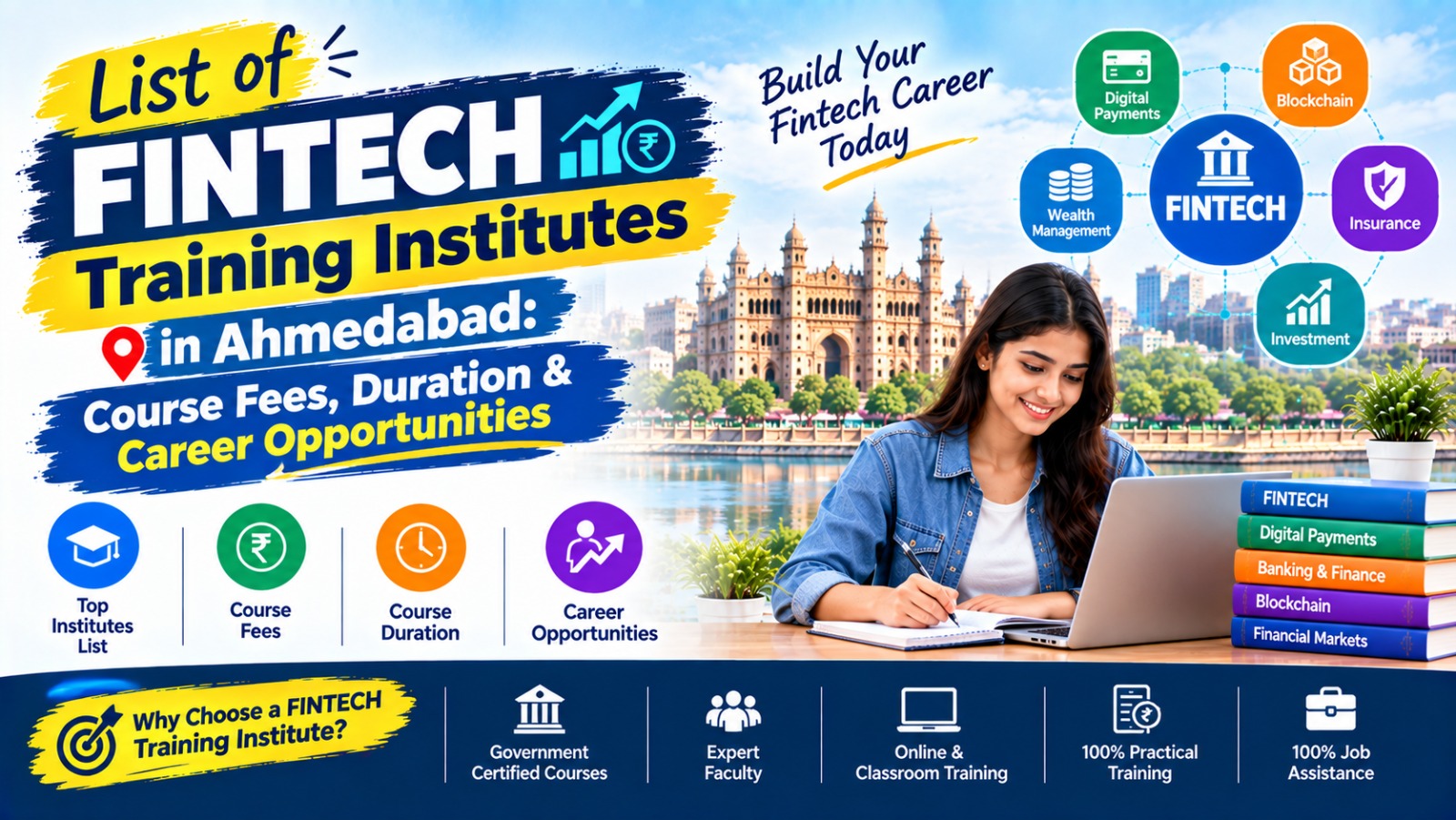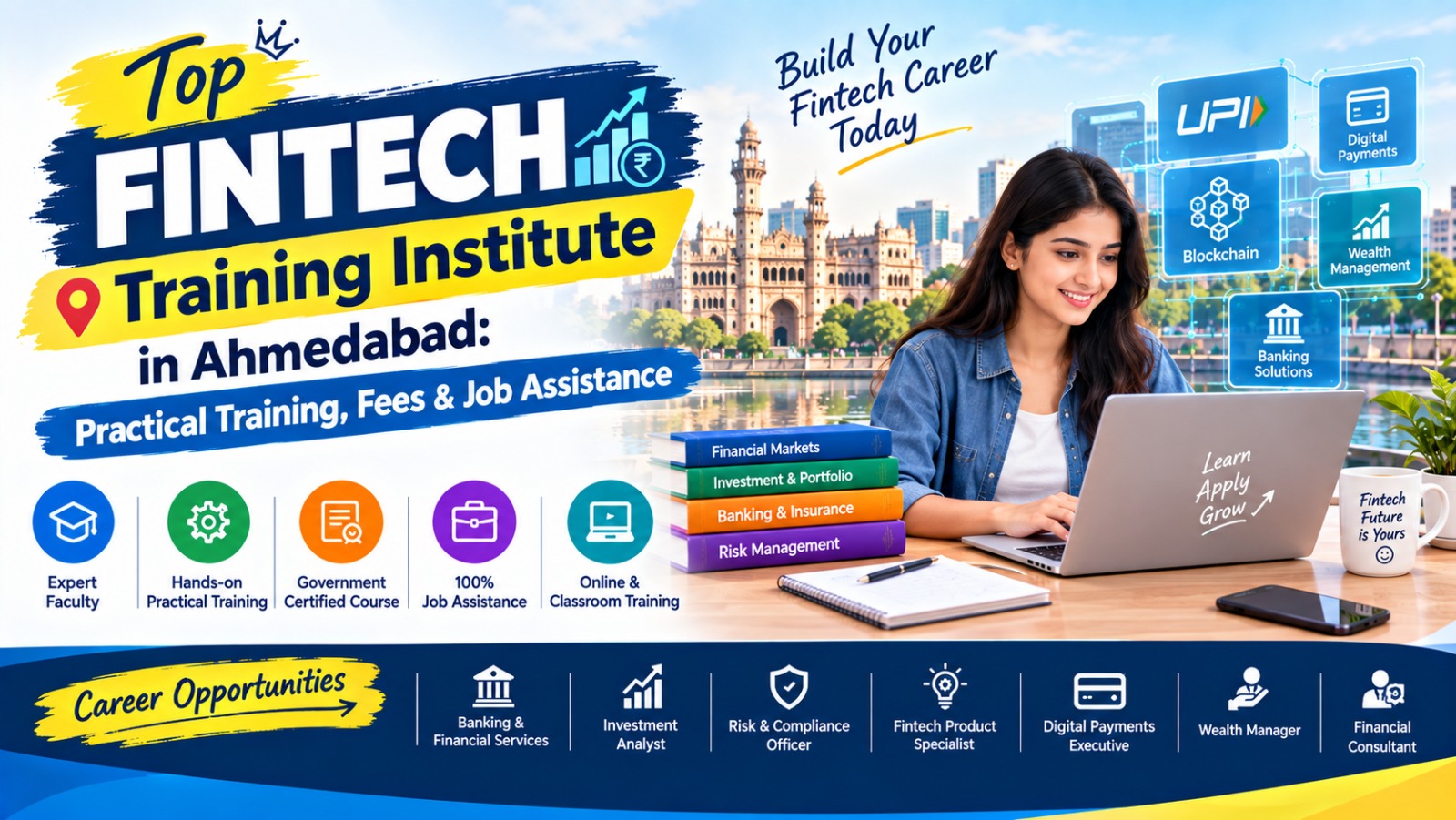
Financial technology, commonly called FinTech, has changed the way financial services are delivered and managed. Digital payments, online banking, financial analytics, digital lending, investment platforms and automated financial services are becoming increasingly connected with technology.
This has created interest among students, graduates and working professionals who want to develop skills related to both finance and technology.
For learners searching for the best FINTECH institute in Ahmedabad, selecting a course involves more than comparing names and fees. The syllabus, practical training, faculty, course duration, certification, learning mode and career support should all be considered.
This complete guide explains what to look for in a FinTech institute in Ahmedabad and how students and working professionals can choose a programme that matches their learning requirements.
What Is FINTECH?
FINTECH stands for Financial Technology. It refers to the use of technology to create, improve or deliver financial products and services.
FinTech is used in areas such as:
- Digital banking
- Online payments
- Mobile banking
- Digital wallets
- Financial analytics
- Online investment platforms
- Digital lending
- Insurance technology
- Blockchain-based applications
- Artificial intelligence in finance
- Fraud detection
- Financial automation
A FinTech course brings together concepts from finance, business, technology and data.
Why Study FINTECH in Ahmedabad?
Ahmedabad is a major commercial and educational centre in Gujarat. Students and professionals can find learning opportunities across finance, accounting, banking, technology and business-related fields.
Choosing a FinTech institute in Ahmedabad can be useful for learners who want to study in a structured environment while developing knowledge of modern financial technologies.
A well-designed programme can provide:
- Finance fundamentals
- Technology-oriented learning
- Practical assignments
- Case studies
- Project work
- Certification
- Career guidance
- Interview preparation
For local learners, classroom or hybrid programmes can also provide opportunities for direct interaction with trainers and other students.
Who Should Join a FINTECH Course?
FinTech is not limited to students with a technical background. The subject can be explored by learners from different academic and professional fields.
1. Commerce Students
Students pursuing B.Com or other commerce-related programmes can add technology skills to their knowledge of accounting, finance and business.
2. Finance Graduates
Finance graduates can learn how technology is being applied to banking, financial analysis and other financial services.
3. Banking Aspirants
Learners interested in banking can explore topics such as digital banking, payment systems and technology-driven financial services.
4. IT Students
Computer and IT students can understand how their technical knowledge can be applied to financial services.
5. MBA Students
Students from business and management backgrounds can explore FinTech from a business, operations and digital-transformation perspective.
6. Working Professionals
Professionals already working in finance, accounting, banking, business or technology can use FinTech training to develop additional knowledge.
FINTECH Course for Students
Students often have more flexibility to explore a broader curriculum.
A student-focused FinTech programme may include:
- FinTech fundamentals
- Digital banking
- Digital payments
- Financial markets
- Financial data analysis
- Blockchain basics
- AI in finance
- Risk management
- Cybersecurity fundamentals
- FinTech projects
Practical assignments can help students connect classroom concepts with real-world financial technology applications.
FINTECH Course for Working Professionals
Working professionals generally have different learning requirements. They may prefer programmes that fit around their existing work schedules.
Depending on the institute, options may include:
- Evening classes
- Weekend classes
- Online learning
- Hybrid learning
- Short-term certification
- Flexible learning schedules
Professionals can focus on areas that complement their existing roles, such as:
- Digital finance
- Financial analytics
- Business analysis
- Digital banking
- Payment technology
- Risk management
- FinTech operations
Before enrolling, working professionals should check the class schedule, attendance requirements and course duration.
FINTECH Course Syllabus
The syllabus varies between institutes, but a comprehensive FinTech programme may cover the following areas.
Module 1: Introduction to FinTech
Students learn the meaning, evolution and importance of financial technology.
Topics may include:
- FinTech overview
- Evolution of financial technology
- FinTech ecosystem
- Traditional finance vs digital finance
- FinTech business models
Module 2: Digital Banking
This module introduces technology-enabled banking services.
Topics may include:
- Internet banking
- Mobile banking
- Digital customer services
- Digital account services
- Banking technology
Module 3: Digital Payments
Students learn about modern payment systems.
Topics can include:
- Electronic payments
- Payment gateways
- Digital wallets
- UPI and digital payment systems
- Transaction security
Module 4: Financial Data Analytics
Data is an important part of modern financial decision-making.
Students may learn:
- Financial data fundamentals
- Data interpretation
- Financial reports
- Data analysis
- Business analytics
- Data-driven decisions
Module 5: Blockchain
Blockchain fundamentals can help students understand one of the technologies associated with modern financial applications.
Topics may include:
- Blockchain concepts
- Distributed ledger technology
- Smart contracts
- Financial use cases
- Benefits and limitations
Module 6: Artificial Intelligence in Finance
AI is increasingly used in different financial applications.
Students may explore:
- Automation
- Fraud detection
- Financial forecasting
- Customer service
- Risk analysis
- AI-supported financial processes
Module 7: Risk Management and Compliance
Learners may be introduced to:
- Financial risk
- Operational risk
- Fraud risk
- KYC concepts
- Compliance fundamentals
- Data protection
Module 8: Practical Projects
A practical module can include:
- Case studies
- Assignments
- Financial analysis exercises
- FinTech research
- Project presentations
- Business scenarios
FINTECH Course Duration in Ahmedabad
The duration of FinTech training depends on the programme.
| Programme Type | Typical Duration |
|---|---|
| Foundation Course | 1–3 months |
| Certificate Course | 3–6 months |
| Advanced Programme | 6–12 months |
| Professional/Academic Programme | Varies |
Short-term courses may focus on fundamental concepts, while advanced programmes may cover more specialised areas.
Students and professionals should choose the duration based on their existing knowledge, career goals and available time.
FINTECH Course Fees in Ahmedabad
There is no single fixed fee for every FinTech course in Ahmedabad.
Fees can depend on:
- Course duration
- Syllabus
- Faculty
- Practical training
- Project work
- Certification
- Online or classroom mode
- Advanced modules
- Career support
Indicative Fee Range
| Course Type | Approximate Fee Range |
|---|---|
| Foundation/Short-Term | ₹10,000–₹25,000 |
| Certificate Programme | ₹20,000–₹50,000 |
| Advanced FinTech Programme | ₹40,000–₹1,00,000+ |
These figures are indicative only. Actual fees vary by institute and programme.
Before joining, ask whether the fee includes:
- Study material
- Practical sessions
- Projects
- Assessments
- Certification
- Career guidance
- Interview preparation
Practical Training in FINTECH
Practical learning can make it easier to understand how FinTech concepts are applied outside the classroom.
A practical FinTech programme may include:
Case Studies
Students analyse financial technology scenarios and business problems.
Financial Data Exercises
Learners work with financial information to understand basic analysis and interpretation.
Digital Payment Examples
Students explore how modern payment systems operate.
FinTech Projects
Learners can develop projects based on digital banking, payment systems, financial analytics or other FinTech topics.
Presentations
Presenting projects can help students improve communication and explain technology-related financial concepts.
How to Choose the Best FINTECH Institute in Ahmedabad?
The phrase “best FinTech institute” can mean different things for different learners. Instead of relying on a single factor, compare the institute across several areas.
1. Check the Syllabus
The curriculum should cover relevant financial and technology concepts.
2. Look for Practical Learning
Ask whether students complete projects, assignments and case studies.
3. Compare Course Fees
Understand exactly what is included in the total fee.
4. Check Faculty Experience
Review the trainers’ academic and professional background where available.
5. Consider Certification
Check the issuing institute and certification requirements.
6. Look at Learning Options
Students may prefer classroom training, while working professionals may prefer evening, weekend or online classes.
7. Ask About Career Support
Career services may include resume preparation, mock interviews, job-search guidance and employer connections.
8. Consider Location
For classroom learning, accessibility from areas such as CG Road, Satellite, Navrangpura, Thaltej, Bopal and Prahlad Nagar can be an important consideration.
Career Opportunities After FINTECH Training
FinTech combines financial knowledge with technology and business processes. Depending on qualifications and experience, learners may explore roles such as:
FinTech Analyst
Works with FinTech products, processes, data or business requirements.
Financial Data Analyst
Analyses financial information and supports data-based decision-making.
Digital Banking Executive
Works with digital banking services and related operational processes.
Payments Executive
Supports digital payment operations and transaction-related activities.
Business Analyst
Helps identify business requirements and connect them with technology solutions.
Risk Analyst
Supports the identification and analysis of financial or operational risks.
Compliance Executive
Works with documentation, processes and compliance-related activities.
FinTech Operations Executive
Supports the operational side of technology-enabled financial services.
Job requirements vary according to the employer, position and candidate’s qualifications.
FINTECH Skills for Students and Professionals
A FinTech programme can help develop a combination of technical and professional knowledge.
Finance Skills
- Banking fundamentals
- Financial services
- Financial markets
- Risk concepts
- Digital finance
Technology Skills
- Digital payments
- Digital banking
- Blockchain fundamentals
- AI applications
- Financial technology concepts
Analytical Skills
- Data interpretation
- Financial analysis
- Problem-solving
- Business analysis
- Decision-making
Professional Skills
- Communication
- Presentation
- Research
- Project management
- Business understanding
Certification and Job Assistance
A certificate can provide evidence that a learner has completed a particular training programme. However, certification is only one part of career development.
When comparing institutes, students should also look at:
- Practical projects
- Assessments
- Industry-oriented curriculum
- Portfolio development
- Interview preparation
- Resume support
- Career counselling
Job assistance should not automatically be interpreted as guaranteed placement. It may refer to services such as interview opportunities, job-search guidance, resume support or employer connections.
Online vs Classroom FINTECH Training
| Online Training | Classroom Training |
|---|---|
| Flexible learning | Direct interaction with trainers |
| Suitable for busy schedules | Structured classroom environment |
| Can learn from different locations | Face-to-face discussions |
| Useful for working professionals | Useful for students seeking regular classes |
| May require stronger self-discipline | Fixed schedule may provide structure |
A hybrid option can combine elements of both learning methods where available.
FINTECH Training for Career Growth
FinTech knowledge can be useful across several areas of modern financial services.
For example, a finance professional who understands digital payment systems and data analysis may have a broader understanding of technology-driven financial operations.
Similarly, an IT graduate who understands banking and financial processes can better understand the business context in which financial technology is used.
This makes FinTech a multidisciplinary field involving:
Finance + Technology + Data + Business
Future Scope of FINTECH
The financial sector is becoming increasingly digital. Technology is being applied to areas such as:
- Digital payments
- Mobile banking
- Online investment
- Financial analytics
- Digital lending
- Fraud detection
- Risk management
- Financial automation
- Customer service
For learners interested in the intersection of finance and technology, FinTech can provide a way to understand these developments and build relevant knowledge.
Frequently Asked Questions
1. Which FINTECH institute is best for students in Ahmedabad?
The suitable institute depends on the student’s requirements. Compare syllabus, practical training, faculty, fees, certification, duration and career support before selecting a programme.
2. Can working professionals join a FinTech course?
Yes. Working professionals can look for evening, weekend, online or hybrid programmes that fit their schedules.
3. What is the duration of a FinTech course in Ahmedabad?
Course duration varies by programme and can range from a few weeks to several months or longer.
4. How much does a FinTech course cost in Ahmedabad?
Fees depend on the institute, course duration, syllabus, practical training and certification. Short-term programmes generally cost less than advanced programmes.
5. Is FinTech suitable for B.Com students?
Yes. B.Com students can use FinTech training to complement their existing knowledge of commerce, accounting and finance with technology-oriented skills.
6. Can students from non-technical backgrounds learn FinTech?
Yes. Beginners can choose foundation-level programmes that introduce technology concepts alongside financial fundamentals.
7. What practical skills are taught in FinTech courses?
Depending on the programme, practical learning may include financial data exercises, case studies, digital payment examples, research assignments and FinTech projects.
8. Does FinTech training provide job assistance?
Some institutes offer career support such as resume preparation, interview training, job-search guidance and employer connections. The exact services vary by institute.
9. Does a FinTech course guarantee a job?
No. Job assistance and job placement are different. Employment depends on factors such as qualifications, skills, experience, interview performance and employer requirements.
10. What career options are available after FinTech training?
Possible career areas include FinTech analysis, financial data analysis, digital banking, payments, business analysis, risk management, compliance and FinTech operations.
11. Is online FinTech training suitable for working professionals?
It can be suitable for professionals who need flexible learning. However, learners should check the course structure, live sessions, practical activities and trainer support.
12. What should I check before joining a FinTech institute?
Check the syllabus, course duration, fees, practical training, faculty, certification, learning mode, project work and career support before enrolling.
Conclusion
Finding the best FINTECH institute in Ahmedabad for students and working professionals starts with understanding your own learning requirements. Students may prefer comprehensive programmes with projects and structured classroom training, while working professionals may look for flexible schedules, online learning or weekend classes.
Regardless of the learner profile, important factors include course syllabus, practical training, faculty, duration, fees, certification and career support.
FinTech brings together finance, technology, data and business, making it a multidisciplinary field for learners who want to understand modern financial services. By comparing institutes carefully and choosing a programme that matches your educational background and career objectives, you can build a stronger foundation in financial technology.