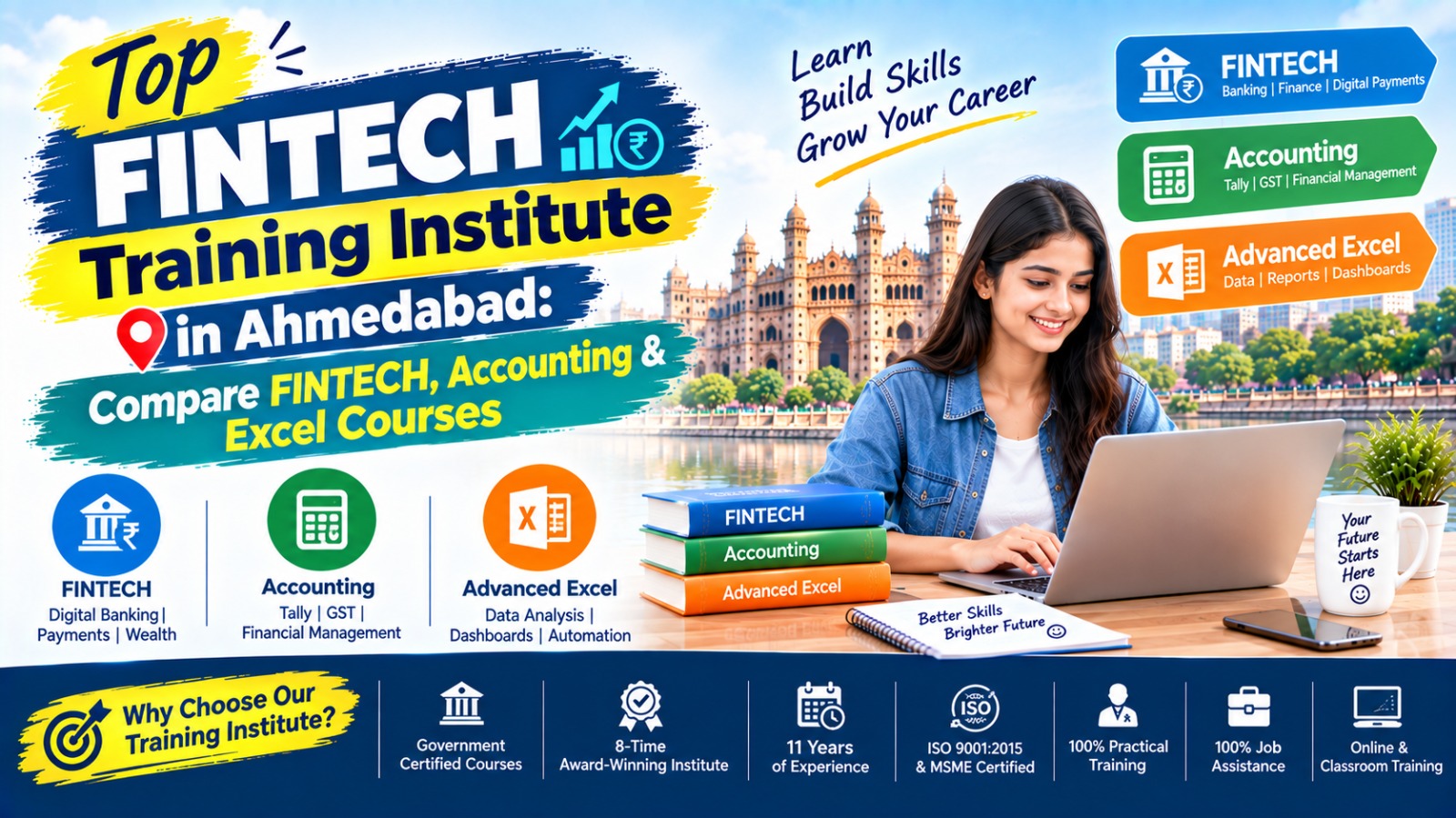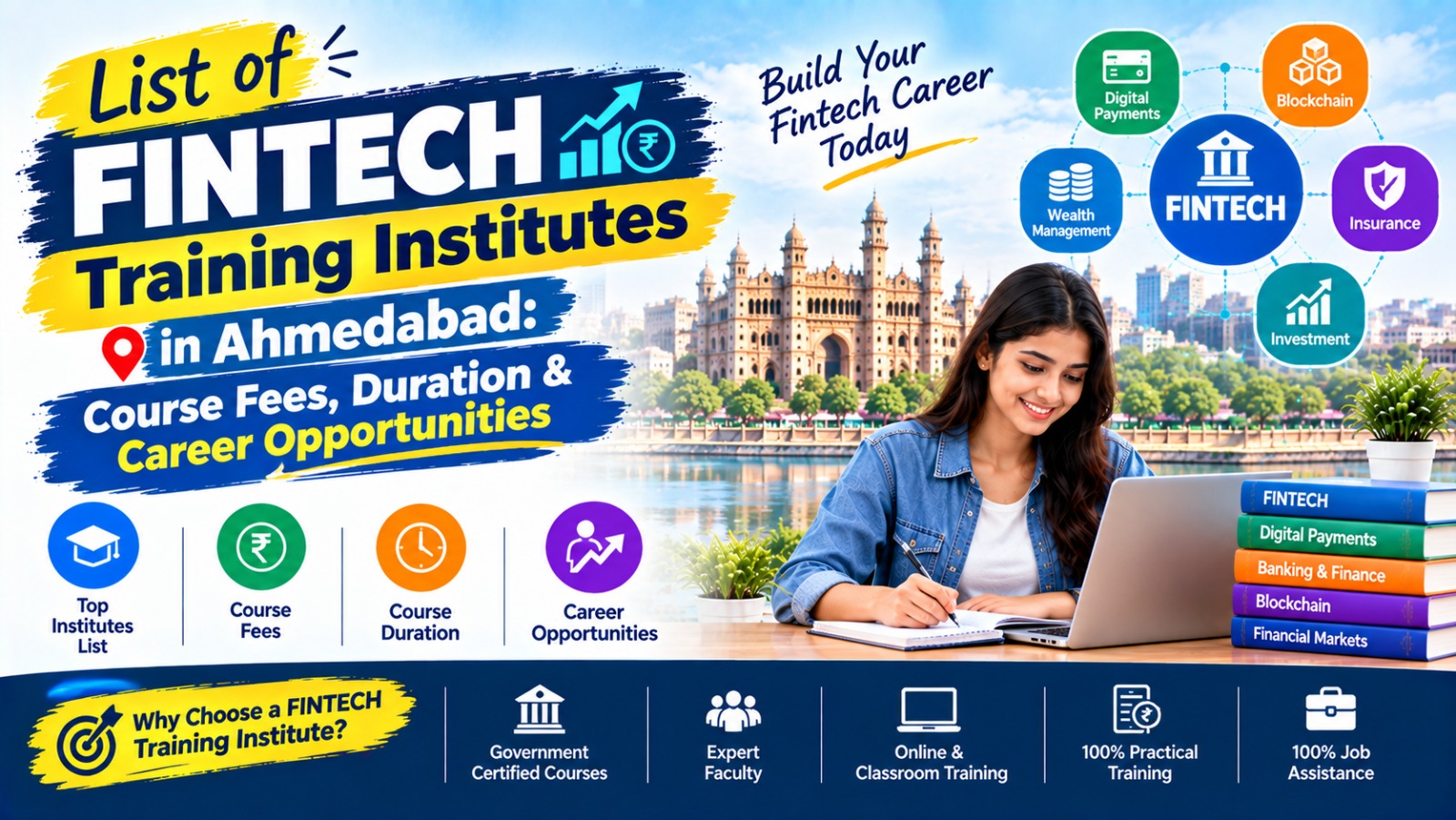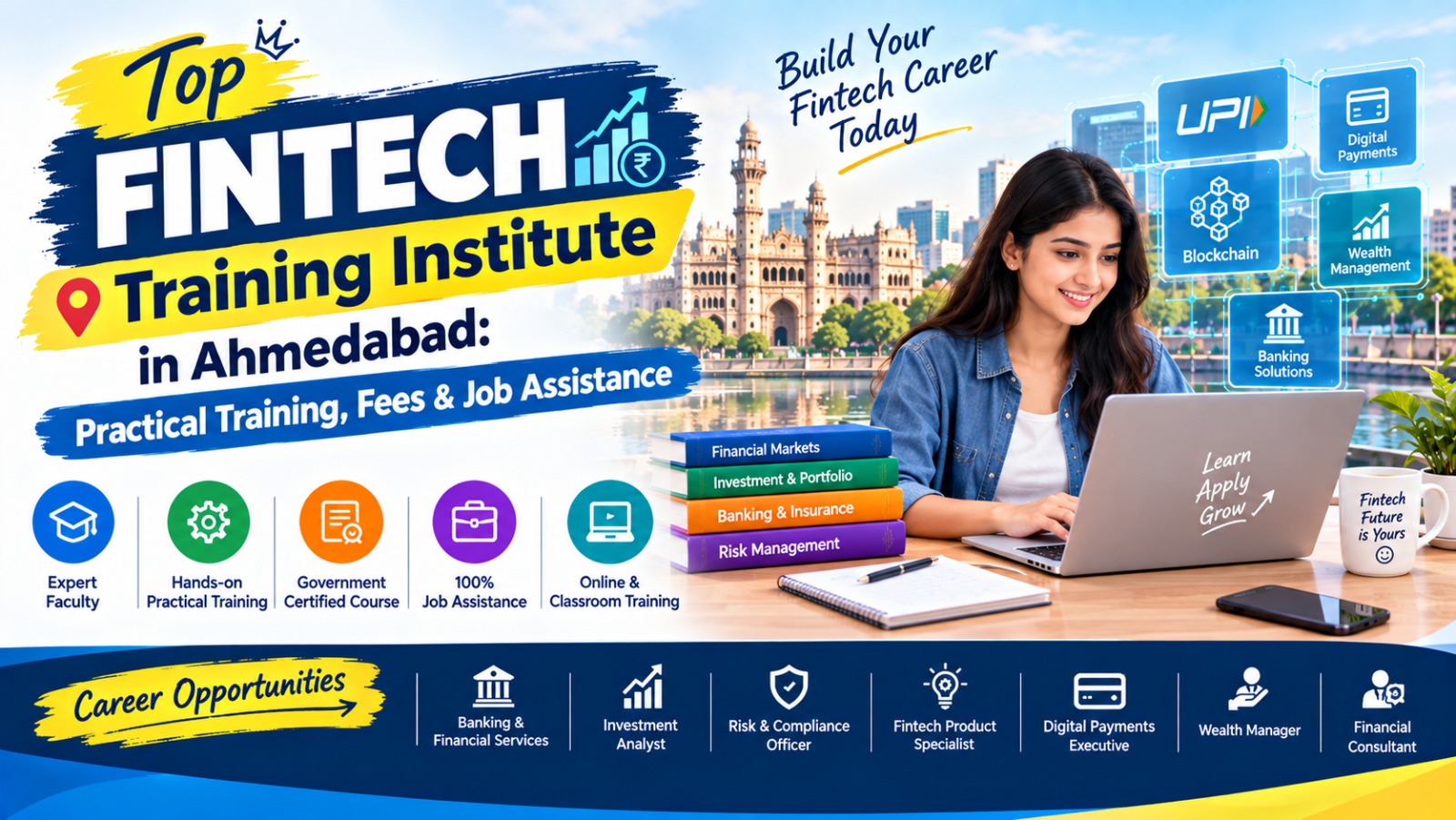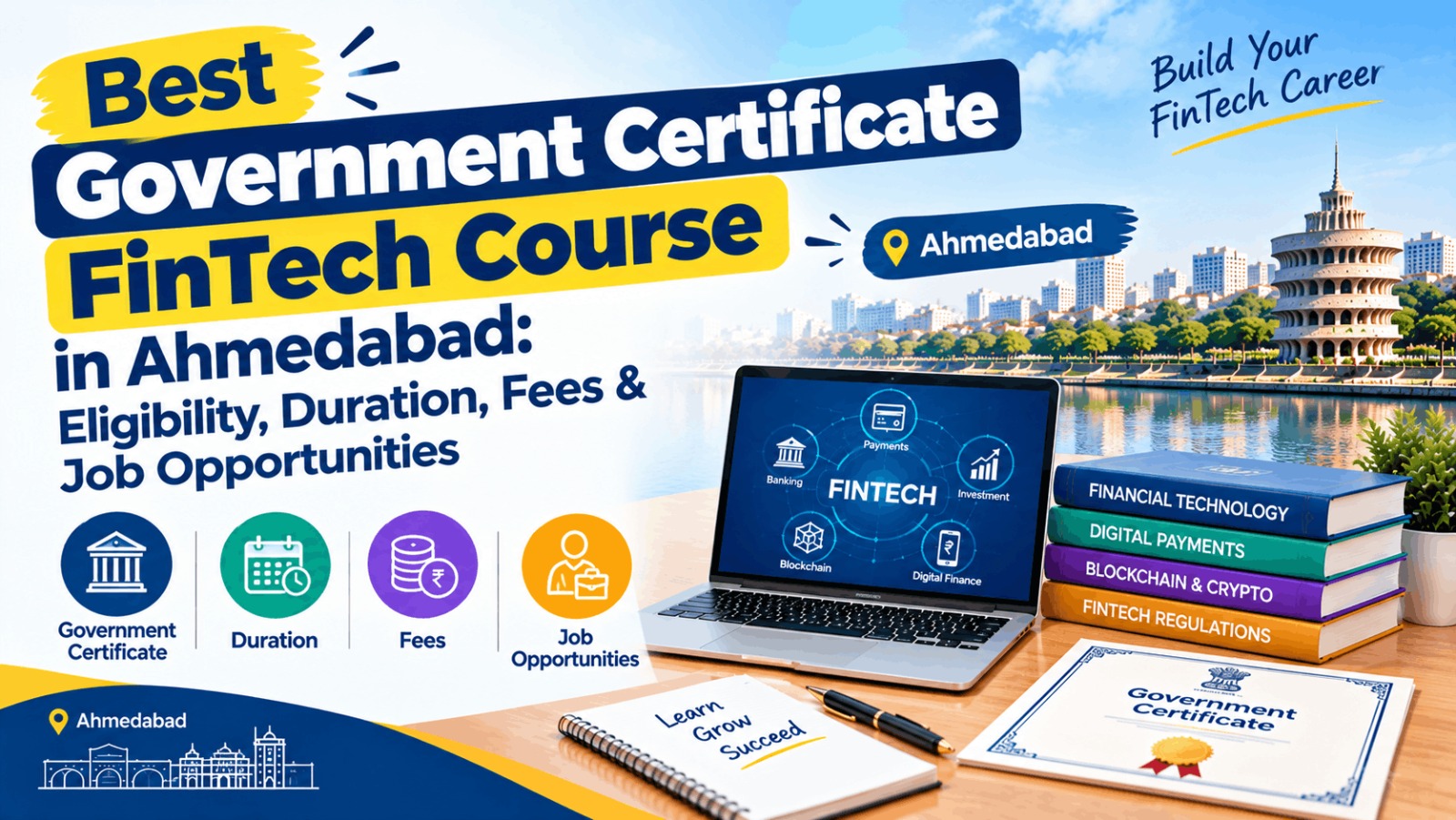
The financial services industry is rapidly becoming technology-driven. Digital payments, online banking, artificial intelligence, blockchain, financial data analytics, automation and digital investment platforms are changing how individuals and businesses manage money.
This transformation has created demand for professionals who understand both finance and technology.
If you are searching for the best FinTech course in Ahmedabad in 2026, this guide will help you understand everything you need to know before enrolling, including course fees, syllabus, eligibility, certification, practical training, career opportunities, job roles and placement assistance.
Whether you are a 12th-pass student, B.Com graduate, finance professional, accountant, banking professional, IT professional or working professional, FinTech can be an interesting career-oriented skill to add to your profile.
What Is FinTech?
FinTech, short for Financial Technology, refers to the use of technology to develop, improve and automate financial products and services.
FinTech combines several areas, including:
- Finance
- Banking
- Technology
- Data Analytics
- Artificial Intelligence
- Blockchain
- Digital Payments
- Cybersecurity
- Automation
- Digital Marketing
Simple Definition of FinTech
FinTech is the use of technology to make financial services faster, smarter, more accessible and more efficient.
Examples include:
- UPI payments
- Mobile banking
- Online loan applications
- Digital investment platforms
- Payment gateways
- Online insurance
- Robo-advisory
- AI-powered financial services
Why Learn FinTech in 2026?
Finance is no longer limited to traditional accounting and banking operations.
Financial organisations increasingly use technology for:
- Digital payments
- Customer verification
- Fraud detection
- Credit assessment
- Financial reporting
- Investment analysis
- Risk management
- Customer support
- Data-driven decision-making
This means professionals who understand finance + technology + data can build a broader career profile.
A modern finance professional can combine FinTech with skills such as:
Tally Prime + Advanced Excel + Power BI + Python + FinTech
This combination can be particularly useful for students and professionals interested in accounting, finance, analytics and digital financial services.
Why Choose a FinTech Course in Ahmedabad?
Ahmedabad is a major educational, commercial and business centre in Gujarat.
The city has opportunities across:
- Banking
- Finance
- Accounting
- IT
- Business Services
- Startups
- Investment Services
- Digital Payments
- Financial Technology
The development of GIFT City in Gujarat has also strengthened the state’s financial-services ecosystem and increased interest in careers related to international finance, banking and financial technology.
For students searching for FinTech courses in Ahmedabad, this creates an opportunity to learn skills relevant to both traditional financial services and emerging digital finance.
Who Can Join a FinTech Course?
One of the advantages of FinTech is that it can be approached from different educational backgrounds.
1. 12th-Pass Students
Students can begin with basic finance, technology and digital financial concepts.
2. Commerce Students
Commerce students can combine accounting knowledge with FinTech and data analytics.
3. B.Com Graduates
B.Com graduates can expand their career options by learning:
- FinTech
- Advanced Excel
- Power BI
- Python
- Data Analytics
- Digital Banking
4. BBA & MBA Students
Management students can learn about FinTech business models, financial products and digital transformation.
5. Accountants
Accountants can move beyond traditional accounting by learning digital finance, analytics and automation.
6. Banking Professionals
Banking employees can develop knowledge of digital banking, payments, compliance and financial technology.
7. IT Professionals
IT professionals can add financial-domain knowledge to their technical skills.
8. Working Professionals
Online and weekend FinTech courses can be suitable for professionals who want to upgrade their skills while continuing their current employment.
FinTech Course Eligibility
Eligibility depends on the institute and course level.
For many certificate or professional FinTech programs, learners may be eligible after 12th standard or graduation.
A background in the following areas can be helpful but is not always mandatory:
- Commerce
- Accounting
- Finance
- Economics
- Business
- Mathematics
- Computer Applications
- Information Technology
Beginners should look for courses that start with fundamental concepts before moving into advanced technologies.
Best FinTech Course Syllabus in 2026
A career-focused FinTech course should combine financial concepts, technology, analytics and practical applications.
A comprehensive syllabus can include the following modules.
Module 1: Introduction to FinTech
Students learn:
- What is FinTech?
- History and evolution of FinTech
- FinTech ecosystem
- Traditional finance vs FinTech
- FinTech business models
- Role of technology in financial services
Module 2: Digital Banking
Topics may include:
- Digital Banking
- Internet Banking
- Mobile Banking
- Neo Banking
- Core Banking
- Digital Customer Experience
- Banking Automation
Module 3: Digital Payments
Students learn the fundamentals of:
- UPI
- NEFT
- RTGS
- IMPS
- Payment Gateways
- QR Payments
- Digital Wallets
- Payment Processing
Module 4: Blockchain & Cryptocurrency Fundamentals
This module can introduce:
- Blockchain technology
- Distributed Ledger Technology
- Smart Contracts
- Cryptocurrency concepts
- Blockchain applications in finance
- Advantages and limitations of blockchain
The focus for beginners should be understanding the technology and its financial applications rather than simply learning cryptocurrency terminology.
Module 5: Artificial Intelligence in Finance
AI is increasingly relevant to financial services.
Students can explore:
- AI fundamentals
- Fraud detection
- Credit scoring
- Financial forecasting
- Customer service automation
- Customer behaviour analysis
- AI-assisted financial analysis
- Financial process automation
Module 6: Data Analytics for Finance
Financial professionals increasingly need data skills.
A strong FinTech course can include:
- Advanced Excel
- Data Cleaning
- Financial Data Analysis
- Data Visualization
- Power BI
- Financial Dashboards
- Business Intelligence
- Basic Python for Data Analysis
Module 7: Investment Technology
Topics can include:
- Digital investment platforms
- WealthTech
- Robo-advisory
- Portfolio management technology
- Investment analytics
- Digital financial products
Module 8: Risk Management & Compliance
Students can understand the fundamentals of:
- KYC
- AML
- Financial Risk
- Fraud Prevention
- Regulatory Compliance
- Cybersecurity Awareness
- Data Privacy
Practical FinTech Projects
Choosing a course with practical projects can be more beneficial than selecting a program based only on classroom theory.
Examples of suitable FinTech projects include:
1. Financial Dashboard
Create an Excel or Power BI dashboard analysing:
- Revenue
- Expenses
- Profit
- Transactions
- Customer information
- Financial KPIs
2. Digital Payment Analysis
Analyse a sample payment dataset to identify:
- Transaction trends
- Payment preferences
- Customer behaviour
- Growth patterns
3. Loan Risk Analysis
Use sample data to study:
- Loan applications
- Customer profiles
- Credit risk
- Approval patterns
- Risk indicators
4. FinTech Business Case Study
Analyse a FinTech business model based on:
- Target market
- Technology
- Revenue model
- Customer acquisition
- Competition
- Risks
- Growth opportunities
FinTech Course Fees in Ahmedabad in 2026
FinTech course fees vary depending on the institute, course duration and training format.
Factors that influence the fee include:
- Course duration
- Number of modules
- Live classes
- Trainer expertise
- Practical projects
- Certification
- Internship
- Learning materials
- Placement assistance
As a broad indicative range, professional FinTech training programs may cost approximately ₹25,000 to ₹80,000 or more, depending on the depth and features of the program.
Students should not compare courses based on fees alone.
Before enrolling, check whether the fee includes:
- Complete training
- Certification
- Projects
- Assessments
- Study material
- Internship support
- Resume building
- Interview preparation
- Placement assistance
Tip: Always request the institute’s current 2026 fee structure because course fees and offers can change.
Government Certificate for FinTech Courses
A government-related certificate can strengthen a learner’s professional profile, but students should verify exactly what the certification represents.
Before enrolling in a course advertised as a “Government Certificate FinTech Course,” ask:
- Who issues the certificate?
- Which government department or authorised body is involved?
- Is the course recognised or accredited?
- Is the certificate verifiable?
- Is the certificate government-issued, government-recognised or institute-issued?
- Is the recognition applicable to the specific course?
Important
Do not choose a FinTech course solely because its advertisement mentions “Government Certificate.”
Always verify the certification details and issuing authority before making a payment.
FinTech Course Duration
FinTech courses are available in different formats.
Common options include:
- 3-month certificate programs
- 6-month professional programs
- Weekend courses
- Online programs
- Classroom programs
- Hybrid programs
- Fast-track programs
The ideal duration depends on your background and career objective.
For beginners, a course should provide enough time for:
Concepts → Practical Training → Projects → Certification → Career Preparation
Career Opportunities After a FinTech Course
FinTech training can prepare learners for a variety of roles.
Potential career opportunities include:
- FinTech Executive
- Digital Banking Executive
- Financial Data Analyst
- Business Analyst
- Risk Analyst
- KYC Analyst
- AML Analyst
- Payment Operations Executive
- Financial Operations Executive
- Investment Operations Executive
- Compliance Executive
- Digital Finance Executive
- FinTech Support Executive
- Banking Operations Executive
The actual job title and salary depend on your education, experience, technical skills and employer requirements.
FinTech Jobs in Ahmedabad
Students completing FinTech training can explore opportunities across:
- Banks
- NBFCs
- FinTech startups
- Insurance companies
- Investment firms
- Payment companies
- Financial consulting firms
- Wealth management companies
- Digital lending businesses
- Technology companies serving financial institutions
For local job seekers, combining FinTech + Data Analytics + Finance can create a versatile profile.
FinTech Salary in India
Salary depends on:
- Qualification
- Experience
- Job role
- Technical skills
- Location
- Company
- Industry
- Specialisation
Entry-level candidates may begin with finance, banking operations, payments, KYC, data or support roles and gradually move into specialised positions.
Learning additional tools such as Advanced Excel, Power BI, Python and financial analytics can help candidates build a stronger technical profile.
Rather than choosing a course only based on advertised salary figures, focus on developing skills that employers actually use.
Why Learn Advanced Excel, Power BI & Python with FinTech?
FinTech is closely connected with data.
Financial companies generate large volumes of information related to:
- Transactions
- Customers
- Investments
- Revenue
- Expenses
- Loans
- Risk
- Payments
Learning data tools can help professionals convert this information into useful insights.
Advanced Excel
Useful for:
- Financial calculations
- Reporting
- MIS
- Data analysis
- Financial modelling
Power BI
Useful for:
- Interactive dashboards
- KPI reporting
- Data visualization
- Business intelligence
Python
Useful for:
- Data analysis
- Automation
- Financial datasets
- Forecasting
- Advanced analytics
Therefore, a strong combination can be:
FinTech + Advanced Excel + Power BI + Python
FinTech + Tally Prime: A Strong Combination for Commerce Students
For students interested in accounting and finance, learning FinTech after Tally Prime can create a broader skill set.
A possible career-learning path is:
Tally Prime → Advanced Excel → Power BI → Python → FinTech
This can help learners progress from traditional accounting tasks toward:
- Financial Reporting
- MIS
- Data Analytics
- Business Intelligence
- Digital Finance
- FinTech Operations
FinTech + Digital Marketing
FinTech companies also need marketing professionals to promote financial products and acquire customers.
Digital marketing skills can be useful for:
- FinTech startups
- Banking products
- Investment platforms
- Insurance services
- Payment platforms
- Financial education businesses
Useful digital marketing skills include:
- SEO
- Social Media Marketing
- Content Marketing
- Google Ads
- Email Marketing
- Lead Generation
- Web Analytics
- AI Marketing Tools
This creates an interesting skill combination:
Finance + FinTech + Digital Marketing
How to Choose the Best FinTech Course in Ahmedabad
Before enrolling, compare institutes using these factors:
1. Course Syllabus
Make sure the syllabus covers current FinTech concepts rather than only basic finance.
2. Practical Training
Ask how many projects are included.
3. Trainer Experience
Check whether trainers have relevant academic and industry knowledge.
4. Certification
Verify the issuing authority and recognition.
5. Learning Format
Check whether classes are:
- Live
- Recorded
- Classroom
- Online
- Hybrid
6. Placement Assistance
Ask exactly what is included in the placement program.
7. Internship Opportunities
Industry exposure can help learners gain practical experience.
8. Student Reviews
Look for genuine and recent student feedback.
9. Total Fees
Ask about the complete cost, including certification and additional charges.
10. Career Support
Check whether the institute provides:
- Resume building
- Mock interviews
- Career counselling
- Job referrals
- Placement drives
What Does 100% Job Assistance Mean?
The phrase “100% job assistance” should be understood carefully.
Generally, job assistance can include:
- Resume preparation
- Interview preparation
- Mock interviews
- Job referrals
- Placement drives
- Career counselling
- Interview scheduling
It does not automatically mean a guaranteed job for every student.
If an institute advertises 100% job assistance, ask for a clear explanation of its placement process and terms.
FinTech Career Roadmap 2026
A beginner can follow this simple roadmap:
Step 1: Learn Accounting & Finance Fundamentals
↓
Step 2: Understand FinTech Fundamentals
↓
Step 3: Learn Digital Banking & Digital Payments
↓
Step 4: Learn Advanced Excel
↓
Step 5: Learn Power BI & Data Visualization
↓
Step 6: Learn Python Basics for Data Analysis
↓
Step 7: Understand AI & Blockchain in Finance
↓
Step 8: Complete Practical FinTech Projects
↓
Step 9: Build a Resume & Portfolio
↓
Step 10: Apply for FinTech & Finance Jobs
Is FinTech a Good Career Choice in 2026?
Yes, FinTech can be a promising career area for learners interested in the combination of finance, technology, data and digital business.
However, completing a certificate alone does not guarantee employment.
Career growth depends on:
- Practical knowledge
- Technical skills
- Communication
- Projects
- Education
- Experience
- Interview performance
- Continuous learning
The strongest approach is to combine a FinTech qualification with practical, job-relevant skills.
Frequently Asked Questions (FAQs)
1. Which is the best FinTech course in Ahmedabad?
The best FinTech course should offer an updated syllabus, practical projects, experienced trainers, credible certification and structured career support. Students should compare institutes based on learning outcomes rather than advertisements alone.
2. What is the fee for a FinTech course in Ahmedabad?
Fees vary by institute and course structure. A professional FinTech program may cost approximately ₹25,000–₹80,000 or more, depending on duration, certification, practical training and placement support.
3. What is taught in a FinTech course?
A comprehensive course can cover digital banking, digital payments, blockchain, AI in finance, data analytics, Power BI, Advanced Excel, investment technology, risk management, KYC and AML.
4. Who is eligible for a FinTech course?
Eligibility varies by program. Many certificate courses are suitable for 12th-pass students, graduates, commerce students, finance professionals and working professionals.
5. Can B.Com students learn FinTech?
Yes. B.Com students can combine their accounting and finance knowledge with FinTech, Advanced Excel, Power BI, Python and data analytics.
6. Is coding required for FinTech?
Advanced coding is not mandatory for many FinTech roles. However, basic Python and data-analysis knowledge can be valuable for analytics and technology-oriented positions.
7. Is a government certificate available for FinTech courses?
Some institutes offer government-recognised or government-related certifications. Students should verify the issuing authority, recognition and certificate verification process before enrolling.
8. What jobs can I get after a FinTech course?
Potential roles include FinTech Executive, Digital Banking Executive, Financial Data Analyst, Business Analyst, Risk Analyst, KYC Analyst, AML Analyst, Payment Operations Executive and Financial Operations Executive.
9. Is FinTech useful for accountants?
Yes. Accountants can combine FinTech with Tally Prime, Advanced Excel, Power BI and Python to expand into digital finance, reporting and analytics-oriented roles.
10. Can I study FinTech online?
Yes. Online FinTech programs can be useful for students and working professionals who need flexible learning schedules.
11. Does FinTech training guarantee a job?
No course should be assumed to guarantee employment unless there is a clearly defined contractual guarantee. “100% job assistance” generally refers to placement and career support.
12. Is FinTech a good career after 12th?
It can be a useful career direction for students interested in finance and technology. Commerce students may find it particularly relevant, while learners from other streams can also build the necessary finance and technology fundamentals.
Conclusion
The best FinTech course in Ahmedabad in 2026 is not simply the course with the lowest fees or the most attractive advertisement. Students should look for a program that combines FinTech fundamentals, digital payments, digital banking, AI, blockchain, financial data analytics and practical projects.
A strong career-oriented program can become even more valuable when combined with Tally Prime, Advanced Excel, Power BI, Python, data visualization and digital marketing.
Before enrolling, carefully compare the syllabus, fees, eligibility, trainers, practical projects, certification authority, internship opportunities and job-assistance process.
For students, graduates and working professionals in Ahmedabad, building a skill profile around Finance + FinTech + Data + Technology can provide a strong foundation for adapting to the changing financial-services industry.
Choose a course based on practical skills, credible certification and genuine career support—and build your FinTech career one skill at a time.