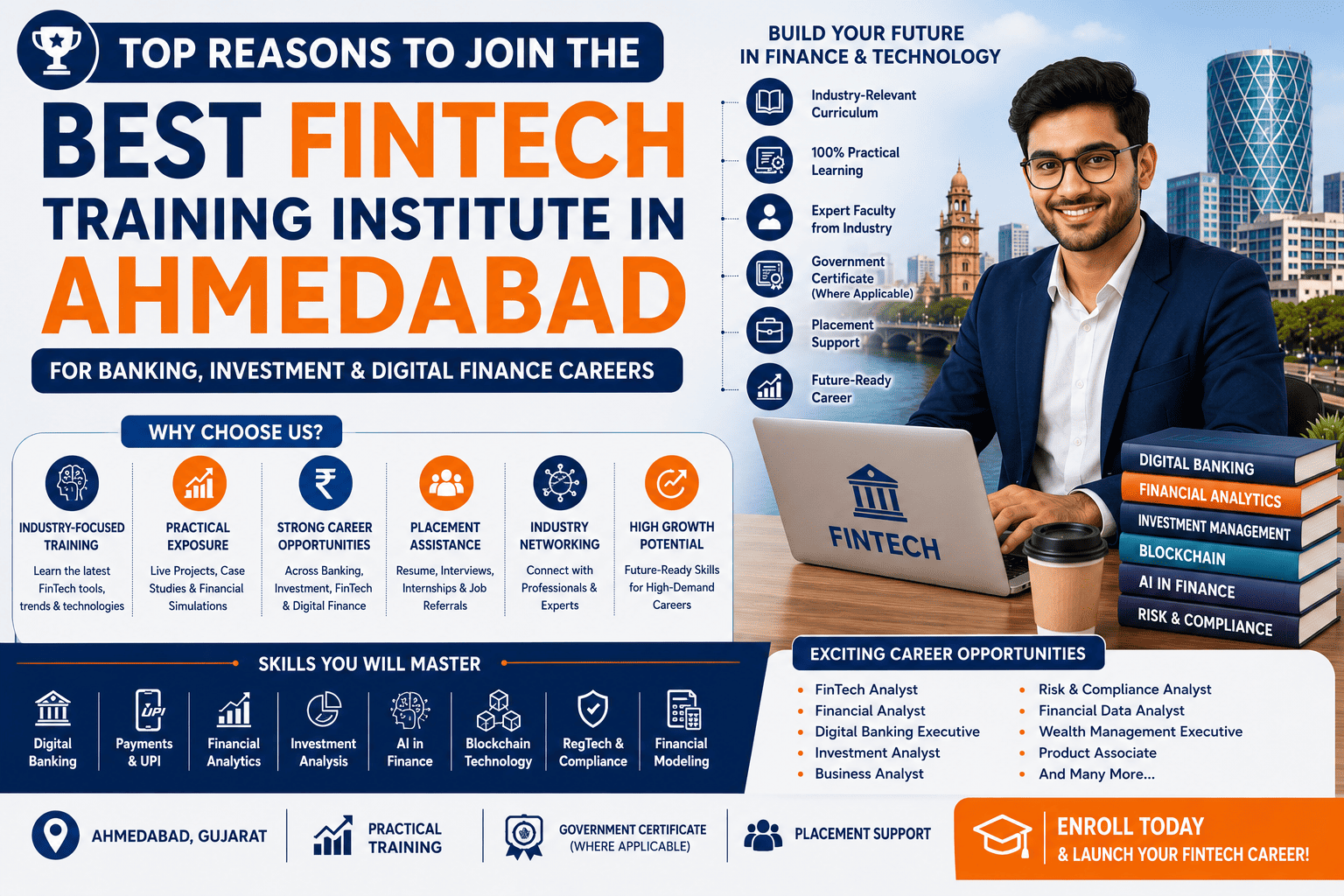
The global financial industry is experiencing an unprecedented digital transformation. Traditional banking, investment management, insurance, lending, and payment systems are rapidly evolving through technologies such as Artificial Intelligence (AI), Blockchain, Digital Payments, Financial Analytics, Cloud Computing, Open Banking, and RegTech. As financial institutions embrace digital innovation, the demand for skilled FinTech professionals continues to rise. For students, graduates, banking professionals, finance executives, and career changers, joining the best FinTech training institute in Ahmedabad can provide the practical knowledge, industry exposure, and career support needed to succeed in this fast-growing sector. This guide explores the top reasons to choose a FinTech training institute in Ahmedabad, the skills you'll develop, career opportunities, salary expectations, and the key factors to consider before enrolling. Why FinTech is One of the Fastest-Growing Career Fields in 2026 Financial Technology (FinTech) is transforming how individuals and businesses manage money. From instant digital payments to AI-powered investment advice, FinTech solutions are becoming an integral part of everyday financial services. Key growth sectors include: Digital Banking UPI & Digital Payments AI in Finance Financial Analytics Blockchain Technology WealthTech InsurTech RegTech Embedded Finance Digital Lending Financial Cybersecurity As organisations modernise their financial systems, professionals with FinTech expertise are increasingly valued across industries. Why Ahmedabad is Emerging as a FinTech Education Hub Ahmedabad has become one of Gujarat's leading destinations for finance and technology education due to several factors: Growing startup ecosystem Proximity to GIFT City Expanding banking and financial services sector Affordable education compared to larger metropolitan cities Strong academic institutions Increasing demand for FinTech talent Opportunities for internships and industry networking This ecosystem provides learners with access to quality education and growing employment opportunities. Top Reasons to Join the Best FinTech Training Institute in Ahmedabad 1. Industry-Oriented Curriculum The best institutes regularly update their curriculum to reflect current industry trends and employer requirements. A comprehensive FinTech programme typically includes: Digital Banking Financial Analytics AI in Finance Blockchain UPI & Digital Payments Financial Modelling Open Banking Risk Management RegTech Compliance A modern curriculum helps learners build relevant and future-ready skills. 2. 100% Practical Learning Employers increasingly seek candidates who can apply theoretical knowledge to real-world situations. Look for institutes offering: Live projects Financial simulations Banking case studies Analytics exercises Dashboard creation Digital payment workflows Capstone projects Practical assignments Hands-on experience improves confidence and workplace readiness. 3. Learn from Industry Experts Experienced trainers with backgrounds in banking, financial services, consulting, or technology can provide valuable practical insights beyond classroom theory. Benefits include: Real-world examples Industry best practices Current market trends Career guidance Interview preparation 4. Exposure to Emerging Financial Technologies The financial industry is constantly evolving. A quality FinTech institute introduces learners to technologies shaping the future of finance, including: Artificial Intelligence Machine Learning Blockchain Cloud Computing Robotic Process Automation (RPA) Financial APIs Data Analytics Digital Payments Cybersecurity Understanding these technologies helps learners stay competitive. 5. Government-Recognised Certification (Where Applicable) Some institutes offer certifications issued by or aligned with recognised government bodies or approved skill development frameworks. Before enrolling, verify: Issuing authority Recognition status Accreditation Industry acceptance A recognised certification can strengthen your professional profile when combined with practical skills. 6. Placement Assistance Career support services often include: Resume development LinkedIn profile optimisation Mock interviews Soft skills training Career counselling Internship support Employer referrals Note: Placement assistance supports your job search but does not guarantee employment. Hiring decisions depend on your skills, interview performance, and employer requirements. 7. Banking & Digital Finance Career Preparation A strong FinTech programme prepares learners for opportunities in: Commercial Banks Private Banks NBFCs Digital Banks Payment Companies FinTech Startups Insurance Companies Investment Firms Wealth Management Companies Consulting Organisations This broad industry exposure expands career options. 8. Investment & Financial Markets Knowledge Many FinTech programmes also include topics related to: Capital Markets Investment Analysis Portfolio Management Mutual Funds Financial Planning Robo-Advisory Wealth Management These skills are valuable for careers in investment and financial advisory services. 9. Analytics & Business Intelligence Skills Data-driven decision-making is becoming essential across financial services. Learners typically develop skills in: Microsoft Excel SQL Power BI Financial Reporting Dashboard Development Data Visualisation Business Analytics These technical competencies are highly valued by employers. 10. Strong Career Growth Potential As digital finance continues to expand, professionals with FinTech expertise may benefit from diverse career paths, opportunities for specialisation, and long-term career development. Continuous learning and practical experience remain key factors for career advancement. What You'll Learn During a FinTech Course A comprehensive FinTech curriculum generally includes: FinTech Fundamentals Financial Technology Overview Digital Transformation Financial Services Ecosystem Digital Banking Core Banking Internet Banking Mobile Banking Banking APIs Digital Payments UPI Payment Gateways QR Payments Digital Wallets Financial Analytics Excel SQL Power BI Reporting Artificial Intelligence in Finance Fraud Detection Credit Risk Assessment Predictive Analytics Automation Blockchain Blockchain Fundamentals Smart Contracts Distributed Ledger Technology RegTech & Compliance KYC AML Risk Management Regulatory Compliance Financial Modelling Budgeting Forecasting Business Valuation Financial Statement Analysis Who Can Join a FinTech Training Programme? Most FinTech courses are suitable for: Class 12 pass students B.Com graduates BBA graduates MBA students Engineers Banking professionals Accountants Finance executives Entrepreneurs Career changers Most beginner-level programmes do not require advanced programming skills. Skills You'll Develop By completing a quality FinTech programme, learners can strengthen their abilities in: Financial Analysis Digital Banking Financial Analytics Data Visualisation Business Intelligence Excel SQL Power BI Blockchain Fundamentals AI Awareness Financial Modelling Risk Management Compliance Communication Problem Solving Career Opportunities Graduates can explore roles such as: FinTech Analyst Financial Analyst Business Analyst Digital Banking Executive Payments Specialist Financial Data Analyst Compliance Executive Product Associate Investment Analyst Wealth Management Executive Risk Analyst RegTech Analyst Financial Consultant Expected Salary in India (2026) Experience Estimated Annual Salary Fresher ₹4–7 LPA 2–5 Years ₹7–12 LPA 5–8 Years ₹12–20 LPA Senior Professionals ₹20–40+ LPA Actual salaries vary based on skills, experience, certifications, employer, and location. How to Choose the Best FinTech Training Institute in Ahmedabad Before enrolling, compare institutes using these criteria: Updated curriculum Practical learning approach Experienced faculty Live projects Industry case studies Recognised certification Placement assistance Internship opportunities Alumni outcomes Student reviews Flexible learning options Transparent fee structure Selecting an institute based on learning quality and career outcomes rather than marketing claims can provide better long-term value. Frequently Asked Questions (FAQs) 1. Why should I join a FinTech training institute in Ahmedabad? Ahmedabad offers a growing finance and technology ecosystem, access to experienced trainers, proximity to GIFT City, and increasing opportunities in banking, digital finance, and FinTech startups. 2. Is practical training important in a FinTech course? Yes. Practical learning through live projects, case studies, and analytics exercises helps learners apply concepts in real-world scenarios and strengthens employability. 3. Who can join a FinTech course? Students, graduates, banking professionals, accountants, engineers, entrepreneurs, and career changers can typically enrol, depending on the institute's eligibility requirements. 4. Is coding mandatory for a FinTech career? No. Many entry-level FinTech roles do not require coding, although knowledge of SQL or Python can be beneficial for analytics and technical positions. 5. What careers are available after completing a FinTech course? Common roles include FinTech Analyst, Financial Analyst, Business Analyst, Digital Banking Executive, Payments Specialist, Compliance Executive, Investment Analyst, and Financial Data Analyst. 6. Does placement support guarantee a job? No. Placement assistance provides guidance, interview preparation, and employer referrals, but employment depends on the candidate's skills, experience, and interview performance. 7. How do I choose the best FinTech institute? Evaluate the curriculum, faculty expertise, practical training, certification, placement support, student reviews, and alumni success before making a decision. Conclusion The rapid evolution of digital finance has made FinTech one of the most promising career domains for aspiring professionals. Joining the best FinTech training institute in Ahmedabad can help you develop practical, industry-relevant skills in digital banking, investment, analytics, blockchain, AI, and financial technology. When choosing a training provider, prioritise a comprehensive curriculum, experienced faculty, practical learning, recognised certification (where applicable), and strong career support. By investing in continuous learning and hands-on experience, you'll be well-positioned to build a successful career in banking, investment management, digital payments, financial analytics, and the broader FinTech ecosystem.


The global financial industry is experiencing an unprecedented digital transformation. Traditional banking, investment management, insurance, lending, and payment systems are rapidly evolving through technologies such as Artificial Intelligence (AI), Blockchain, Digital Payments, Financial Analytics, Cloud Computing, Open Banking, and RegTech.

As financial institutions embrace digital innovation, the demand for skilled FinTech professionals continues to rise. For students, graduates, banking professionals, finance executives, and career changers, joining the best FinTech training institute in Ahmedabad can provide the practical knowledge, industry exposure, and career support needed to succeed in this fast-growing sector.

This guide explores the top reasons to choose a FinTech training institute in Ahmedabad, the skills you’ll develop, career opportunities, salary expectations, and the key factors to consider before enrolling.

Why FinTech is One of the Fastest-Growing Career Fields in 2026

Financial Technology (FinTech) is transforming how individuals and businesses manage money. From instant digital payments to AI-powered investment advice, FinTech solutions are becoming an integral part of everyday financial services.

Key growth sectors include:

  • Digital Banking
  • UPI & Digital Payments
  • AI in Finance
  • Financial Analytics
  • Blockchain Technology
  • WealthTech
  • InsurTech
  • RegTech
  • Embedded Finance
  • Digital Lending
  • Financial Cybersecurity

As organisations modernise their financial systems, professionals with FinTech expertise are increasingly valued across industries.

Why Ahmedabad is Emerging as a FinTech Education Hub

Ahmedabad has become one of Gujarat’s leading destinations for finance and technology education due to several factors:

  • Growing startup ecosystem
  • Proximity to GIFT City
  • Expanding banking and financial services sector
  • Affordable education compared to larger metropolitan cities
  • Strong academic institutions
  • Increasing demand for FinTech talent
  • Opportunities for internships and industry networking

This ecosystem provides learners with access to quality education and growing employment opportunities.

Top Reasons to Join the Best FinTech Training Institute in Ahmedabad

1. Industry-Oriented Curriculum

The best institutes regularly update their curriculum to reflect current industry trends and employer requirements.

A comprehensive FinTech programme typically includes:

  • Digital Banking
  • Financial Analytics
  • AI in Finance
  • Blockchain
  • UPI & Digital Payments
  • Financial Modelling
  • Open Banking
  • Risk Management
  • RegTech
  • Compliance

A modern curriculum helps learners build relevant and future-ready skills.

2. 100% Practical Learning

Employers increasingly seek candidates who can apply theoretical knowledge to real-world situations.

Look for institutes offering:

  • Live projects
  • Financial simulations
  • Banking case studies
  • Analytics exercises
  • Dashboard creation
  • Digital payment workflows
  • Capstone projects
  • Practical assignments

Hands-on experience improves confidence and workplace readiness.

3. Learn from Industry Experts

Experienced trainers with backgrounds in banking, financial services, consulting, or technology can provide valuable practical insights beyond classroom theory.

Benefits include:

  • Real-world examples
  • Industry best practices
  • Current market trends
  • Career guidance
  • Interview preparation

4. Exposure to Emerging Financial Technologies

The financial industry is constantly evolving. A quality FinTech institute introduces learners to technologies shaping the future of finance, including:

  • Artificial Intelligence
  • Machine Learning
  • Blockchain
  • Cloud Computing
  • Robotic Process Automation (RPA)
  • Financial APIs
  • Data Analytics
  • Digital Payments
  • Cybersecurity

Understanding these technologies helps learners stay competitive.

5. Government-Recognised Certification (Where Applicable)

Some institutes offer certifications issued by or aligned with recognised government bodies or approved skill development frameworks.

Before enrolling, verify:

  • Issuing authority
  • Recognition status
  • Accreditation
  • Industry acceptance

A recognised certification can strengthen your professional profile when combined with practical skills.

6. Placement Assistance

Career support services often include:

  • Resume development
  • LinkedIn profile optimisation
  • Mock interviews
  • Soft skills training
  • Career counselling
  • Internship support
  • Employer referrals

Note: Placement assistance supports your job search but does not guarantee employment. Hiring decisions depend on your skills, interview performance, and employer requirements.

7. Banking & Digital Finance Career Preparation

A strong FinTech programme prepares learners for opportunities in:

  • Commercial Banks
  • Private Banks
  • NBFCs
  • Digital Banks
  • Payment Companies
  • FinTech Startups
  • Insurance Companies
  • Investment Firms
  • Wealth Management Companies
  • Consulting Organisations

This broad industry exposure expands career options.

8. Investment & Financial Markets Knowledge

Many FinTech programmes also include topics related to:

  • Capital Markets
  • Investment Analysis
  • Portfolio Management
  • Mutual Funds
  • Financial Planning
  • Robo-Advisory
  • Wealth Management

These skills are valuable for careers in investment and financial advisory services.

9. Analytics & Business Intelligence Skills

Data-driven decision-making is becoming essential across financial services.

Learners typically develop skills in:

  • Microsoft Excel
  • SQL
  • Power BI
  • Financial Reporting
  • Dashboard Development
  • Data Visualisation
  • Business Analytics

These technical competencies are highly valued by employers.

10. Strong Career Growth Potential

As digital finance continues to expand, professionals with FinTech expertise may benefit from diverse career paths, opportunities for specialisation, and long-term career development.

Continuous learning and practical experience remain key factors for career advancement.

What You’ll Learn During a FinTech Course

A comprehensive FinTech curriculum generally includes:

FinTech Fundamentals

  • Financial Technology Overview
  • Digital Transformation
  • Financial Services Ecosystem

Digital Banking

  • Core Banking
  • Internet Banking
  • Mobile Banking
  • Banking APIs

Digital Payments

  • UPI
  • Payment Gateways
  • QR Payments
  • Digital Wallets

Financial Analytics

  • Excel
  • SQL
  • Power BI
  • Reporting

Artificial Intelligence in Finance

  • Fraud Detection
  • Credit Risk Assessment
  • Predictive Analytics
  • Automation

Blockchain

  • Blockchain Fundamentals
  • Smart Contracts
  • Distributed Ledger Technology

RegTech & Compliance

  • KYC
  • AML
  • Risk Management
  • Regulatory Compliance

Financial Modelling

  • Budgeting
  • Forecasting
  • Business Valuation
  • Financial Statement Analysis

Who Can Join a FinTech Training Programme?

Most FinTech courses are suitable for:

  • Class 12 pass students
  • B.Com graduates
  • BBA graduates
  • MBA students
  • Engineers
  • Banking professionals
  • Accountants
  • Finance executives
  • Entrepreneurs
  • Career changers

Most beginner-level programmes do not require advanced programming skills.

Skills You’ll Develop

By completing a quality FinTech programme, learners can strengthen their abilities in:

  • Financial Analysis
  • Digital Banking
  • Financial Analytics
  • Data Visualisation
  • Business Intelligence
  • Excel
  • SQL
  • Power BI
  • Blockchain Fundamentals
  • AI Awareness
  • Financial Modelling
  • Risk Management
  • Compliance
  • Communication
  • Problem Solving

Career Opportunities

Graduates can explore roles such as:

  • FinTech Analyst
  • Financial Analyst
  • Business Analyst
  • Digital Banking Executive
  • Payments Specialist
  • Financial Data Analyst
  • Compliance Executive
  • Product Associate
  • Investment Analyst
  • Wealth Management Executive
  • Risk Analyst
  • RegTech Analyst
  • Financial Consultant

Expected Salary in India (2026)

ExperienceEstimated Annual Salary
Fresher₹4–7 LPA
2–5 Years₹7–12 LPA
5–8 Years₹12–20 LPA
Senior Professionals₹20–40+ LPA

Actual salaries vary based on skills, experience, certifications, employer, and location.

How to Choose the Best FinTech Training Institute in Ahmedabad

Before enrolling, compare institutes using these criteria:

  • Updated curriculum
  • Practical learning approach
  • Experienced faculty
  • Live projects
  • Industry case studies
  • Recognised certification
  • Placement assistance
  • Internship opportunities
  • Alumni outcomes
  • Student reviews
  • Flexible learning options
  • Transparent fee structure

Selecting an institute based on learning quality and career outcomes rather than marketing claims can provide better long-term value.

Frequently Asked Questions (FAQs)

1. Why should I join a FinTech training institute in Ahmedabad?

Ahmedabad offers a growing finance and technology ecosystem, access to experienced trainers, proximity to GIFT City, and increasing opportunities in banking, digital finance, and FinTech startups.

2. Is practical training important in a FinTech course?

Yes. Practical learning through live projects, case studies, and analytics exercises helps learners apply concepts in real-world scenarios and strengthens employability.

3. Who can join a FinTech course?

Students, graduates, banking professionals, accountants, engineers, entrepreneurs, and career changers can typically enrol, depending on the institute’s eligibility requirements.

4. Is coding mandatory for a FinTech career?

No. Many entry-level FinTech roles do not require coding, although knowledge of SQL or Python can be beneficial for analytics and technical positions.

5. What careers are available after completing a FinTech course?

Common roles include FinTech Analyst, Financial Analyst, Business Analyst, Digital Banking Executive, Payments Specialist, Compliance Executive, Investment Analyst, and Financial Data Analyst.

6. Does placement support guarantee a job?

No. Placement assistance provides guidance, interview preparation, and employer referrals, but employment depends on the candidate’s skills, experience, and interview performance.

7. How do I choose the best FinTech institute?

Evaluate the curriculum, faculty expertise, practical training, certification, placement support, student reviews, and alumni success before making a decision.

Conclusion

The rapid evolution of digital finance has made FinTech one of the most promising career domains for aspiring professionals. Joining the best FinTech training institute in Ahmedabad can help you develop practical, industry-relevant skills in digital banking, investment, analytics, blockchain, AI, and financial technology.

When choosing a training provider, prioritise a comprehensive curriculum, experienced faculty, practical learning, recognised certification (where applicable), and strong career support. By investing in continuous learning and hands-on experience, you’ll be well-positioned to build a successful career in banking, investment management, digital payments, financial analytics, and the broader FinTech ecosystem.

Denounce with righteous indignation and dislike men who are beguiled and demoralized by the charms pleasure moment so blinded desire that they cannot foresee the pain and trouble.

Latest Portfolio

Need Any Help? Or Looking For an Agent

Working Hours : Sun-monday, 09am-5pm
© 2022 Vankine. All Rights Reserved.