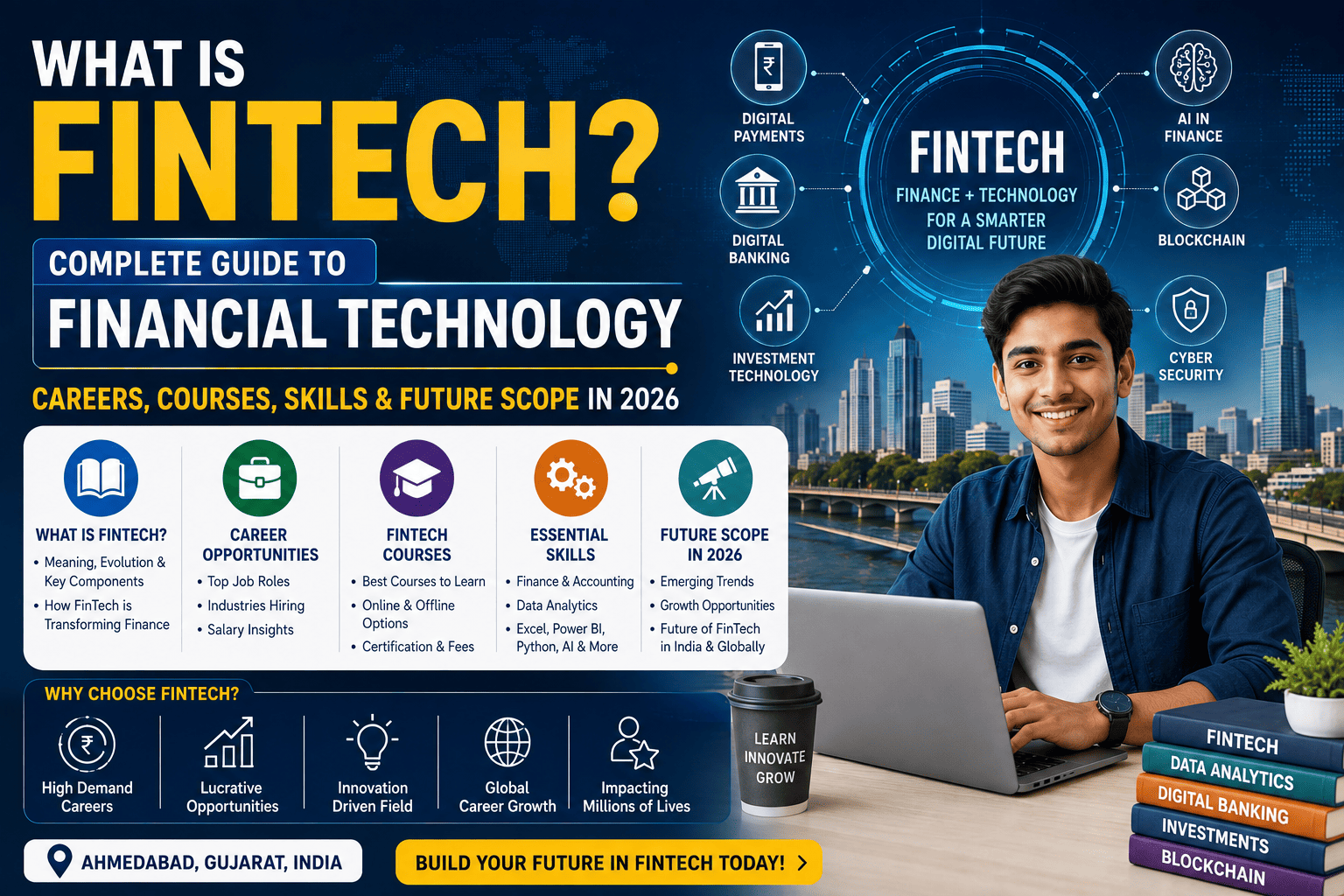
FinTech, short for Financial Technology, has become one of the most important areas connecting finance, technology and digital business.
From UPI payments and mobile banking to digital lending, online investments, artificial intelligence, blockchain and financial data analytics, technology is changing how people and businesses access and use financial services.
This transformation is also creating new career opportunities for students, graduates, finance professionals, accountants, banking professionals, data analysts and technology specialists.
If you are wondering what FinTech is, what a FinTech professional does, which skills are required, which FinTech courses to choose, what jobs are available and what the future scope of FinTech is in 2026, this complete guide explains the subject in simple terms.
What Is FinTech?
FinTech means Financial Technology.
It refers to the use of technology, software, data and digital systems to develop, improve, automate and deliver financial products and services.
Simple Definition of FinTech
FinTech is the combination of finance and technology used to make financial services faster, more convenient, accessible, automated and data-driven.
Examples of FinTech include:
- UPI and digital payments
- Mobile banking
- Internet banking
- Digital wallets
- Payment gateways
- Online lending
- Digital insurance
- Investment applications
- Robo-advisory
- Blockchain-based financial applications
- AI-powered financial services
- Financial data analytics
In simple terms:
Finance + Technology + Data + Digital Innovation = FinTech
Why Is FinTech Important in 2026?
Financial services are becoming increasingly digital.
Customers expect to:
- Make instant payments
- Open accounts online
- Apply for financial products digitally
- Track investments through apps
- Receive personalised financial services
- Access banking services from mobile devices
- Make data-driven financial decisions
At the same time, financial companies need technology to:
- Process transactions
- Detect fraud
- Analyse customer behaviour
- Assess financial risk
- Automate operations
- Improve customer experience
- Manage large amounts of data
- Strengthen compliance processes
As a result, the modern financial industry increasingly requires professionals who understand both financial concepts and technology.
How Does FinTech Work?
FinTech brings together several technologies and financial processes.
For example, consider a digital payment.
A customer initiates a transaction using a mobile application. The payment system securely processes the transaction, communicates with the relevant financial institutions, verifies the transaction and provides confirmation.
Behind this simple experience, multiple technologies and processes may be involved, including:
User Interface → Digital Identity → Payment Technology → Banking Infrastructure → Security → Data Processing → Transaction Confirmation
This is one example of how technology can simplify a traditional financial process.
Major Areas of FinTech
FinTech is a broad industry rather than a single technology.
Some of its major areas include:
1. Digital Payments
Digital payment technology enables customers and businesses to transfer money electronically.
Examples include:
- UPI
- Mobile payments
- QR payments
- Payment gateways
- Digital wallets
- Online transactions
2. Digital Banking
Digital banking allows customers to access banking services through digital platforms.
Examples include:
- Mobile banking
- Internet banking
- Digital account services
- Online customer support
- Digital onboarding
3. Digital Lending
FinTech platforms can use digital systems and data to streamline lending processes.
Applications may include:
- Online loan applications
- Digital verification
- Credit assessment
- Automated processing
- Loan management
4. WealthTech
WealthTech combines wealth management and technology.
It can include:
- Digital investment platforms
- Portfolio tools
- Investment analytics
- Robo-advisory
- Digital wealth management
5. InsurTech
InsurTech refers to technology applications in insurance.
Examples include:
- Digital insurance platforms
- Online policy management
- Automated claims processing
- Data-driven risk assessment
- Digital customer service
6. RegTech
RegTech, or regulatory technology, helps financial organisations manage compliance and regulatory processes.
It can support:
- KYC
- AML
- Compliance monitoring
- Risk management
- Regulatory reporting
7. Blockchain in Finance
Blockchain provides a distributed method of recording transactions.
Potential financial applications include:
- Digital asset systems
- Smart contracts
- Transaction records
- Cross-border financial processes
- Financial infrastructure
8. AI in Finance
Artificial intelligence is increasingly used for applications such as:
- Fraud detection
- Customer support
- Risk analysis
- Financial forecasting
- Personalisation
- Document processing
- Process automation
FinTech vs Traditional Finance
A common question is:
What is the difference between FinTech and traditional finance?
| Traditional Finance | FinTech |
|---|---|
| Often relies on conventional processes | Uses digital and technology-driven processes |
| Branch-based services may be important | Digital-first services are common |
| Manual processes may be involved | Automation is widely used |
| Limited real-time analytics in some workflows | Data analytics is central |
| Conventional financial products | Technology-enabled financial products |
| Physical documentation may be used | Digital documentation is increasingly common |
FinTech does not necessarily replace traditional financial institutions. Instead, technology can transform, automate and improve financial services.
What Skills Are Required for a FinTech Career?
A successful FinTech professional does not necessarily need to master every technology.
The required skills depend on the job role.
However, a strong FinTech skill set can include the following.
1. Finance & Accounting Knowledge
Understanding financial fundamentals is important.
Useful areas include:
- Accounting
- Banking
- Financial markets
- Investment basics
- Risk management
- Financial products
- Financial regulations
2. Data Analytics
Data is central to modern financial services.
Important skills include:
- Data cleaning
- Data analysis
- Data interpretation
- Data visualization
- Financial reporting
- Business intelligence
3. Advanced Excel
Advanced Excel remains useful for financial analysis and reporting.
Important skills include:
- Pivot Tables
- XLOOKUP
- INDEX-MATCH
- Conditional formulas
- Data validation
- Financial functions
- Dashboards
- Data analysis
4. Power BI
Power BI can help professionals convert financial data into interactive dashboards.
It can be used for:
- Financial reporting
- KPI dashboards
- Business intelligence
- Transaction analysis
- Management reporting
- Data visualization
5. Python
Python can be useful for more technical FinTech and analytics roles.
Applications include:
- Data analysis
- Automation
- Financial modelling
- Data processing
- Forecasting
- Machine learning
Beginners do not necessarily need advanced programming immediately. Basic Python and data-analysis skills can be a useful starting point.
6. Artificial Intelligence
Understanding AI applications in finance is increasingly valuable.
Professionals can learn about:
- AI fundamentals
- Machine learning concepts
- Generative AI
- Fraud detection
- Financial forecasting
- Automation
- AI-assisted analysis
7. Blockchain Fundamentals
FinTech learners can benefit from understanding:
- Blockchain
- Distributed ledgers
- Smart contracts
- Digital assets
- Financial use cases
8. Cybersecurity Awareness
Financial data is highly sensitive.
Basic knowledge of:
- Data security
- Identity protection
- Fraud prevention
- Cybersecurity
- Privacy
can be valuable for FinTech professionals.
9. Communication Skills
Technical knowledge alone is not enough.
FinTech professionals may need to communicate with:
- Customers
- Finance teams
- Developers
- Managers
- Compliance teams
- Business stakeholders
Strong communication and analytical thinking can therefore improve career opportunities.
Best FinTech Course: What Should You Learn?
A good FinTech course should combine theory + technology + practical application.
A comprehensive beginner-to-professional syllabus can include:
Module 1: FinTech Fundamentals
- FinTech meaning
- Evolution of financial technology
- FinTech ecosystem
- Traditional finance vs FinTech
Module 2: Digital Banking
- Digital banking
- Mobile banking
- Online banking
- Neo-banking concepts
Module 3: Digital Payments
- UPI
- Payment gateways
- QR payments
- Digital wallets
- Payment processing
Module 4: Blockchain
- Blockchain fundamentals
- Distributed ledgers
- Smart contracts
- Financial applications
Module 5: AI in Finance
- AI fundamentals
- Automation
- Fraud detection
- Risk analysis
- Financial forecasting
Module 6: Financial Data Analytics
- Advanced Excel
- Power BI
- Data visualization
- Financial dashboards
- Python basics
Module 7: Investment Technology
- WealthTech
- Robo-advisory
- Digital investments
- Portfolio technology
Module 8: Risk & Compliance
- KYC
- AML
- Financial risk
- Compliance
- Data privacy
Module 9: Practical Projects
- Financial dashboard
- Payment analysis
- Loan risk analysis
- FinTech business case study
Who Can Learn FinTech?
FinTech is suitable for learners from multiple educational backgrounds.
After 12th
Students can begin with fundamental finance and technology concepts.
After B.Com
B.Com graduates can combine their existing finance knowledge with:
FinTech + Advanced Excel + Power BI + Python
This can create a stronger profile for digital finance and analytics roles.
For Accountants
Accountants can move toward digital finance by learning:
Tally Prime → Advanced Excel → Power BI → Python → FinTech
For Banking Professionals
FinTech can help banking professionals understand:
- Digital payments
- Digital banking
- Automation
- Data analytics
- Compliance technology
For IT Professionals
IT professionals can add finance-domain knowledge to their technical skills.
For Working Professionals
Online and weekend FinTech courses can make upskilling more flexible.
FinTech Career Opportunities in 2026
FinTech can lead to different career paths depending on a learner’s skills and qualifications.
Potential roles include:
- FinTech Executive
- Financial Data Analyst
- Business Analyst
- Digital Banking Executive
- Payment Operations Executive
- Risk Analyst
- KYC Analyst
- AML Analyst
- Compliance Executive
- Financial Operations Executive
- Investment Operations Executive
- FinTech Support Executive
- Digital Finance Executive
- Product Operations Executive
More technical professionals can also explore areas involving:
- Data Science
- Machine Learning
- Software Development
- Cybersecurity
- Cloud Technology
- Blockchain Development
FinTech Career Paths by Skill
Different skills can lead to different career directions.
| Skill Combination | Potential Career Direction |
| Finance + FinTech | Digital Finance / FinTech Operations |
| Finance + Excel | Financial Reporting / MIS |
| Finance + Power BI | Financial Data Analytics |
| Finance + Python | Advanced Financial Analytics |
| FinTech + Data Analytics | FinTech Data Roles |
| FinTech + AI | AI in Financial Services |
| FinTech + Blockchain | Blockchain & Digital Asset Roles |
| FinTech + Cybersecurity | Financial Security |
| FinTech + Digital Marketing | FinTech Marketing & Customer Acquisition |
FinTech Career Roadmap for Beginners
If you are starting from zero, follow a structured learning path.
Step 1: Learn Finance Fundamentals
Understand:
- Accounting
- Banking
- Investments
- Financial products
↓
Step 2: Understand FinTech
Learn:
- Digital finance
- FinTech ecosystem
- Digital banking
- Digital payments
↓
Step 3: Learn Data Skills
Start with:
- Advanced Excel
- Data analysis
- Power BI
↓
Step 4: Learn Python
Develop basic programming and data-analysis skills.
↓
Step 5: Learn Emerging Technologies
Explore:
- AI
- Blockchain
- Automation
- Cybersecurity
↓
Step 6: Build Projects
Create:
- Financial dashboards
- Payment analysis
- Loan-risk analysis
- FinTech case studies
↓
Step 7: Build Your Portfolio
Showcase your projects, certifications and technical skills.
↓
Step 8: Apply for Entry-Level Roles
Target relevant banking, finance, analytics and FinTech positions.
FinTech Jobs in India
FinTech employment opportunities can be found across several sectors, including:
- Banks
- FinTech startups
- NBFCs
- Insurance companies
- Payment companies
- Investment firms
- Wealth management
- Financial consulting
- Technology companies
- Digital lending platforms
Major financial and technology hubs such as Mumbai, Bengaluru, Delhi-NCR, Hyderabad, Pune, Chennai and Ahmedabad/Gujarat can offer different types of opportunities depending on the role.
FinTech Career Opportunities in Ahmedabad
Ahmedabad is an important business and educational centre in Gujarat.
Learners can explore opportunities across:
- Banking
- Accounting
- Financial services
- Business analytics
- FinTech operations
- Digital payments
- Investment services
- Technology
The broader Gujarat financial ecosystem also includes GIFT City, which has increased the state’s visibility in financial and international financial services.
For Ahmedabad students, combining:
Finance + FinTech + Data Analytics
can create a practical career-learning path.
FinTech Salary in India
FinTech salaries vary significantly based on:
- Job role
- Qualification
- Experience
- Technical skills
- Company
- Location
- Industry
- Specialisation
A beginner may start in an entry-level finance, banking, operations, KYC, payments or analytics role.
With experience and specialised skills, professionals can move into more advanced areas such as:
- Financial analytics
- Business analysis
- Product management
- Risk management
- Data science
- AI
- Technology
- Compliance
Instead of focusing only on a promised salary figure, learners should develop skills, projects and experience that employers value.
Is FinTech a Good Career Choice in 2026?
Yes, FinTech can be a strong career option for people interested in finance, technology and data.
However, FinTech is a broad field, and simply completing a certificate does not guarantee a job.
A stronger career profile comes from combining:
Education + FinTech Knowledge + Technical Skills + Projects + Communication + Experience
For example:
B.Com + FinTech + Advanced Excel + Power BI + Python + Projects
can create a more versatile profile than a qualification without practical skills.
Future Scope of FinTech in 2026 and Beyond
The future of FinTech is likely to be influenced by several technologies and trends.
1. Artificial Intelligence
AI can support:
- Financial analysis
- Fraud detection
- Customer service
- Risk assessment
- Automation
- Personalisation
2. Digital Payments
Digital payment ecosystems continue to change how consumers and businesses transfer money.
3. Financial Data Analytics
As financial organisations generate more data, analytics and business intelligence skills become increasingly important.
4. Blockchain
Blockchain may continue to find applications in areas such as financial infrastructure, digital assets and transaction systems.
5. Embedded Finance
Financial services can increasingly be integrated into non-financial digital platforms and customer journeys.
6. Open Banking and API-Based Services
Technology-enabled connectivity between financial services and applications can create new products and customer experiences.
7. RegTech
As financial regulation becomes more complex, technology can help organisations monitor and manage compliance.
8. Cybersecurity
As financial services become more digital, protecting financial information and transactions remains essential.
Top FinTech Technologies to Learn in 2026
If you want to prepare for the future, consider learning a combination of:
- Advanced Excel
- Power BI
- Python
- Artificial Intelligence
- Machine Learning Fundamentals
- Blockchain
- Cloud Computing Fundamentals
- Cybersecurity Awareness
- Data Analytics
- Digital Payments
You do not need to master everything at once.
Choose skills according to your intended career path.
FinTech + Accounting: A Career Opportunity for Commerce Students
Traditional accounting and FinTech are increasingly connected.
Accountants can expand their capabilities by learning:
Tally Prime → Advanced Excel → Power BI → Python → FinTech
This can help them move toward roles involving:
- MIS
- Financial reporting
- Data analytics
- Business intelligence
- Digital finance
- FinTech operations
For commerce students, this can be a practical way to combine existing financial knowledge with future-oriented technology skills.
FinTech + Digital Marketing
FinTech businesses also need marketing professionals.
Digital marketing can support:
- Customer acquisition
- Lead generation
- SEO
- Content marketing
- Social media
- Online advertising
- Financial product promotion
- Customer education
Therefore, professionals interested in the business side of FinTech can explore:
FinTech + Digital Marketing + Analytics
This combination can be useful for FinTech startups and digital financial-product businesses.
How to Choose the Best FinTech Course
Before enrolling in a FinTech course, check the following:
1. Syllabus
Is the curriculum updated for current financial technology?
2. Practical Projects
Does the program include projects and case studies?
3. Trainers
Do trainers understand both finance and technology?
4. Tools
Does the course provide exposure to relevant tools such as Excel, Power BI and Python?
5. Certification
Who issues the certificate, and is its recognition clearly documented?
6. Learning Format
Check whether the course is:
- Online
- Classroom
- Hybrid
- Weekend
- Full-time
7. Career Support
Check for:
- Resume building
- Interview preparation
- Mock interviews
- Job referrals
- Placement assistance
8. Fees
Compare the complete fee structure rather than the advertised starting price.
9. Projects & Portfolio
A course that helps you build demonstrable projects can provide greater career value.
Is a Government-Certified FinTech Course Better?
A government-recognised or government-certified credential can provide additional credibility depending on the issuing authority and the nature of the certification.
However, students should verify:
- Issuing authority
- Recognition
- Accreditation
- Certificate verification
- Exact course covered by the recognition
Do not assume that every certificate marketed as a “government certificate” has the same status.
A good course should combine credible certification with practical skills and projects.
What Are the Benefits of Learning FinTech?
Learning FinTech can help students and professionals:
- Understand modern financial technology
- Develop digital finance knowledge
- Explore new career paths
- Improve data skills
- Understand digital payments
- Learn emerging financial technologies
- Build practical projects
- Combine finance with technology
- Prepare for digital transformation
The biggest advantage is the ability to understand how technology is changing financial services.
Frequently Asked Questions (FAQs)
1. What is FinTech in simple words?
FinTech means using technology to provide, improve or automate financial services such as digital payments, banking, lending, investments and financial analytics.
2. What does FinTech stand for?
FinTech stands for Financial Technology.
3. Is FinTech a good career in 2026?
FinTech can be a promising career field for people interested in finance, technology, data and digital business. Career success depends on skills, qualifications, practical experience and the chosen role.
4. Which skills are required for FinTech?
Important skills can include finance, accounting, data analytics, Advanced Excel, Power BI, Python, AI, blockchain, cybersecurity awareness and communication.
5. Can B.Com students learn FinTech?
Yes. B.Com students can combine their finance and accounting knowledge with FinTech, Advanced Excel, Power BI and Python.
6. Is coding necessary for a FinTech career?
Not for every FinTech role. Operations, finance, compliance, KYC and business roles may require little or no advanced coding. Technical and analytics roles may require programming skills.
7. Which course is best for FinTech?
A good FinTech course should cover financial technology fundamentals, digital payments, digital banking, AI, blockchain, data analytics, risk and compliance, along with practical projects.
8. Can I learn FinTech after 12th?
Yes. Depending on the institute and course, 12th-pass students may be eligible for introductory or certificate-level FinTech programs.
9. Can accountants learn FinTech?
Yes. Accountants can combine Tally Prime, Advanced Excel, Power BI, Python and FinTech to develop a broader digital-finance skill set.
10. What jobs are available in FinTech?
Potential roles include FinTech Executive, Financial Data Analyst, Business Analyst, Digital Banking Executive, KYC Analyst, AML Analyst, Risk Analyst, Payment Operations Executive and Financial Operations Executive.
11. What is the future scope of FinTech?
Future FinTech opportunities are expected to involve areas such as AI, digital payments, financial data analytics, embedded finance, blockchain, cybersecurity, open banking and regulatory technology.
12. Can I learn FinTech online?
Yes. Online FinTech courses can be suitable for students and working professionals who need flexible learning options.
13. Is FinTech useful for finance professionals?
Yes. FinTech can help finance professionals understand digital payments, automation, analytics, AI and technology-driven financial services.
14. What is the difference between FinTech and banking?
Banking is a financial-service industry, while FinTech refers to technology used to create, improve or deliver financial services. Modern banks increasingly use FinTech technologies.
Conclusion
FinTech, or Financial Technology, is the combination of finance, technology, data and digital innovation. It is transforming payments, banking, lending, investments, insurance, compliance and financial analytics.
For students and professionals in 2026, FinTech can offer a wide range of learning and career opportunities. However, the most valuable approach is not to learn FinTech as an isolated subject.
A stronger career strategy is to build a combination such as:
Finance + FinTech + Data Analytics + Advanced Excel + Power BI + Python
Depending on your interests, you can further add AI, blockchain, cybersecurity or digital marketing.
Whether you are a 12th-pass student, B.Com graduate, accountant, banking professional, IT professional or working professional, the right FinTech course can help you understand the rapidly changing financial-services industry.
The future of finance is increasingly digital, data-driven and technology-enabled. Building practical FinTech skills today can help you stay prepared for the evolving career opportunities of tomorrow.